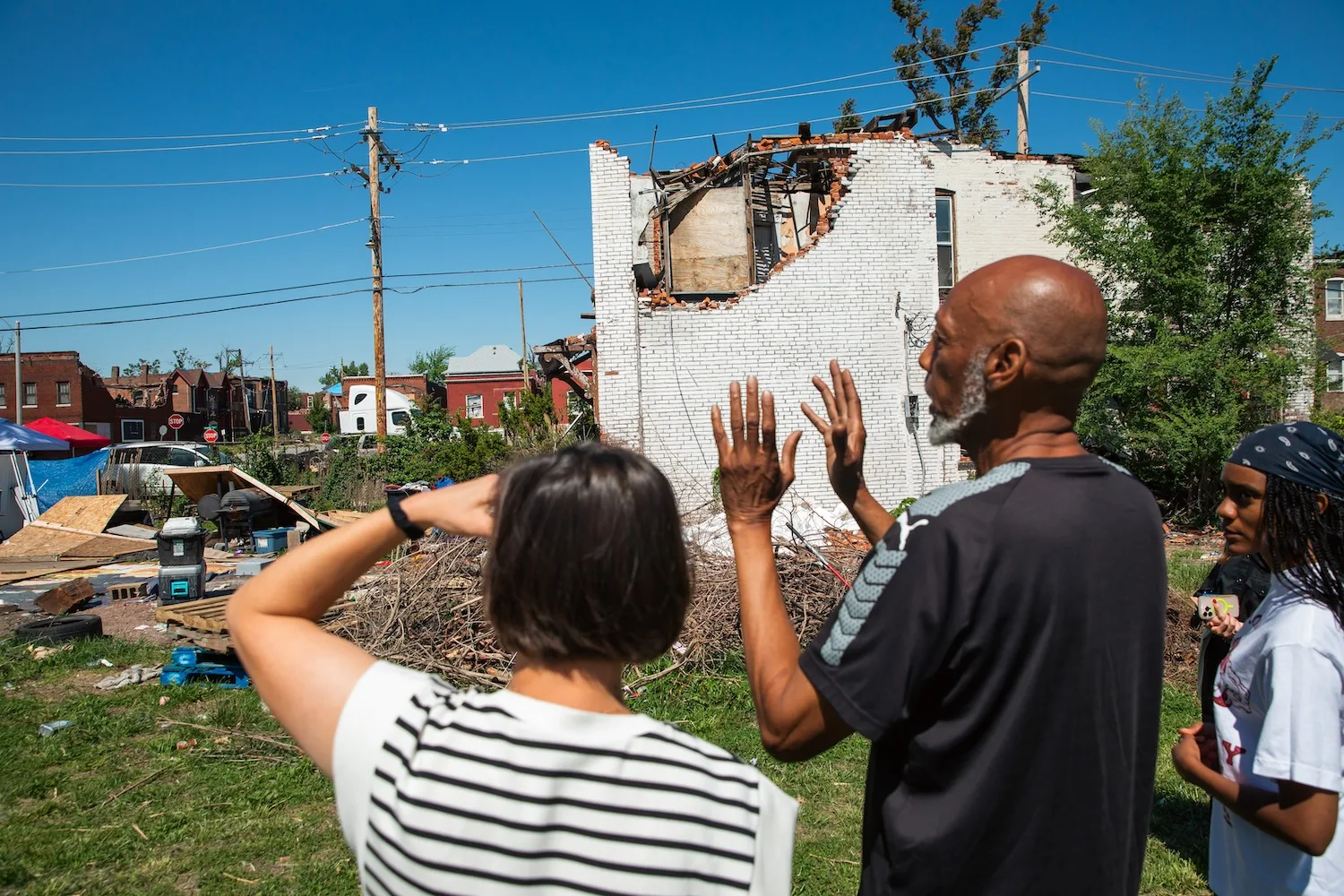
A year after a tornado tore through St. Louis, the city’s development agency’s strategies for long-term economic recovery for the hardest hit part of North City are coming into focus.
The St. Louis Development Corporation brought on Russell Halliday as a program manager for tornado recovery in a $1 million contract awarded last September, which runs through September 2027. A New Zealand resident, Halliday founded the firm Kea Point Solutions after spending nearly a decade as a program manager for Stantec in St. Louis.
Keep up with local business news and trends
Subscribe to the St. Louis Business newsletter to get the latest insights sent to your inbox every morning.
In an interview with SLM, Halliday described his role as kickstarting SLDC’s strategy and coordination for the long haul as the agency aims to simultaneously spur more housing and concentrated commercial corridors, particularly along Dr. Martin Luther King Drive.
“If you have rooftops, it supports the retail,” he says. “You cannot just plant retail anywhere in the city and expect it to work, unless you do a range of other things and heavy advertising.”
As SLDC president and CEO Stephen Westbrooks and many others have noted, the damage from the tornado didn’t spawn new challenges for St. Louis as much as exacerbate ones that already existed.
“There was a need for coordinated action and investment before,” he says. “The tornado dramatically emphasized the need for that action, that coordination, and intentionality around investment and layering capital, where it needs to go to help support thriving communities.”
Halliday says it’s also essential for the development agency to execute projects where it doesn’t need to wait for approval or help from other government agencies. To that end Halliday has identified some 1,450 lots owned by the city’s landbank, the Land Reutilization Authority, that SLDC can make ready for a developer to build upon.
“We’re doing that deliberately by saying we can control this land, it in-fills this city block, that’s the purpose,” he says. “We do that city block by city block, and it would be done in a way that it’s done at a level or at a scale for remediation where we get some level of efficiency, so we can use heavy equipment.”
There’s a chance that the LRA sites need remediation or other predevelopment work that would keep home builders from being interested, Halliday says. He adds the first set of lots will be cleared in the coming months after SLDC solicits and picks a contractor for the work.
Halliday expects the agency will likely have to adjust as challenges arise, though initially he sees SLDC bringing tracts of between 3 to 22 acres to the development market at a time.
“We’re trying to compare it to what a residential developer would expect in a green field suburban development,” he says. “That homebuilders turn up and build a house, and they know what they’ve got in terms of the ground, they know that the utilities are in a set location, they know that the construction pad is prepared and ready for a build.”
Halliday acknowledges newly constructed homes are likely to cost more than what the real estate market can currently support, making it critical for SLDC to resume homebuyer assistance programs, such as HomeSTL, and find other resources to bridge the gap between builders and buyers. He adds it’s just as important to protect existing residents from displacement, with SLDC also exploring ways to implement tax abatement strategies similar to what was established for residents in the neighborhoods surrounding the new National Geospatial-Intelligence Agency headquarters.
In addition to infill housing, Halliday says he’s tracking—and seeking to support—over 70 existing or proposed developments, such as a new senior housing and grocery store along Natural Bridge Road, as well as ones along MLK, including a roughly $1 million construction project to turn a vacant building into small business incubation space.
The corridor along MLK is a key focus, with SLDC having helped apply for a grant from the U.S. Department of Transportation to fund surface transportation infrastructure projects along it, with selections expected to be revealed this summer. Halliday says the up to $25 million grant is meant to support what is already laid out in neighborhood plans adopted by the city and the work that organizations such as 4theVille are already doing.
“The community has already spoken,” he says. “Our job is to help deploy it.”


