
A $26.3 million development that will establish 52 new affordable housing units and revitalize two prominent vacant South City buildings is moving forward to construction after financing for the project closed late last month.
The long-awaited Marquette Homes project by Lutheran Development Group and Rise Community Development has been in the planning stages for the past six years, says Rise’s director of real estate development Mark Stroker.
Keep up with local business news and trends
Subscribe to the St. Louis Business newsletter to get the latest insights sent to your inbox every morning.
“When [the financing] finally closed, it was a tremendous sense of relief, a flood of emotions,” he says. “It’s not closed till it’s closed, and you’re dealing with lots of emotion and trying to take care of last minute obstacles.”
Work can now begin on the three new-construction four-family homes and the rehabilitation of six buildings in the Dutchtown and Gravois Park neighborhoods, including the Melba Theatre/Grandview Arcade along South Grand Boulevard and a vacant eyesore at 3305 Meramec Street. In all, Stroker expects a ground breaking in July and construction on all nine buildings to take 18 months to complete.
“The various buildings will come on line over time,” he says. “Once those buildings have been placed in service and are ready for occupancy, we’ll start leasing them and getting people in there.”
The construction timeline is brief in comparison to how long it took the community developers to secure the capital needed for the project, which won approval from the city about two years ago. It uses a mixture of funding from low-income housing tax credits and historic tax credits from both federal and state governments, the Missouri Housing Development Commission, a construction period tax-exempt bond and a few other sources, Stroker explains.
“We had to apply several times to MHDC until we were able to get the project funded,” he says. “In particular, the affordable housing tax credits are very competitive.”
This breadth of funding sources adds layers of complexity, says Colleen Hafner, Rise Community Development executive director. She explains there’s a “sweet spot of scale” to take advantage of different funding resources.
“We can’t make it too big, because we won’t meet the program criteria in one angle,” she says. “We can’t make it too small [or] there won’t be enough scale to utilize the complicated tax credits.”
Hafner adds today’s equity markets add to the challenge of closing a deal such like Marquette Homes, because investors’ interest in affordable housing tax credits has chilled. That’s in part because larger companies are waiting to see what happens in Congress as lawmakers continue to work on bills that directly affect tax policy, she says.
“Before we had the ‘Big Beautiful Bill’ finalized, at least in the House, we didn’t know what was going to happen with corporate taxes,” she says. “If there had been a significant corporate tax cut, that would chill the investment market there for federal tax credits.”
While companies invest in low-income housing, historic or other kinds of tax credits to reduce their annual corporate tax liability, Hafner says other tax credit options, like those around solar energy, may be more attractive for companies seeking to reduce their federal taxes.
“For a federal-driven investor, I may have an investment for 15 years, and the solar credits have a much shorter timeline,” she says. “So unless they have a community reinvestment motivation, it’s also less appealing.”
But, Stroker and Hafner argue, projects like Marquette Homes are badly needed to add affordable rental housing to St. Louis. The city estimated the shortage eclipsed 30,000 units in its 2023 affordable housing report.
The 52 units in this project are a drop in that bucket, but do add 42 new residences for people making up to 60 percent of the annual area median income, plus 10 units for those making up to 30 percent of the annual area median income ($66,840 and $33,400 for a family of four, respectively).
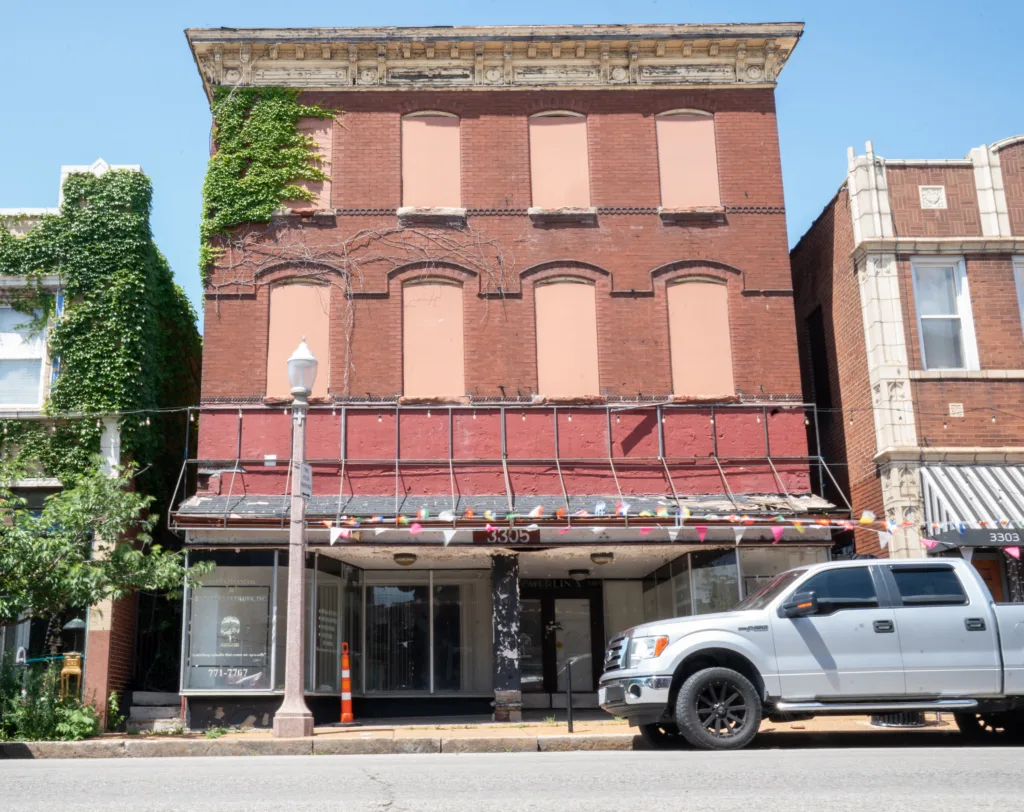
The project should also help to transform the perception of the area, Stroker says. He anticipates that the Melba Theatre/Grandview Arcade and the building at 3305 Meramec Street will become anchors on their respective streets.
The Melba Theatre/Grandview Arcade will become the new home of Lutheran Development Group, add office space for “like-minded” nonprofit service providers and have 16 affordable housing units. Similarly, 3305 Meramec’s ground floor storefront will be rehabilitated, with 10 affordable housing units added above.
“It’s been my experience in doing this for a very long time, that if you do something that’s catalytic, in fact, we’ll have that effect,” Stroker says. “You’ll see stuff that will flow from significant and well done developments, affordable or not.”
Countless community members have personally expressed excitement about the project moving forward, he says. That includes Jennifer Summers, who owns Jenilyn’s Boutique, just across from 3305 Meramec.
It’s the lone boarded up building on the block. Seeing it, customers sometimes ask her if the area is safe, she says.
“I tell them, ‘Yes [or] I wouldn’t be here,’” Summers says. “As far as [a] nuisance, it hasn’t been. It’s just not attractive. I’m going to be very excited to see it get the face lift it needs; it’s a beautiful building.”


