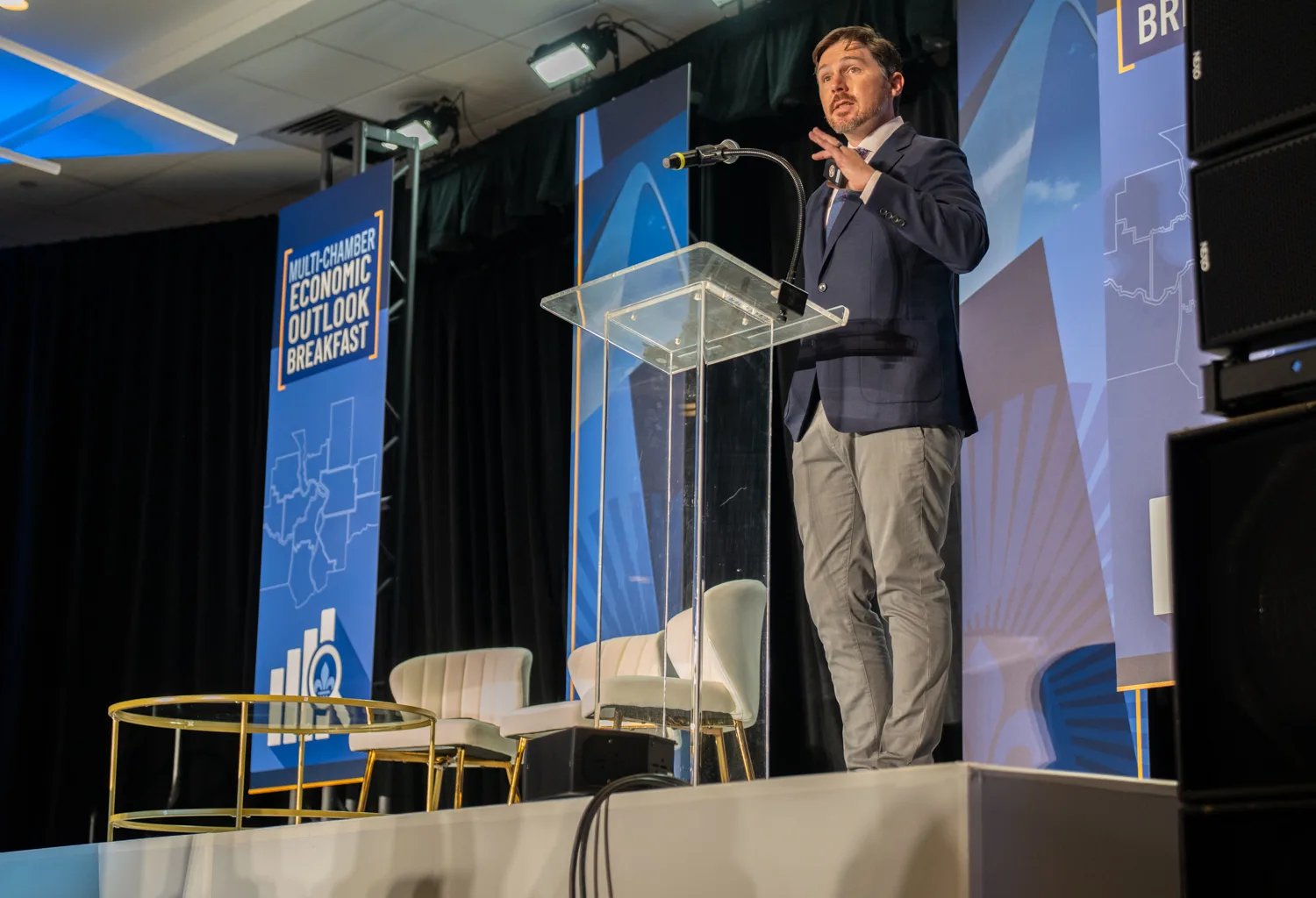
Uncertainty in the economy overall has driven some of the choppy conditions playing out on both a national and local level this year. That was one of the underlying themes in a presentation at Greater St. Louis Inc.’s annual economic outlook breakfast, attended by nearly two dozen regional chambers of commerce on Thursday.
Charles Gascon, an economist and research officer at the Federal Reserve Bank of St. Louis, shared a detailed look at national and regional economic conditions, including views of consumer habits, business sentiment, labor trends, inflation, and other indicators.
Keep up with local business news and trends
Subscribe to the St. Louis Business newsletter to get the latest insights sent to your inbox every morning.
“We saw a steady economy over the last couple years, and a pretty steady improvement. [Then] we got to the beginning of this year, and we saw a pretty sharp pullback in business activity,” he said. “A lot of that seems like it was related to trade disruptions, but also just broader uncertainty in the economy, leading consumers to pull back and businesses to pull back on some of their investment.”
One of his slides showed how references to economic uncertainty in news coverage over the past year was as high as it was during the pandemic, though he adds it’s unlikely to remain that elevated.
Gascon stressed the views he presented are his own and don’t reflect the St. Louis Fed or the overall Fed System. And some of the data he shared wasn’t current as it hasn’t been updated amid the ongoing government shutdown. He said this makes the surveys of first-hand information the Fed collects critical to understanding what’s going on in the local economy and encouraged businesses to share their experiences.
“Our leaders are going to be looking more and more to, What are we hearing on the ground? The bigger samples I can put together, the deeper dives I can go into sectors, it really helps us improve our forecasts and outlook,” Gascon explained.
Still, Gascon was able to capture some of the factors leading to a “tough environment” for the policy makers at the Fed, who must balance the dual mandate of maximum employment while keeping inflation under control.
“It seems like the labor market is relatively stable or stagnant in some cases, and the outlook looks relatively weak. Inflation has been above target for a long time and now, inflation expectations have drifted up,” Gascon says. “That’s really the debate that policymakers are trying to deal with, is, how do we balance these two sides of the mandate of persistently above target inflation, but also a labor market that does seem to be cooling.”
The supply of and demand for employment has cooled over the past few months, but remains balanced, Gascon said. Historically speaking, it’s a tight labor market and consistent with pre-pandemic conditions in 2019, just slower.
Workers aren’t quitting jobs to look for a new one as much as in past years, leading to less “natural attrition” for employers and potentially leaving some with more workers than they anticipated, he said. This drives up the risk for layoffs in the coming months as employers look to get to their desired headcounts.
Many Fed contacts share that they’re focused on artificial intelligence as a way to manage higher than anticipated labor costs and the economic uncertainty, Gascon said.
“You don’t want to hire a lot of people just to have to lay them off,” he said. “Right now, it’s pretty tepid. I don’t think that bodes well for thinking about a real big boom in capital outlays or a big boom in employment.”
On the consumer side of things, Gascon shared topline figures that paint a healthy picture, belying challenges under the surface. He explains that people in the top 30 percent of income distribution are driving more than half of consumer spending, while those at the opposite end of the spectrum are using more credit for their purchases and experiencing rising credit card delinquencies.
“In the aggregate picture, it looks like consumers [are] still looking pretty good and healthy, but they’re really stretching their finances,” Gascon said. “In many cases, they’re seeing things like their utility costs going up, their insurance costs going up at a faster rate than maybe they were anticipating. And as a result they’re not able to make their payments on some of these bills.”
Businesses are seeing these rising costs too, and some are passing them along where they can, he said. This has left inflation stubbornly above the Fed’s target, and surveys from the central bank show it’s rising, Gascon said.
Inflation expectations are also rising, which could become a self-reinforcing cycle of workers demanding higher wages to keep up with higher prices, he added.
“That does present some notable risks to the outlook. We’ve had inflation above the 2 percent target now for five years and so inflation expectations drifting upward is not a good sign,” he said. “Keeping inflation expectations well anchored is essential for price stability in the economy.”
Even amid all this, Gascon said both the Fed and private sector forecasters expect stronger growth in St. Louis and nationally next year as uncertainty abates in the year’s second half.
“The general sentiment that we hear from people is, There are a lot of challenges, things are difficult, but we’re going to get through them. We always get through them. We got through the pandemic, we got through the financial crisis, this is no different,” he explains. “That’s really one of the baselines as to why you would expect growth to pick up as we move into next year.”