The only thing St. Louis canonizes more fiercely than Gaslight Square is the World’s Fair, and Rocco Landesman has deep, familial connections to both. His grandfather Benjamin emigrated from Germany in 1904 to paint murals at the fairgrounds; his father, Fred, and his Uncle Jay pretty much created the beating heart of Gaslight Square when they borrowed a bunch of chandeliers from the family antiques business and opened a tipsy, avant-garde cabaret called the Crystal Palace. Though Rocco was too young to really know the Square firsthand (he was 12 when his Aunt Fran and Uncle Jay debuted their famous beatnik musical, The Nervous Set), he’s a Landesman, which means growing up marinating in creativity. Yet it was grounded creativity; the late Joe Pollack described Fred as the “sane and sober” foil to Jay’s “overarching Rasputin.”
Rocco’s personality seems to be an amalgamation: He loves rush, risk, and theater—he’s a horse-racing fan and has produced shows for Broadway, including Big River and Angels in America—yet he also effortlessly held down a respectable, responsibility-heavy post as chairman of the National Endowment for the Arts. (When he stepped down from the position last November, he announced, “The time has come for me to become a cliché: I turned 65, am going to retire, and cannot wait to spend more time in Miami Beach.”)
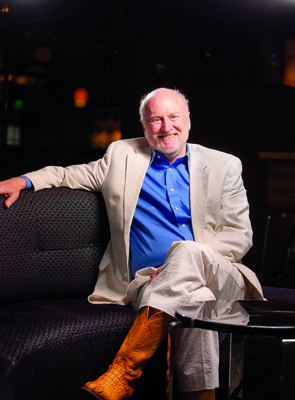
This June, Joe Edwards embedded a star on the St. Louis Walk of Fame for Landesman, who modestly protested that he didn’t deserve to be in such company. So Rocco flew in from New York with his wife, Debbie, and 22-year-old-son, Dodge (who is also a Landesman “living by his own lights”; at age 18, he was the youngest person to ever run for New York City Council). Father and son chatted with us at the Moonrise Hotel, minutes before they headed across Delmar Boulevard for the induction ceremony at the Regional Arts Commission. As the Dixieland band River Critters played, Rocco posed next to his star for a photo op, flashing his bright yellow cowboy boots and gingerly kneeling on a black dropcloth that someone had thoughtfully thrown down, so he wouldn’t ruin the knees of his gorgeous white seersucker suit.
I have a hard time imagining you lounging on the beach—yet I could not find a thing about new projects. That’s because I have retired! I was actually serious. It used to be that people used to work hard. They’d save up some money. They’d hit 65, they’d retire, they’d have their own time, and sit on their back porch and enjoy themselves. That’s what I intend to do, except no one wants to hear that.
So you’re not even doing theater anymore? I’m not producing. I still have my financial interest in Jujamcyn Theatres, my theater company. But I have no plans to produce shows at the moment. I have no plan to do that next big thing. I’m getting a chance to read some books on my shelf that I’ve had no time to open. Time is precious during this point in my life. And I’m guarding it zealously.
Now the American way is never getting off the Habitrail wheel. That ain’t me, babe. I’m going to enjoy the things I enjoy doing, no matter what people expect me to do or want me to do. One of the great Landesman qualities—my son Dodge here is the latest iteration of it—I think “Landesman” has always meant living by your own lights and doing what you want to do, not doing what you think will impress somebody else or what somebody else thinks you should be doing or what the conventional course is. The Landesmans have always been very individualistic in what they want to do for themselves. Others might call that selfish, or not as altruistic as you could be, but that’s been our style.
Yeah, last year I read your Uncle Jay’s memoir, Jaywalking… [Dodge bursts out laughing. Father and son exchange a smile.] Yeah, Jay was probably the extreme example of that! [Laughs.] The greatest gift I got from my father was that: You should distrust all kinds of received wisdom and go with what you think is right.
By the way, I saw your dad’s paintings on the NEA blog. The one depicting a colorful Victrola, in particular, struck me. It’s called Goodbye Lola, Goodbye. He was an exceptional painter. My big hope is that my sons will find a way to preserve those paintings.
Did you ever find your father’s painting that was at large? No, we never could find it. I’d love to find a way to repatriate that. I’d pay almost any price to get it back. It’s a painting of a ship with a tiny hull and big, billowing sails. But we haven’t been able to locate it. I’m about to get another one, though, because my Aunt Hedy died recently, and her family has one, and they are graciously giving that back to me. I’ve got six of them, and I’m about to get a seventh. He was a tremendous romanticist as a painter. He did not like the term surrealist. He felt it didn’t apply, and I have to agree. Surrealism’s much colder. He was a very emotional painter.
During your time at the NEA, you traveled all across the country. What jumped out at you about the arts in various cities? I got the great sense that the arts don’t just happen in New York, California, and Chicago; they happen everywhere across the country. And what I saw was how the arts can revitalize communities, and neighborhoods, and cities—the role they play in economic development and bringing vitality to places. The arts can really change places. And that was kind of our theme during my tenure at the NEA, again and again and again.
What do you think of the arts here? Take Citygarden, for example. Citygarden’s a great example of what we call creative place-making. It used to be that downtown St. Louis was kind of hollowed out. People would get in their car and drive down there to go to the ballgame and then go back to the western suburbs. Now things are going on downtown, the riverfront, and so forth, so they linger and walk around downtown.
And of course this all touches on your family’s legacy. Well, Crystal Palace was one of the most bohemian enclaves in the country when it was flourishing in the late ’50s and early ’60s. And Gaslight Square was one of the most exciting places to be. Crystal Palace was the center of that. That’s where the Compass Players performed. They later became Second City: Mike Nichols, Elaine May, Severn Darden, Del Close. Paul Morsky was there. Woody Allen was there… It was a very, very lively enclave. If you wanted to see something interesting in those days, you’d go to the Crystal Palace. They did the second production of Waiting for Godot in the country. They did The Nervous Set, which went on to run on Broadway and Fran and Jay wrote. It has one of the great scores—fantastic songs in that show; “Spring Can Really Hang You Up the Most” is now a jazz standard. The interesting thing is, when they did the show on Broadway, they omitted that song. They thought it was too depressing, I guess. But it was a huge mistake.
What do you think killed Gaslight Square? There was a lot of crime down there, and people stopped coming in from the suburbs. They started avoiding it because people perceived it as dangerous. And then it started to have a different flavor. It got commercialized, a little bit nickel-and-dimey and touristy. It lost some of the élan it had. And I think it lost a lot when my Uncle Jay moved to London and my parents moved to New York. These things only last so long, anyway. But it was creative place-making before we knew what creative place-making was!
It’s kind of sad to know that it blossomed in St. Louis and then went away. But now it’s coming back. It used to be in St. Louis, if you wanted to see the play, occasionally there’d be one at the American Theatre or at The Muny—in the summer, you’d see shows performed for 5,000 people. But there wasn’t anything like the theater scene there is now. We have a whole bunch of active, interesting companies doing very compelling work. There is a community of actors here. From the point of view of the theater, St. Louis is more alive than it ever was.
You once wrote about the exact moment when you fell in love with theater. Do you recall the play? It was [Eugene O’Neill’s] Long Day’s Journey Into Night, which I saw at Bowdoin College when I was a student at Colby College. I’d never seen it before, and it was one of the most powerful things I’d ever experienced. It’s a great play—one of the greatest American plays. I thought, “Wow, this is transporting.”
How old were you when you saw that production? I was a freshman. At that point, I was thinking I was maybe going to have a career in the theater. My dad was a painter, and they had the Crystal Palace, which had all kinds of performances. But that was when I started to concentrate on plays, per se, and theater, and ended up going to the Yale School of Drama, where I got a doctorate in dramatic literature and criticism.
And you also like country music. Yes, I love country music! My son Dodge, he and I have had this great, shared love of country music. I love the storytelling, the inventive lyrics, the characterizations, and I think there is a tremendous undeveloped potential for country music on Broadway, because I think it does a lot of what Broadway show tunes do: tell stories, develop a character. Country music’s about the words. Rock music’s about the beat. If you love words—and I’ve always had a literary sensibility—how can you not like country music? Just the titles of the songs tell you the whole story.
Your list of the top 15 country songs of all time made that apparent. [Laughs.] One of those songs’ authors was on our council at the NEA: Lee Greenwood. He wrote “Ring on Her Finger, Time on Her Hands.” You know the whole story of her life just from the title of the song.
One last question: You recently bought a small piece of the Chicago White Sox. Are you still a Cardinals fan? Totally! I’m proud of the way the team’s playing this year. In fact, my St. Louis friends and I get together for Cardinals games… I’m a big baseball fan, and I’m a big Cardinals fan. Although in the American League, I’m a White Sox guy—but they’re the other league! People ask me, “Who are you going to root for in the World Series?” I tell them, “Well, I’ll burn that bridge when I come to it.”