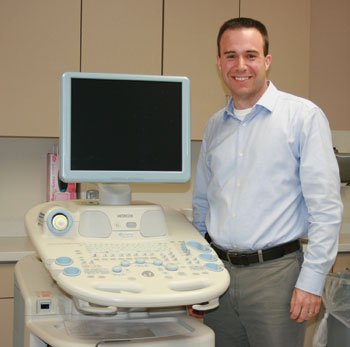
Endoscopic Ultrasound Technology—it’s a long name for a relatively short procedure that could provide patients not only with diagnostic answers, but also with some piece of mind.
Endoscopic Ultrasound (EUS) Technology represents a movement in the medical imaging field, one towards imaging with more detail, more accuracy, and fairly definitive answers in a short amount of time. To use a simple analogy, “EUS is kind of like using a magnifying glass to look at a particular area,” says Dr. Michael Heavey, gastroenterologist and hepatologist at SSM St. Mary’s. “Where it excels is in finding those little details.”
SSM St. Mary’s first offered EUS technology in November 2010, and although the program is still relatively new, Heavey says that “numbers are growing by the week. We’re surpassing our initial estimates as to how many procedures we would do per week.” “We only see that as a way to grow,” he adds. St. Mary’s is among only a few hospitals in the region that use EUS technology on such a large scale, although, according to Heavey, “We’re going to be seeing it more and more in the community as the technology becomes easier to use, the training becomes widespread, and the indications continue to grow.” Because EUS technology requires additional training, Heavey says that “the first several years after it was introduced in the US, it was mainly located at a few advanced academic centers.” However, he adds, “As time has gone on, now that we’re in 2011, this type of procedure and equipment is becoming more of a community standard.”
EUS technology, first used overseas in the 1980’s, was originally “developed as a way to view internal structures of the body with more detail than the external imaging, like MRIs and cat scans, could do at the time,” says Heavey. But EUS technology proved to be more useful as its use continued. “The other needs that it fulfilled were to help diagnose and stage some gastrointestinal tumors or cancers, and pancreatic cancer was one of the big ones,” Heavey says.
After making its way to the U.S., EUS technology has only “grown in its number of indications and usefulness,” says Heavey. “It’s useful for staging many GI cancers… but it’s also useful for other benign conditions, for which more detail imaging or some therapeutic procedures require,” he says.
Benefits of EUS technology include a fairly quick procedure, lasting anywhere from 15 minutes to over an hour, and detailed results. Patients are placed under anesthesia for the exam. “A prime example is staging some types of cancer,” says Heavey. “What EUS can do is not only find the tumor, which can also be done by things like cat scans or MRIs, but it can also be used to biopsy the tissue, to get the diagnosis of cancer and also to look at other surrounding structures and the lymph nodes to see if the cancer has spread beyond its point of origin.” He adds, “When the patient wakes up we can tell them exactly what we saw, and generally we can tell them if the diagnosis is a malignancy or benign condition.” The diagnosis is always followed up with a final result, most often just a few days after the procedure.
There are other benefits to using EUS technology, as well. “It is a scope procedure…it’s not surgery…it is a little less invasive than that,” says Heavey. “But when you’re only going through the mouth or rectum, there are no incisions, no skin that needs to heal or chances of getting an infection from that.” He adds, “There is essentially no recovery time. By the time you wake up, you can go home. Pain and other symptoms afterwards are minimal, if any at all. There are risks, just like with any procedure, but is an otherwise safe procedure.” Heavey also points out that there can be more than physical benefits. “Sometimes knowing what they’re dealing with sort of helps them [the patient] mentally and emotionally deal with the problem, instead of waiting for another test and then waiting for more results,” he says.
And although EUS technology does seem to offer a significant amount of benefits, Heavey still stresses that it’s a compliment, rather than a replacement. “It doesn’t necessarily eliminate other types of imaging procedures, but it adds more detail to an area of question and can also provide more information than some,” says Heavey. “It doesn’t replace any of the other modalities, but it is quite useful in expediting the diagnostic process.”
Heavey notes that EUS technology is intended with several purposes, beyond that of helping individual patients. “Not only is this here to help patients, but also to improve the care in the community,” he says. “And that’s one of the things that we’ve heard most from people, especially those that come here for everything, they don’t want to go anywhere else, they want to stay here, so by offering this it’s a big help for them.”
Such patient response seems to touch on the biggest benefit of EUS technology, which Heavey describes as a “‘one stop shop” as opposed to getting a cat scan, finding a tumor, and then doing a separate test to try and get a biopsy, and then a third test for other lymph nodes or if it spread elsewhere.” With EUS technology, “This is almost always a definitive exam, and they [patients] leave with the information they’re looking for,” says Heavey. “We’re excited for it to be here, it’s been a long time coming from what I understand for St. Mary’s, and we’re excited to finally have it going.”