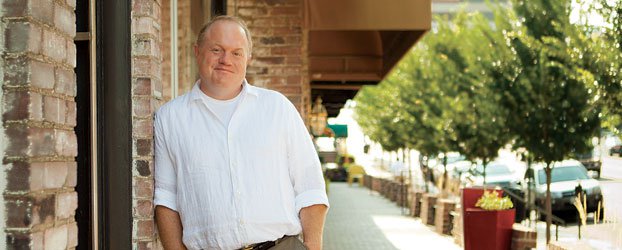
When one of the city’s most talented chefs sells his award-winning restaurant to get into the burger business, you wonder. When you dig deeper and discover he’s applying the same philosophy he espoused Harvest, i.e., to bring St. Louis something it hasn’t experienced before, you’re curious. And when you hear Chef Steve Gontram discuss just the sourcing of the beef and the buns for Five Star Burgers in Clayton (slated to open in late September), you’re sold. Our first order will be the Blue Ribbon Burger (with smoked bacon, Port-braised onions, and creamy Gorgonzola), if only because the name seems so fitting.
Before we move to the present, let’s discuss the past. Harvest was—and remains—a major success story.
It was an amazing fourteen years. Nick [Miller, the new chef/owner]is doing well, but his style is different from mine. His food is more elegant. I never considered myself a fine dining chef even though I was in the fine dining business. My style was always more rustic, like my Red Flannel Hash.
So you never got into things like molecular gastronomy.
I never learned how to do that and once I bought the restaurant outright I never had time to learn it. But it fascinates me, to a certain point, which as a diner usually involves a price point. I don’t want to pay $20 for a few pearls of agar-agar.
How about as a chef?
I felt I never needed to learn it until I realized I should have learned it. It might have come in handy when Highway 40 was closed and I was looking for something different–some kind of advantage–to build business. But as the chef/owner, I also became the manager and the wine buyer and the accountant, so there was no time for much else. It’s not a huge regret, but looking back I think I could have done that better.
How hard was it to sell the place? For all intents and purposes, you were Harvest.
It was a relief because I had been trying to sell it for a long time–since at least 2008–so I could do a burger concept with my father who opened Five Star Burgers in Taos that same year–and the plan was for me to develop it here–but I didn’t sell Harvest until late 2010.
Nick Miller became your Chef de Cuisine. At what point did he become a prospective buyer?
For the last several years, Nick was creating most of the recipes, which allowed me to go out on the floor–so it was a natural for him take the reins. One day, it just hit me: I said “I have to sell it to Nick.”
So how was working the floor after being in the kitchen for so many years?
Great, and tough. I did it partly to counteract the decrease in business that I knew would come. People just love to see the chef on the floor, schmoozing and laying down plates. It also gave me a whole new world of respect for front of the house management. Dealing directly with the public….is a challenge.
Between one and a hundred, how many times has Harvest’s bread pudding recipe been published?
Hey, there are times when I think it was that dessert kept me in business for 14 years.
Any parting words on Harvest?
We set some trends, some that are common today….the whole seasonal thing, constantly changing the menu, sometimes daily. Looking back, we maybe made it a lot more work than it probably had to be. I remember making coffee at 1:30 in the morning and it was still hot when we came back at 7:30.
Harvest was known for exemplary service. It was perhaps the first place St. Louis experienced the amuse bouche, a small, gratis tidbit from the chef.
We did that for regular customers and for those in the business, most of whom were not accustomed to touches like that. In this business, you work too hard not to get an occasional nod from your peers. That said, let me tell you that I am officially out of the amuse bouche business.
What was the reaction to Chef Gontram announcing that he was entering the burger business?
I heard it all–“you’re wasting your time…your talent…your food was so good…how the hell can you go flip burgers?” It was time to just have fun and not be handcuffed to a stove and to the restaurant. And I can still be creative, making something that everybody—everybody—loves.
So no regrets.
No. It’s a good move for my sanity. And moving into a lower price point is something I’ve wanted to do for a long time, more low brow—and I’m ready for some lower brow. I made a conscious decision to enjoy the business more, and I think this concept will be one way to do that. Plus, it’s something that I hope to grow.
How many units do you envision?
The market can hold four, maybe five.
Was Five Star patterned after another concept?
Several actually—like Zinburger and Deluxe Burger—there was nothing like that in New Mexico, so that’s where my father decided to roll it out, in Taos, then in Albuquerque. It’s now franchised to a group in Denver who has just opened their second location. So this will be the fifth store.
So there are other Five Star locations…are the menus the same?
The other four stores follow the New Mexico model but the St. Louis menu—and the logo here—will be completely different. I just didn’t feel that the Five Star menu—one that leaned heavily Southwest—would work here. I wanted a Midwest feel and meet Five Star’s menu somewhere in the middle, and grow it from there. The cooking technique, though, is exactly the same.
Which is what?
The cooking method uses two pieces of equipment: we sear the burgers on a flat top grill and finish them over an open flame. It’s an unusual, but worthwhile, process.
Simple or fancy burgers?
Gourmet burgers: half a dozen types of beef burgers, plus a pork, lamb, bison, turkey, tuna, and a veggie, at a price point of $7 to $10, which is reasonable, all things considered.
Your choice if beef is unusual as well.
It’s pasture-raised, grain-finished Angus from Creekstone Farms in Kansas, all natural, hormone free, antibiotic free, where the steers are tracked from birth from slaughter, then finished on grain and in a calm environment, which allows fattening but without any ill effects. It costs more and that’s the reason why it does. So the half-pound, 80/20 burger that we grind and form in house is flavorful and intense…it just has this beefiness.
What’s the trick to get a burger cooked medium-rare all the way through? You rarely see it.
A burger is the hardest meat to temp so temping burgers will be our biggest challenge.
Can’t talk burgers without talking french fries.
The concept lends itself to making hand-cut fries, but the process takes a lot of space and labor. And after all that, they’re often inconsistent, so I’m using a long, skin-on, ultra-premium frozen french fry. You must err on the side of consistency. Now I’m not stuck on that henceforth, but in Clayton I just do not have the space.
How about condiments.
I don’t see the need to make my own ketchup, or my own mayonnaise. An organic, all natural product is the way to go. We made our own ketchup at Harvest and people would ask if we had any Heinz.
And the buns? Many a decent burger has been done in by a lousy bun.
I’m on the board of The Bridge, a local soup kitchen, and they’ve started a social entrepreneurship program called Bridge Bread. If it all works out, they will provide us with a brioche bun, our only bun. The product still needs some tweaking, but I am hopeful. This would be great on so many levels.I will also source a gluten-free bun, but only if I can fine a good one. Most of them are not very good at all.
Is there an outrageous burger on the menu?
Maybe The Whole Hog, a ground pork burger with bacon and pulled pork, all from Geisert Farms. Is that outrageous enough?
Will there be a signature item and will it be a burger?
It will definitely be a burger, most likely the Green Chili Cheeseburger that’s topped with New Mexico hatch chiles and an all-natural pepper jack cheese..it’s one of the best burgers I’ve ever had. The choice of cheese on a burger is important, too. You can’t just throw some esoteric cheese on a burger just because it sounds good. Cheese has to melt! This is a burger joint, not rocket science, and if you treat it like it is, you’re setting yourself up for failure.
I’ve always said that you’ll never go broke selling burgers and beer. How will the latter be handled?
Eight local craft beers on tap, about 20 in bottles, a dozen wines, all by the glass, and some higher-end half-bottles. I’m hoping to arrange for craft fountain sodas from Maine Root, fair trade certified and organically-sweetened sugar cane sodas, in funky flavors. I’ll be the only guy in town doing this. The blueberry soda is made from Maine blueberries. How does a blueberry float with Serendipity ice cream sound?
What else will set Five Star apart?
Table service. I’ve never liked taking a little number to my table. I like familiarity and personal touches. We’ll make up for any lost time by using a pay at the table system like Tabbedout.
What part will social media play? Every time I ask that question, I get a longer answer.
The new buzzwords are social media management and reputation management. When compliments and complaints occur, having the tools to respond immediately pays large dividends.
What else besides burgers?
Five Star has a salad program and I have one that I’m particularly proud of, too. There’s still too much Harvest in me not to be creative there.
Photograph by Kevin A. Roberts