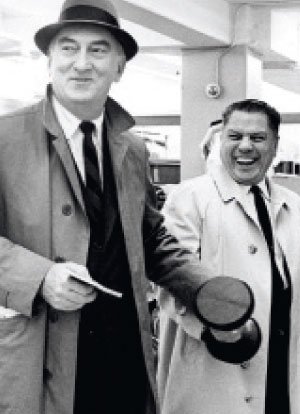
The partnership between controversial labor leaders Harold Gibbons and Jimmy Hoffa was forged under trying circumstances.
By late 1952, mobsters associated with East St. Louis crime boss Frank “Buster” Wortman had crossed the Mississippi to seize control of three Teamsters local unions and Joint Council 13, the coordinating body for the St. Louis union. They then targeted Teamsters Local 688, the city’s biggest union. They informed Gibbons, the organization’s leader, that they would kill him unless he put one of their own on his staff.
“Gibbons sent his wife and kids out of town,” recalled Jake McCarthy, a former lieutenant of his, in a 1983 interview. “I remember Ted Schafers of the Globe-Democrat telling me that Gibbons wouldn’t live out the year.”
Gibbons was a fighter, but he’d had no experience in dealing with criminal gangs. So he traveled to Detroit to seek the advice of Hoffa, the boss of that city’s Teamsters union. As recounted in Steven Brill’s 1978 book The Teamsters, Hoffa said Gibbons had two choices: He could add a mobster to his staff—and watch as that person took over the local—or he could buy “a pistol, and the first son of a bitch who walks in the door, you shoot him in the head.” Gibbons returned to St. Louis to purchase guns.
There followed a campaign in which the national Teamsters—then headquartered in Indianapolis—quietly deposed the mob leadership of several St. Louis locals and handed over control to a trustee, Gibbons.
In March 1953, Gibbons led a raid on the union hall at 4141 Forest Park. Caught by surprise, the mobsters surrendered the building. The war ended without a shot fired. Wortman was finished in the union, and Gibbons was the power figure for St. Louis’ Teamsters.
Hoffa later claimed responsibility for the victory. He said he’d used his own underworld connections to tell Wortman’s people they would face retribution from a more powerful mob—Chicago’s old Al Capone gang, better known as “The Outfit”—unless they left Gibbons in peace. There’s no way to know whether he was telling the truth, but Gibbons believed Hoffa had saved his life.
Gibbons turned 43 that April. He was a tall, good-looking man with bushy brows over sleepy gray eyes. Born to a family of coal miners outside of Scranton, Pa., he had dropped out of school at a young age to wash dishes in a diner. After his father died, the family moved to Chicago. There, in the late 1930s, young Gibbons joined the union movement. He became an organizer for the new Congress of Industrial Organizations, leading strikes among taxi drivers, schoolteachers, and textile workers. In 1941, the CIO warehouse workers’ union sent him to St. Louis to discipline a rebellious affiliate. Gibbons quickly won the loyalty of the city’s warehousemen—and then became a rebel himself. In the late 1940s, he would lead his members out of the CIO and into the American Federation of Labor as Teamsters Local 688.
Gibbons struck St. Louis like a whirlwind.
For years, warehouse workers had endured low wages and instability. Led by Gibbons, however, members of Local 688 won job stability, better wages, and solid benefits. The local’s Labor Health Institute provided medical care that was the envy of other American unions.
Gibbons’ innovations weren’t limited to the union. In those days, St. Louis was a Southern city; Jim Crow ruled. In 1947, Gibbons put civil-rights activist Bernice Fisher on the union’s payroll as an organizer—which, as he well knew, was like hiring abolitionist John Brown to be a crossing guard. Fisher assembled a mélange of Local 688 members and academics from Washington University in a chapter of the national Congress of Racial Equality. CORE launched an attack on segregationist practices, starting with lunchroom sit-ins at downtown department stores. The campaign would last more than 20 years, and Fisher would ultimately turn over its leadership to others, but in those years CORE became a vital force in wringing legal racism out of the city’s institutions. Gibbons was CORE’s godfather.
“Most of us live out our lives without leaving a mark on things,” says attorney Thomas Guilfoil, a longtime St. Louis political and financial power broker. “But Harold Gibbons left a mark. He changed things for the better for a lot of people.”
When Gibbons met Hoffa in 1953, some of their most notable accomplishments were yet to come.
Hoffa was then 40. One writer described him as having “thick legs, thick wrists, broad heavy shoulders, large feet… His eyes are small, bright, gray-green, hard. He has big, hard, callused hands and stubby fingers.” He stood 5-foot-5. Standing together, he and Gibbons resembled comic-strip characters Mutt and Jeff.
Hoffa, like Gibbons, was the son of a coal miner, though he mostly grew up in Detroit. His father had escaped the pits to become a coal broker, but didn’t prosper at it and died when Jimmy was only 7. In his early teens, Jimmy dropped out of school to work in a Kroger warehouse. At 17, he organized a successful strike there, persuading his fellow workers to refuse to unload an unrefrigerated railroad car of strawberries until Kroger agreed to restrain a bullying foreman.
It must have thrilled Hoffa to learn that a group of men would follow a kid, even a runty kid, if the kid seemed to know what he was doing. “Stepping up” became his habit. Years later, a Local 688 officer watched Hoffa move through a St. Louis shop, introducing himself with an easygoing, no-bull way, saying to a complete stranger, “Goddammit, your glasses don’t fit right. Why don’t you go get them fixed?” Hoffa had clearly learned that constant, unceasing forward motion—aggressiveness, some might call it—wipes out all sorts of disadvantages. Energy and chutzpah can count for more than physical size.
By the time he was 23, Hoffa had become an organizer for Detroit’s Teamsters Joint Council 43, working with the city’s truck drivers. Compared to St. Louis, Detroit in the 1930s was a frontier town. Among poor and laboring people, it was a place where gambler Moe Dalitz—who then owned a chain of laundries—and mafioso Angelo Meli—who controlled the jukeboxes—were respected figures. Not industrial titans, such men nevertheless towered over the typical trucking-company owner, who had only a handful of vehicles.
Having little choice, Hoffa learned to bargain with businessmen who were also gangsters. In 1937, the Detroit Teamsters won a citywide truck strike that was surprisingly peaceful—largely, Hoffa’s associates said, because he had formed some key friendships, most notably with Meli, who employed thugs to break up strikes. “It wasn’t that Jimmy had made any alliances with those guys during the 1937 strike, because he didn’t,” recalls a veteran Detroit Teamster. “It was a matter of knowing who was going to hurt you and then asking them to back off.”
Hoffa’s methods weren’t so different from the mobsters’. In his 2003 book Out of the Jungle: Jimmy Hoffa and the Remaking of the American Working Class, biographer Thaddeus Russell writes that Local 299, Hoffa’s longtime base of operations in Detroit, grew because it used violence as a tool. Local 299 specialized in “organizing” employers, rather than workers.
“The local’s business agents first approached the owner of a firm and told him that if he did not enroll his employees with the union, his trucks would be bombed,” writes Russell. “If the employer refused to capitulate, they bombed his trucks. In the mid-1930s the local gained a reputation as the most violent, lawless union in an unusually lawless, violent city.”
In his own view, Hoffa was not a cynical man. Rather, he was the boy who blurts out that the emperor is naked, except it wasn’t just the emperor but practically everyone, and Hoffa saw himself as the only person cleareyed and forthright enough to point it out. He had the hard wisdom of a streetwise adolescent—and an adolescent’s emotional brittleness.
Once, Hoffa was invited by a college professor to have dinner with 10 of his brightest graduate students. Hoffa agreed to the dinner, but announced that he would stay only as long as the students asked intelligent questions. Hoffa began the evening with a brief talk, after which, the professor wrote in the Saturday Review, “My carefully selected audience blasted him with ‘intelligent’ questions for almost three hours. He responded agilely. Finally, after a perceptive, emotional monologue on the history of labor legislation, the ‘tough’ Jimmy Hoffa burst from the room in tears.”
In vocational terms, the big event in Hoffa’s life was meeting Farrell Dobbs, a Minneapolis Teamster. Dobbs was a communist, a follower of the Russian revolutionary Leon Trotsky, and a genius organizer. In the late 1930s, Dobbs brought together Teamster truck drivers to present a united front when negotiating with employers. He set up a network first in Minneapolis, then across the entire state of Minnesota, and finally spanning 11 Midwestern states from the Dakotas to Ohio.
Hoffa once wrote, “I wouldn’t agree with Farrell Dobbs’s political philosophy or his economic ideology, but that man had a vision that was enormously beneficial to the labor movement. Beyond any doubt, he was the master architect of the Teamsters’ over-the-road operation.” Hoffa never hesitated to praise Dobbs, though he later took over the Midwestern network that Dobbs worked so hard to build.
By the early 1950s, Hoffa was vice president of the Teamsters. Dave Beck, the organization’s president, preferred hobnobbing with celebrities to running the union. Seeing this, Hoffa cheerfully volunteered to perform Beck’s more mundane duties. “Beck made speeches on foreign affairs; Hoffa undercut him by handling wages and working conditions,” writes John Bartlow Martin, another Hoffa biographer. “When a problem arose anywhere in the country, Beck sent Hoffa in to straighten it out. And in each place Hoffa took over for himself. Minneapolis, Philadelphia, Cleveland, and St. Louis fell to Hoffa, and he laid siege to New York.”
St. Louis was a particularly important target. Having already won Gibbons’ gratitude over the Wortman affair, Hoffa began to ply him with gifts. First, he appointed the St. Louisan trustee of the Teamster locals that were recaptured from the Wortman gang. Later, Hoffa made Gibbons trustee of the entire St. Louis joint council. And eventually, Hoffa placed in Gibbons’ care the Central Conference of Teamsters (the network inherited from Dobbs), whose headquarters transferred to St. Louis.
These jobs weren’t just patronage, though. They were crucial for Hoffa, and he needed them done well. They included the job that was closest to Hoffa’s heart: Though it was never announced publicly, Gibbons was also appointed chief strategist of Hoffa’s campaign to replace Dave Beck as president at the Teamsters’ next scheduled national convention in 1957. “Harold orchestrated the whole campaign,” said former Gibbons lieutenant McCarthy. “I know that because we ran the whole thing out of St. Louis.”
Gibbons and Hoffa spent a lot of time together in the early ’50s, growing from mere allies to close friends.
In some ways, they were very different. Gibbons liked to read about social science from writers like John Kenneth Galbraith and Simone de Beauvoir. Hoffa preferred trucking statistics. Gibbons was a socialist who believed unions should lead campaigns to abolish racism, poverty, and unemployment. Hoffa was a Republican with little interest in politics except as it affected the Teamsters. And while both worked long hours, Hoffa, a teetotaler and nonsmoker, then usually went home to his family; Gibbons frequented saloons and nightclubs.
One enthusiasm they shared was exercise. When visiting the Gibbons home in Kirkwood, Hoffa liked to get down on the living-room floor and challenge his host to a push-up contest. Hoffa was especially impressed by Gibbons’ ability to perform many push-ups with his wife, Ann, reclining on his back, like Cleopatra on her barge.
They also shared a similar outlook on the labor movement itself. Gibbons and Hoffa were creatures of the Depression. The desperation of those years had scratched deep grooves in their personalities. Although the quarter century from 1950 to 1975—the period of their own personal successes—would be an era of great prosperity, both Hoffa and Gibbons doubted its permanence. Even the conservative Hoffa saw capitalism as too inherently unstable to survive for long, according to writers Ralph and Estelle James, who spent time with him in the early 1960s. Hoffa was sure that overproduction would eventually result in another systemic crash, like that of the ’30s, which would throw millions out of work.
As the Jameses noted in the 1965 book Hoffa and the Teamsters, “He is in the incongruous position of one who likes the present system, but does not believe it can work… We have several times heard Hoffa predict a return to the violence in the streets that he witnessed during the Great Depression. Should this happen, he is prepared to lead the hungry masses forth.”
The Depression of the ’30s had made Gibbons a socialist. Hoffa expected to be turned into one by a depression that was yet to come.
Meanwhile, Gibbons and Hoffa enjoyed each other’s company. Gibbons’ older son, Patrick, recalls riding along one wintry night as a boy while his father drove Hoffa to a speaking engagement in Southern Illinois. Drowsy in the back seat, Patrick half-listened as the two men reminisced about close calls they had survived and labor eccentrics they had known. For young Patrick, the sound of their voices seemed to merge with the warm air issuing from the car’s heater. As Patrick tells it now, he might have been listening to an old, comfortably married couple. “I never saw them as anything but cordial with each other,” he says.
In fact, there seems to have arisen a vague understanding that the two would share the Teamsters’ leadership. With Gibbons’ aid, Hoffa hoped to win the national union’s presidency in ’57. Then, after a term or two, he would help elect Gibbons to take his place. The arrangement was similar to that said to have been made in the 1990s by Britain’s Tony Blair and Gordon Brown. As with Blair and Brown, though, the understanding would suffer many strains.
One early strain involved what was then called the Missouri–Kansas Conference of Teamsters. The conference’s presidency—which coordinated the activities of local unions in both states—was another of Hoffa’s gifts to Gibbons. Gibbons had earlier been named trustee of several locals in Kansas City, and those trustee jobs had irritated Roy Williams, the strongman among that city’s Teamsters. Gibbons began his tenure by replacing officers in the K.C. locals that he controlled. “St. Louis has tried to take over the Kansas City Joint Council,” Williams complained to a friend. “Told Jimmy Hoffa, ‘Over my dead body.’”
Dick Kavner, Gibbons’ lieutenant, overheard Williams’ words at a March 1954 conference meeting in Kansas City and recorded them in a notebook; those notes, today on file at Southern Illinois University Edwardsville’s Lovejoy Library, provide a glimpse into Teamster politics at the ward level and reveal a good deal of unpleasant gossip. So when the Missouri–Kansas Conference split—with St. Louis reps Gibbons and Kavner on one side, and Kansas City’s Williams and associates on the other—
it was no surprise to those in the know.
Simple jealousy was an obvious factor. Williams, who groused that Teamster locals in Kansas City were required to clear proposed strikes with Hoffa, while those in St. Louis were not, seems to have felt like a less-favored sibling. Hoffa probably meant for him to feel that way; Kavner’s notes reveal Hoffa’s habit of playing people against each other to keep them guessing about his real intentions.
For instance, at a February 1954 meeting in Miami, Kavner noted that participants agreed “Roy would now cooperate and work with Gibbons and Kavner.” Yet a proposal by Kavner “that a [Missouri–Kansas gathering] would be called to explain the agreement was vetoed by Hoffa.” In other words, Hoffa gave Gibbons authority over Williams but refused to make that authority public. Later, in the March meeting, Hoffa asked Gibbons and Williams to shake hands. Gibbons refused, saying a handshake would do nothing to settle their differences. According to Kavner’s notes, Hoffa berated Gibbons for balking. Gibbons, he said, “talked with less sense than a 21-year-old.”
While Gibbons and Williams were both Hoffa protégés, Williams was also a protégé of the Kansas City mob, as well as—because that group was a subsidiary of Chicago’s mob—The Outfit. Though long suspected, these ties wouldn’t become clear until 30 years later, when Williams was convicted of conspiring to bribe a U.S. senator. He confessed to having taken orders from K.C.’s mob boss for years, saying he had no choice because mobsters had threatened his life, as well as the lives of his wife and children.
Williams was, however, compensated for his troubles. In 1955, when Hoffa set up the Central States Pension Fund—in effect, a huge Teamsters bank—he put Williams on the board that evaluated applications for loans. His role was to approve loans for the Chicago Outfit, which helped fund construction of casinos in Las Vegas. For doing so, The Outfit’s Kansas City subsidiary paid Williams $1,500 a month, and Hoffa received The Outfit’s backing in his campaign for the Teamsters’ presidency.
“Hoffa wasn’t a hoodlum,” explained McCarthy. “But he understood politics. He knew he had to get along with Chicago and Cleveland [another mob center] to become president.”
We should note here a significant shift in the nation’s criminal-justice system. In America, crime fighting was long seen as a local matter left to prosecutors, police commissioners, and judges—officeholders frequently connected to political machines that were infiltrated by local mobs; as a result, mob bosses had little to fear. In the 1970s, federal legislation—notably the Racketeer Influenced and Corrupt Organizations Act—stripped mobsters of this protection. In the ’50s, however, honest labor leaders often had little choice but to live with them.
McCarthy once tried explaining this in a column that ran in the Post-Dispatch on April 2, 1976. Mobsters in the Teamsters, he said, “were pretty much left alone to do their own thing in their own city, as long as they didn’t mess up a national or bargaining agreement.” Meanwhile, people like Gibbons focused on helping members improve their lives. “Well, how could they exist side by side?” McCarthy asked rhetorically. “Easy. The reformers worked where they had the power to work. After that, nobody got in anybody else’s way. It was an intensely political thing—like the way Congress operates. Like the board of directors of a few companies. Like your average city fathers in your average mob-dominated metropolis. There is the answer to getting it straight, you see?”
Gibbons certainly saw the Teamsters that way. According to Gibbons’ children Larry Gibbons and Elizabeth Vasquez, he once estimated that about a third of the union’s locals were mob-influenced during the ’50s and ’60s. With roughly 1.5 million Teamsters members at the time, however, more than a million would have been free of mob ties—and for that million, Gibbons had big dreams.
In 1965, NBC anchor Chet Huntley recalled an evening when Gibbons talked about what he would do if he were elected as the union’s president: “He said that sometime within the first hour of his administration he would get his union, and all of organized labor, into the works it should have been engaged in for all of these years. Gibbons says that labor should have led all the rest—federal government, state government, local government, insurance companies, and foundations—in undertaking the rehabilitation of cities, slum clearance, job training, war on poverty, juvenile delinquency, beautifying America, all the rest. That evening in Chicago, Hal Gibbons said, ‘Let the Teamsters have Harlem for a few years and we could transform it.’”
At the October 1957 Teamsters convention in Miami Beach, Fla., Hoffa’s long presidential campaign paid off. McCarthy denied that it was mob support that won Hoffa the job. Some people claimed the election was rigged, McCarthy wrote in a 1975 Post-Dispatch column, but “if it was, I don’t know why all of us in Gibbons’ entourage worked so hard in that convention… Gibbons and I wrote Hoffa’s acceptance speech in an all-night session after the winning vote. If it was rigged, it would have been so much easier to write that speech at home and bring it to Miami Beach with us.”
Three months after the convention, Hoffa moved into the president’s suite in the union’s new headquarters building in D.C. Gibbons, who was elected vice president, took the rooms next door as Hoffa’s executive officer.
The two decided to save money by living together. They leased the apartment hitherto occupied by Dave Beck, the union’s former president, at the city’s Woodner Hotel, overlooking Rock Creek Park. Reporters occasionally visited them there. “They are an odd pair, Hoffa the bread-and-butter unionist, and Gibbons the onetime Socialist,” noted a writer from the Saturday Evening Post in 1959. “If they have a free evening, Gibbons is likely to sit up reading, Hoffa to watch television for an hour, then go to bed.”
This sounds more peaceful than it probably was. Yes, they were friends. But they were also two highly ambitious, competitive men, each of whom knew how to nurse a grudge. Gibbons would have remembered that day when, after quarreling with Williams, he was chided by Hoffa. As for Hoffa’s resentment of Gibbons, it may have represented no more than the fact that, as former Hoffa associate Joseph Konowe once put it, “Jimmy liked to get the upper hand over people with education who were taller.”
Even so, Gibbons and Hoffa managed to work together for another six years. When they eventually fell out—and fell out explosively—it was over the assassination of John F. Kennedy.
But that’s a story best left for another time.
Gordon Burnside is a retired journalist whose work has appeared in The New York Times, The Nation, Commonweal, and other publications. He is currently writing a biography of Gibbons.