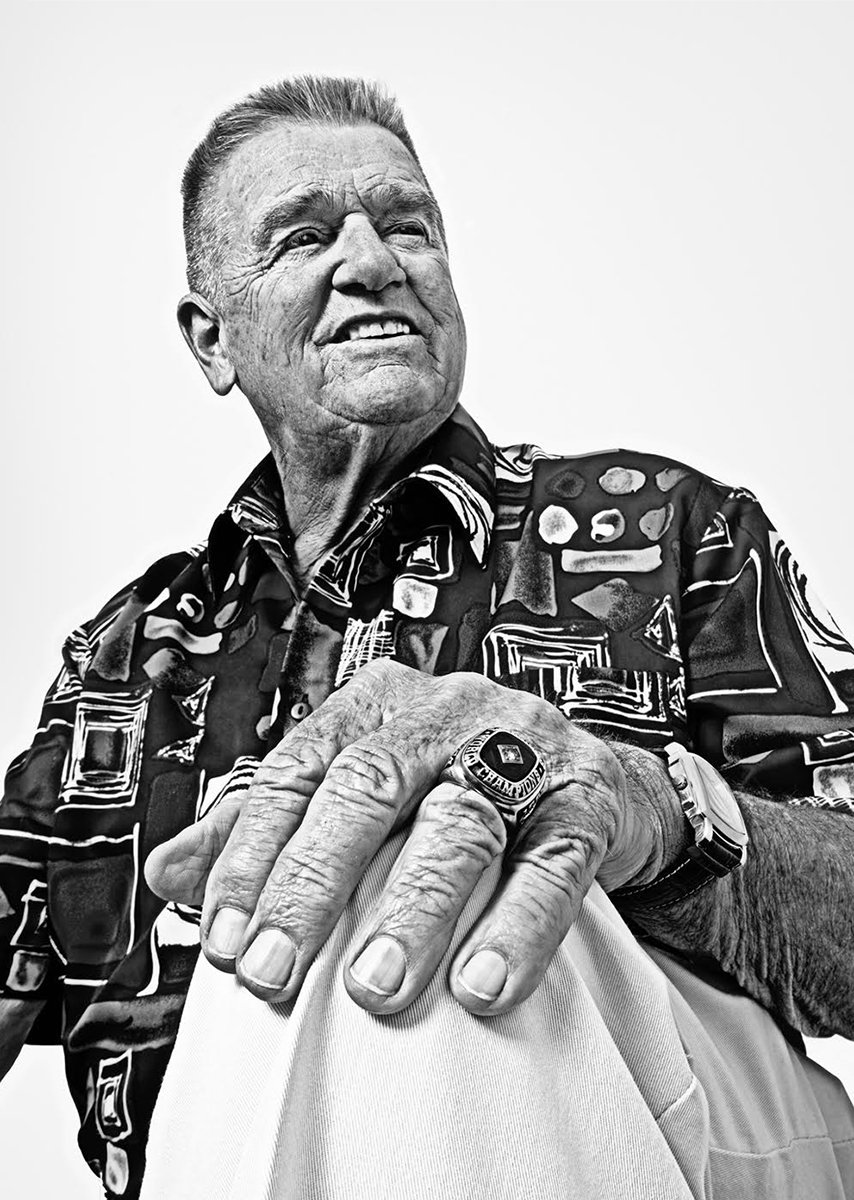
Long before Dorrel Norman Elvert Herzog was known as the White Rat, or even Whitey, friends called him Relly. (“Anything is better than Dorrel, I suppose,” he once wrote.) Back then, growing up in New Athens, Ill., he’d play hooky and hitch a ride to Sportsman’s Park, where he’d climb to the upper deck and scoop up batting-practice balls to sell for $1 each to buy a Coke, a hot dog, and a bus ride home—with money and souvenirs to spare.
Such cunning took him from New Athens to New York and back. He learned to hit from Ted Williams, to manage from Casey Stengel, and to drink from Gussie Busch. He led the Royals to three division titles during the ’70s, then crossed the Show-Me State to teach St. Louis something called Whiteyball. He rebuilt the team, bringing Ozzie Smith here, and led his Runnin’ Redbirds to three World Series—including a win in 1982 and the infamous I-70 Showdown Series in 1985. After retiring to Sunset Hills, the gregarious 78-year-old was selected in December for the National Baseball Hall of Fame, where he’ll be inducted this month.
But it all started in a small town across the river. “We’d start playing baseball at 8 o’clock in the morning,” he recalls, “and our mothers would call us at 6 o’clock for dinner.”
How’s baseball different for kids today?
Today everything’s organized. The kids don’t do anything on their own. We used to go to bat as many times in a day as they go to bat all season in Little League… That’s basically why we’re getting more and more Latin players, because that’s the way they’re playing in Venezuela and the Dominican Republic.
Growing up, which players did you most admire?
In those days, the three most renowned players were Ted Williams, Stan Musial, and Joe DiMaggio… In high school, DiMaggio and Musial were my two heroes. And then, of course, I became pretty tight with Ted Williams when I played. He thought I had a good batting stroke, and I should be a good hitter—but every time he talked to me, he put me in a slump for a month.
As a prospect with the Yankees, you learned under the great Casey Stengel. Do you have a memorable Stengel story?
He’d go to the phone [in the dugout] all the time: “Get so and so up, get so and so up!” This particular day, Bob Friend gave up five runs in three innings, and Casey goes to the phone: [He imitates a deep, gruff voice] “Get Hunt up!” And he hangs up. They call back from the bullpen and say, “Casey, you sent him to Syracuse this morning.” He said, “Bring him back!” About three innings later, he goes back to the phone, and he says, “Get Miller up!” He’d never let anyone talk to him on the phone; he’d just say, “Get so-and-so up!” Five minutes later, they call back and say, “Case, which one do you want? The right-hander or the left-hander?” We had two Millers. You know what he said? “Surprise me!”
How was Stengel off the field?
Casey was probably the best ambassador that baseball ever had. One of the reasons was, he’d buy the writers drinks all night, and he’d sit up and drink with them till daybreak.
You had a way with the press in New York.
When I went to the Mets in ’66, New York had about nine newspapers. You talk about the news-media capital of the world—you had papers up the ass: the Long Island Press, the Daily News, The New York Times… If anything good ever happened for me, as far as being a very mediocre ballplayer and a no-name guy, was once I finally got to coach third base… The press loved me because we lost a lot of games—we were horseshit—so they’d come to me for something, and I’d always give them a story. I think that was my big break, because my name started getting mentioned every time there was a managerial opening.
You ended up with the Texas Rangers in 1973.
I think my year down there might’ve taken some cockiness out of me, because people had always said how smart I was. [In previous jobs], nobody knew if I made a mistake or not. When you manage, it only takes three seconds.
You were fired that September—right after Rangers owner Bob Short said you were the best manager he’d ever had—but ended up in Kansas City in 1975.
I stepped into a wonderful position. George Brett was 21… Frank White and Al Cowens were both on the bench; I put those two kids in. It was like making a major trade without getting rid of anybody… We proceeded to win, and we probably should have won [the World Series] in ’77. We had the best club—we won 102 games.
When the teams weren’t playing, you’d fish with George Brett, and later Bruce Sutter.
Yeah, I taught George Brett how to fish, how to hunt, how to drink whiskey. He was 21 when I got him, and we became pretty tight… Sutter had never caught a fish in his life, and I had to tie knots and everything for him; I never did teach him how to fillet a fish, because I didn’t want him to cut his finger off. Bob Forsch jokes about how he would ask, “How come you let me fillet fish and not him?” And I’d say, “I don’t want him to cut a finger off. I don’t give a shit if you cut yours.”
Did you ever worry about becoming too close to your players?
Here’s the way I’ve always thought about it: When the players respect your knowledge and know you’re honest with all of them, I don’t care how much you do with them off the field… Now, when you put the uniform on, it goes back to the same thing—I’m the manager.
What was harder: managing baseball players or three kids?
My wife kind of raised the kids. When I had to put my foot down, I think I did a pretty good job. But managing a baseball team and handling people is about mutual respect. If they’re good people, that’s really the big thing about it. When you get a bad apple, put him on the goddamn truck. Get him out of there. [“You can’t do that with your kids, though,” jokes his assistant, Kathy, sitting nearby.]
After coming here in 1980, you traded half the team. You wrote, “If it’d been legal…My ass would’ve been hanging from the Gateway Arch.” What gave you that confidence?
You didn’t need confidence to clean house when you’ve got the third-highest payroll in the National League and you’re last.
Plus, you had the owner’s support.
I was here two weeks when an usher said, “Mr. Busch wants to see you.” So I went up to Gussie’s office, and he said, [He imitates a loud, gruff voice] “What do you think?” And I said, “Gussie, you’ve got a bunch of overpaid prima donnas that aren’t ever gonna win anything. It just ain’t gonna happen.” He said, “Well, what do you want to do?” And I said, “I want to get rid of them. I want to change the club over, and I want to do it in a hurry.” He said, “Do it.”
For a time, you served as both manager and GM. You ended up trading away 14 players and signing 11—but it paid off.
In ’81, we had the best record in the league [before the midseason strike]… And, of course, the next year we won the World Championship. I think part of that was that I was able to make that last trade: Garry Templeton for Ozzie Smith. Getting Ozzie to come here kind of put the glue to the thing. He was not only a great player, he was kind of a leader.
You always could scout talent. Why was that?
When I played ball, I was on the bench so much that they called me The Judge. I don’t think I was sittin’ there drinking Coca-Colas or eatin’ sunflower seeds—I might’ve had chewing tobacco—but the thing was, I watched the game and the managers. I was a good student of the game.
You were a player, a scout, a coach, a GM, a manager… Which were you best at?
All of them. Now, not as a player. But I still feel I was the best third-base coach ever. Everybody knows I was the best director of operations who ever lived. And not too many guys go out scouting their first year and sign 12 players and seven of them make the big leagues. I’m not popping my bill; I’m just telling you what people thought.
As a manager, you relied on speed, strong pitching, and on-base percentage. Writers dubbed it Whiteyball.
The funny thing was, once my players bought into how we wanted to play, we always finished in the top three in runs scored without hitting any home runs, and we could win on the road. If we could neutralize the power at home and get 10 singles, we were gonna beat your ass. That’s the way we tried to play the game, and we could, too. And the people loved it. St. Louis is a blue-collar town; they liked the dirty uniforms, and I think the players and fans both enjoyed it.
And the attendance ledger spoke for that, with record crowds at Busch Stadium.
Nobody thought we could draw 3 million; I asked Gussie, and they hadn’t drawn 2 million in more than 10 years. If I’d have said, “If I drew 3 million people, would you give me a $1 million bonus?”, he’d have just said, “Yeah.”
Let’s talk about umpire Don Denkinger’s infamous blown call at first in Game 6 of the ’85 World Series.
It wasn’t right. I knew when I said, “Don, did Todd [Worrell, the Cards’ pitcher] miss the bag?” He said, “No, [Kansas City’s Jorge Orta] beat the play.” I said, “I know he didn’t beat the play. I could see that from the third-base dugout.” And he kind of shrugged, like saying, “Well, I blew it.”… We’d never blown a game in the seventh, eighth, or ninth innings all year when we had a lead until that call.
After you left the Cards in 1990, you turned down several managing jobs.
It was only because I could never find another Gussie. I had such a good relationship with him that I knew I could go anywhere and never be happy. I always felt that if you can’t be happy doing something, then you shouldn’t do it, because you can’t be your best.
What do you miss most about the game?
Oh, I love turning in a lineup card. I love managing a ballgame. But I think when you get older, there’s a lot of things that bother you that don’t bother you when you’re young. Flying till 4 in the morning. The bellhop ringing the goddamn doorbell at 5 to get your bags. Those kind of things started getting to me.
Have you started on your speech for the Hall of Fame ceremony yet?
Oh yeah, I wrote it this morning. It took me about 15 minutes.