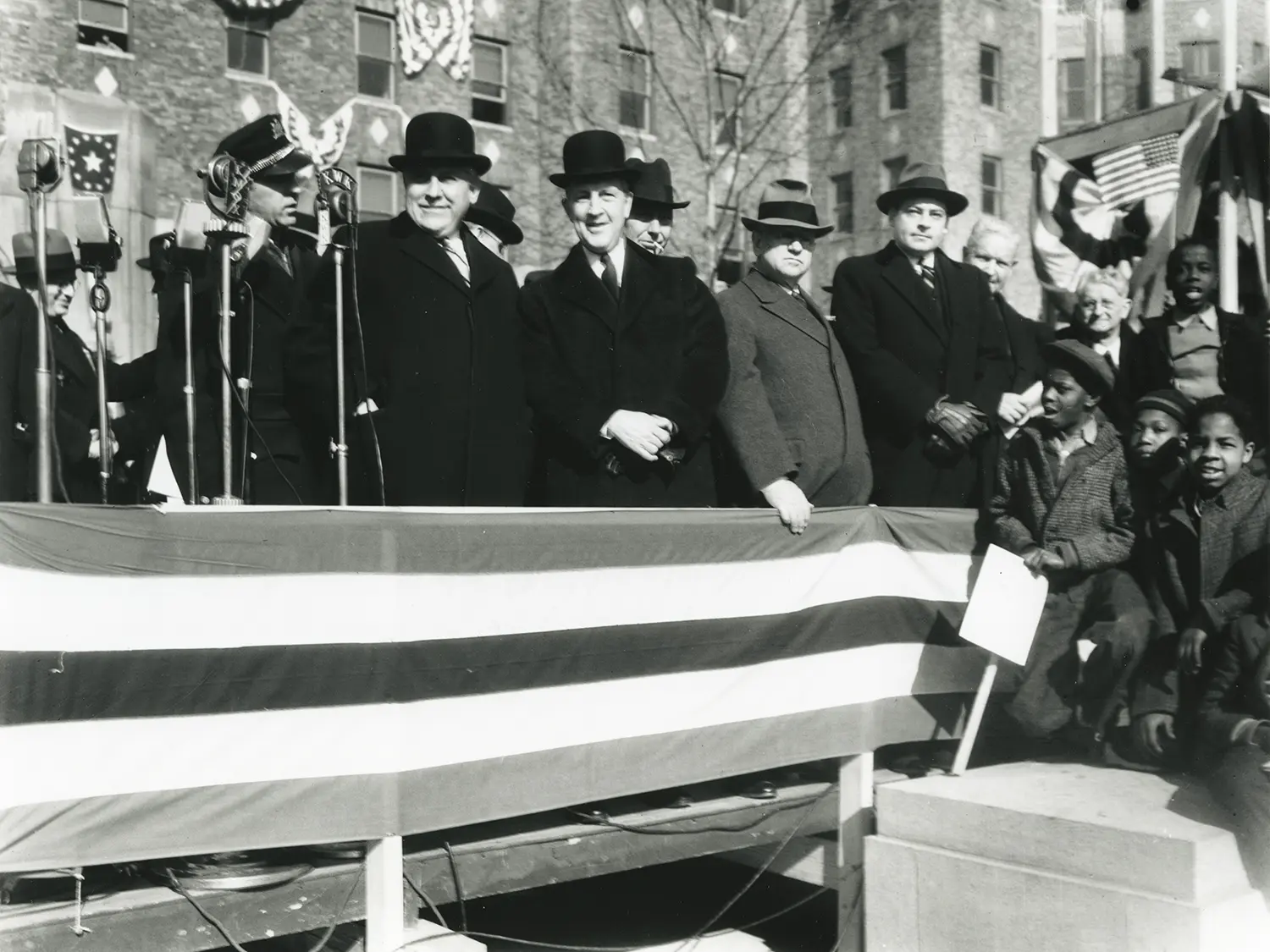
Photographs courtesy of the Missouri Historical Society’s Photograph and Prints Collection, the Saint Louis Art Museum, SIUE, MICDS
It’s not always the politico with the nuclear handshake and the three-piece suit. Or the judge, the archbishop or the tycoon. No, sometimes the folks who profoundly shape (or, as the case may be, scratch and dent) the history of a place are the rabble-rousers, muckrakers, crusaders, visionaries, wingnuts, artists and self-made men and women. Historically, St. Louis has had a generous share of all of these, from philanthropists to anarchists. Our goal was to round up a list of those who, now gone, affected the fabric and fate of the city most profoundly.
Some of the folks here you’ll recognize, like Pierre Laclede, who had the foresight to choose a long, clear bank along the Mississippi—one with a gentle incline, ideal for the docking and unloading of boats—and cemented our place as a commercial river port for centuries. Some names you may recognize—you probably know of Father Dickson Cemetery on Sappington Road, for instance—but you may not know that its namesake, Moses Dickson, was the founder of a secret African-American organization called the Knights of Liberty that was planning a military offensive to end slavery when the Civil War broke out.
In either case, we hope we’ve liberated St. Louis history from the mustiness of the history book, with its endless lists of dates and places and skirmishes, by bringing alive the people who made those dates memorable, gave this place its shape, fought, flourished and left their traces behind in ways both tangible and mysterious.
The Beginning: 1764–1861
First France owned the land. Then it was handed over to Spain. Then a city was founded—under Spanish rule by French fur traders whose boats had glided upriver from New Orleans. Tension from the start.
But St. Louis’ French Creole founders held sway far longer than could be expected, charming the Spanish authorities with satiny ruthlessness. St. Louis received an underlay of Creole culture—a love of gaiety, music and dancing, a deliberate lack of formality and a romantic nostalgia for an older, simpler age. The French Creoles made fun of the “Americans” as rough, unpolished, brutal and priggish. “It would take many French funerals to improve
St. Louis,” one WASP snarled back.
Land commissioner Frederick Bates plumped for “the superior genius of the Americans”—and in the end, he won. Even the Chouteaus couldn’t keep French as St. Louis’ second official language, couldn’t keep the Creole Sabbath that welcomed whiskey and dancing, couldn’t keep the French legal system. By the end of this era, Creole culture was a private affair.
But its influence remained.
Pierre Laclede Liguest (c. 1724–1778)
Who he was: A Frenchman “of good family” whose business in the New World was ruined by the war between France and England, yet who managed to grab a second chance: exclusive privileges for fur trading in the Missouri River county. What he did: Set out with his 14-year-old stepson Auguste Chouteau (today he’d be arrested for child endangerment). Chose a forested spot on the limestone bluffs with direct access to the river and, in 1764, drew the grid for a village. Gave St. Louis its first scandal by bringing the elegant Mme. Chouteau, abandoned by a tavern keeper and Laclede’s wife in all but law. Why it mattered: It’s where we live. The fur trade caused wealth to flow into St. Louis. The scandal left us hungry for propriety.
Louis Groston de Saint-Ange et de Bellerive (d.1774)
Who he was: The first military commandant and acting governor of the post of St. Louis. What he did: Coaxed French artisans and traders to cross the river from the Illinois country; showed up just in time to head off anarchy; provided steady government and protection until the Spanish arrived in 1770. Why it mattered: Using the kind of nonabrasive “niceness” later St. Louisans would take for granted, Saint-Ange was able to win over the Spaniards without jeopardizing his friendship with the French. St. Louis followed his lead.
Clement Delor (d.1805)
Who he was: A former French naval officer who settled just south of what was then St. Louis proper. What he did: Established the village of Carondelet, bordered by Meramec, the Mississippi River, the River des Peres and Morganford, in 1767. St. Louis annexed it in 1870. Why it mattered: As the name for the founder of a resolutely working-class community like Carondelet, “Clement Delor de Treget” sounds a bit effete, but there ya go. Delor founded Carondelet just three years after St. Louis itself was founded. Ever since, Vide Poche (“empty pocket,” the French moniker for the former) has anchored Pain Court (“short of bread,” the French moniker for the latter).
Col. William Chambers (1757–1848)
Who he was: Founding father of North City. What he did: In 1816—five years before St. Louis city incorporated—Col. Chambers, Maj. William Christy and Thomas Wright founded the Village of North St. Louis, using a stunningly progressive layout. Col. Chambers set aside three circular areas—Clinton Place (a school), Jackson Place (a gymnasium) and Marion Place (a house of worship and cemetery grounds for people of all faiths and backgrounds)—to respond to the physical, social and spiritual needs of the community. Why it mattered: Those three circles have continued to anchor the neighborhood for 191 years, buffering it against decades of block-busting, brick rustling and political neglect.
John Mullanphy (1758–1833)
Who he was: St. Louis’ first millionaire. What he did: Fought in the Irish Brigade in France; wound up here in 1804. Had the wit to buy cotton cheap and sell it high at the end of the War of 1812. Used what he didn’t spend on his 14 daughters and one son to give small tokens to his adoptive city: a convent, a hospital, a church … Why it mattered: His daughter Ann Biddle founded a hospital and “foundling asylum.” His son, Bryan, was elected mayor of St. Louis in 1847; he later endowed the Mullanphy Emigrant Home, welcoming much of the labor force that built St. Louis. Described by polite historians as eccentric, he often wore a boot on one foot and a shoe on the other.
Carlos de Hault de Lassus (1767–1843)
Who he was: The last Spanish lieutenant governor of St. Louis and one of the most able, descended from French nobility yet sufficiently angered by the French king’s treatment of his family to be open to Spain. What he did: Dealt calmly with smuggling, Indians and land battles, then gracefully handed the city over to the Americans. Assured the Delaware, Abenaki and Saqui nations, “You will live as happily as if the Spaniard was still here.” Stayed on to advise the new authorities. Why it mattered: If he’d turned us over to the Brits instead, your neighborhood Starbucks would be offering shots of black tea.
St. Rose Philippine Duchesne (1769–1852)
Who she was:: French-born Roman Catholic sister (Society of the Sacred Heart), pioneer, educator, fundraiser, frontierswoman, saver of souls. What she did: Even as a girl in Grenoble, she wanted to be a missionary to the American Indian. She fulfilled that dream in 1818, when she founded missions in St. Charles, Florissant, New Orleans and St. Louis. Mother Duchesne was 49 and could barely speak English, let alone Pottawatomie—but nothing fazed her. She was canonized in 1988. Why it matters: She believed in education, especially for females. And she was the first in a long line of women who led St. Louis educational and healthcare institutions with shrewd authority and selfless dedication.
William Clark (1770–1838)
Who he was: Governor of the Missouri territory, then Superintendent of Indian Affairs. What he did: Kept order. Founded an Indian museum that didn’t reduce its artifacts to curiosities. Socialized with the French-Canadian elite. Turned his house, at Main and Vine, into a center of hospitality. Tried to keep Meriwether Lewis out of trouble. Why it mattered: At a time when the Anglo-American majority was trying to whack St. Louis’ French-Canadian roots and slaughter American Indians, Clark identified himself squarely with the groups in danger, risking his earlier popularity to control the damage.
Antoine Soulard (1776–1843)
Who he was: A refugee from the French Revolution who breathed more easily in America’s open spaces; he became chief surveyor of upper Louisiana for both Spanish and American governors. What he did: Wrote the first review of
St. Louis trade and commerce—$77,000 worth of skins, hides, tallow and boar’s grease—and tactfully suggested making use of native trees and plants as well. Planted the finest fruit orchard in the area, on lush green acreage that stretched from the river to Carondelet and from Park Avenue to Lesperance. Why it mattered: Not only did Soulard’s prodding broaden our economic base and his job as surveyor allow him to influence conflicting land claims, but his widow laid out “Frenchtown,” the historic Soulard neighborhood.
Bishop Joseph Rosati (1789–1843)
Who he was: An Italian who became the first bishop of the newly created St. Louis diocese in 1827. What he did: Cooperated with the Jesuits (bishops didn’t always do so) to reopen Saint Louis Academy; brought various orders of women religious here; is credited with establishing St. Louis Hospital, said to be the first of its kind in the country. (The Sisters of Charity did the bandaging.) Why it mattered: Rosati focused and concentrated DuBourg’s work, giving form and substance to the new St. Louis diocese.
William Carr Lane (1789–1863)
Who he was: An Army surgeon who became the city’s first mayor in 1823. What he did: Had streets paved—for the first time. Persuaded physicians to make weekly reports of deaths. Issued sanitation warnings that could have prevented the cholera epidemics, had anyone listened. Gave the city a sense of identity. Why it mattered: Inspiration. As the new mayor told the first board of aldermen, “The fortunes of the inhabitants may fluctuate, you and I may sink into oblivion, and even our families become extinct, but the progressive rise of our City is morally certain.”
Col. John O’Fallon (1791–1865)
Who he was: President of the St. Louis branch of the U.S. Bank. An easygoing Irishman who could talk anyone into anything, he traced his lineage back to the battle of Clontarf in 1014. What he did: Errands for his uncle, Gov. William Clark, and his Army general. Then he was elected to Missouri’s first state legislature. Then he started making money hand over fist, opening his fist and pouring the profits into St. Louis. Why it mattered: O’Fallon gave the ground for Saint Louis University, land for the city waterworks, money to Washington University and its future medical school, 15 acres to the Home of the Friendless … He wasn’t the type to write checks and walk away, either; he got involved.
Francis Blair Sr. (1791–1876)
Who he was: One of Thomas Hart Benton’s many disciples, a Free-Soiler and U.S. congressman, nominated for president in 1868 by wealthy St. Louisan Lewis Bogy. Blair was a man of substance—but he wasn’t afraid of a stunt. What he did: Afraid Southern sympathizers would drag Missouri out of neutrality, he organized 1,000 men—the “Wide Awakes”—to sing and shout behind him as he stumped for congressional office. Upon hearing of a planned attack on St. Louis’ federal arsenal, he shifted the arms to Alton. He fought with both pen and sword and gave much of his private fortune to the Union cause. Why it mattered: Without his fiercely abolitionist strategizing, the secessionists might easily have broken St. Louis from the Union.
Edward Bates (1793–1869)
Who he was: Lawyer and statesman, tapped as a delegate at the convention that framed Missouri’s first constitution. Served as a judge of the county land court before becoming U.S. Attorney General, Lincoln’s first cabinet member west of the Mississippi. What he did: Led the St. Louis Bar for 40 years (his articulate pleas won the freedom of slave Lucy Delaney in 1844). Opposed slavery but disliked the “colored” and advocated return of free blacks to Africa. Drove home legislation that gave St. Louis title to crucial real estate. Why it mattered: In 1851 Bates’ support for the Pacific Railroad, which he thought would open the way to California, got the first 37 miles of track laid. The real estate he secured kept the St. Louis Public Schools in excellent financial shape for decades.
Samuel R. Curtis (1805–1866)
Who he was: St. Louis’ second city engineer, in an era when we were the second-largest port in the country. What he did: Inherited a list of failures and turned them around, completing Robert E. Lee’s project to re-channel the Mississippi River between 1850 and 1853. Why it mattered: The river was sliding toward Illinois, filling the St. Louis side of the channel with silt. Boats were already having trouble coming into the port of St. Louis—and if they didn’t stop here, neither would their money.
Capt. Isaiah Sellers (1802–1864)
Who he was: A tall, commanding steamboat captain who logged over 1 million miles on the Mississippi without a single accident. What he did: Invented a new system of signaling and new methods of navigation. Saw millions of pounds of cargo safely home. Wrote a column of facts about the river and signed it “Mark Twain” (Samuel Clemens stole the pen name). Why it mattered: Clemens called Sellers “the only genuine Son of Antiquity” on the Mississippi. After lampooning Sellers’ windy, plainspoken style in a column, Clemens regretted his meanness and came to treasure those exhaustively detailed I-can-top-that stories that started St. Louis’ river-city culture. When Sellers died, every flag on the river slid down to half-mast.
Elijah P. Lovejoy (1802–1837)
Who he was: Presbyterian pastor; editor of The St. Louis Observer and The Alton Observer, both religious, antislavery newspapers; a martyr for the cause. What he did: In the slave state of Missouri, he fought for three freedoms: of the press, from slavery and of speech. He emigrated to the free state of Illinois after the Observer’s press was gang-smashed. He was shot defending his press in Alton, Ill., on November 7, 1837—an early skirmish in the undeclared Civil War. Why it mattered: Lovejoy’s tragic death was a silent, constant reminder of the fight for freedom.
Louis Auguste Benoist (1803–1867)
Who he was: A banker in an era when a man’s word was either gold or dross—and there were no layers of bureaucracy to hide the difference. What he did: He studied medicine, then law, before building one of the nation’s leading banking houses. He saw his bank through the panic of 1857 and calmly continued to lend the money that would build the city. Why it mattered: Without money and its vote of confidence, commerce cannot thrive. Without level-headed bankers like Benoist, money cannot grow.
Where would we be without … Cyprian Clamorgan, who wrote The Colored Aristocracy of St. Louis in 1858, before most whites realized there was one.
Joseph Charless (1772–1834)
Who he was: Irish émigré and escapee from the Brits after the Rebellion of 1795. On the way to Missouri, he befriended a fellow printer, chap by the name of Franklin, in Philadelphia. What he did: Founded St. Louis’ first newspaper, the Gazette. Annual subscription: $3 cash or $4 in “country produce.” He reported on Indian movements and the works of Congress, the St. Louis Board of Trustees and the Louisiana legislature; he editorialized against Indians and the English and for St. Louis—and though a slaveowner, he published antislavery letters. Why it mattered: By providing a forum for the opposition voice—and by being that voice—Charless encouraged transparency from the start.
Henry Boernstein (1805–1892)
Who he was: The undisputed leader of what may have been the strongest force in 19th-century St. Louis: the German immigrant community. What he did: Hung out with Karl Marx, wrote plays and managed grand opera in Paris, ran a theater, hotel and brewery and worked as editor of an acclaimed German press here, then became a colonel in the Civil War and U.S. consul in Bremen. In 1851, he penned an anti-Jesuit novel that kept the Black Robes on their toes. Why it mattered: Radical to the core, Boernstein could rally support—or disgust—for virtually any idea. He kept politics a lively art, full of scrapping and local intrigue.
Wayman Crow (1808–1885)
Who he was: A Kentucky business tycoon, two-term Whig state senator, major political player and benefactor. What he did: Secured a charter for the St. Louis Mercantile Library, the oldest library west of the Mississippi, in 1846. Got Wash. U.’s charter signed by the governor before any of the other principal parties even knew they were involved. Endowed what became the Saint Louis Art Museum. Why it mattered: The Merc remains a repository of wisdom. Wash. U. gained the national spotlight. And our art museum is respected worldwide.
Robert A. Barnes (1808–1892)
Who he was: A wholesale grocer who became president of State Bank. Independent, commonsensical and plainly spoken, he was a bit eccentric, a quiet giver. What he did: Married Louise De Mun, a devoted Catholic. Lost their children in infancy, and then lost her. Gave money to create Barnes Hospital—but refused to donate for the funeral of a man who’d given a $1,000 pin to an actress. “If a man wants to live like a fool and die like a dog, he ought not to be buried like a gentleman,” Barnes opined. Why it mattered: He stipulated that Barnes be a modern, Protestant hospital, setting a new tone in St. Louis healthcare.
Dr. Charles Alexander Pope (1818–1870)
Who he was: An eminent physician with the unbending standards of genteel Alabama. Dragged by softhearted philan–thropist James Yeatman to the bedside of a sick little girl, Pope arched an eyebrow at her drunken family and announced, “I prescribe soap and water. Good night.” What he did: As dean of what was then known as Pope’s College—it would become Wash. U. Medical School in 1891—he drew a top-flight faculty to St. Louis; as president of the American Medical Association, he expanded their reputations. Why it mattered: Anybody not know someone who’s received a grave, perplexing diagnosis and been cured by a Wash. U. doc or Wash. U. research?
Bishop William DuBourg (1766–1833)
Who he was: A Sulpician priest born in Santo Domingo, he fled the Reign of Terror, sailed to America and became president of Georgetown College. Sent to New Orleans to oversee the Louisiana territory, he squabbled with his local flock and moved to St. Louis. What he did: Arranged for Mother Duchesne, four nuns and several priests to come with him to St. Louis, starting a seminary and the first free school west of the Mississippi. Founded St. Louis Academy, the first incarnation of Saint Louis University, in a private home in 1818. Complained that his log church looked like a poor stable and charmed Creole Catholics into funding what’s now the Old Cathedral. Why it mattered: DuBourg prepared the ground, bringing religious education and formal practice to a city that would soon be dubbed “The Rome of the West.”
Thomas Hart Benton (1782–1858)
Who he was: Statesman, teacher, farmer, lawyer, politician, Missouri’s first U.S. senator (1821); father of sharp cookie Jessie Benton Fremont and father-in-law of frontiersman John Charles Fremont, great-uncle of cranky artist by the same name. What he did: Benton was the Democratic leader of the Senate, held office for three decades and concentrated attention on the fiery issues of banking (whence his nickname “Old Bullion”), westward expansion and the abolition of slavery. Why it matters: A patriot to the core, Benton advocated “manifest destiny,” homestead laws and transcontinental railways—all of which encouraged shopping for goods, trading furs and securing grubstakes at the Gateway to the West.
Dred Scott (1799–1858) and Harriet Scott (dates unknown)
Who they were: A married couple, both born slaves in Virginia. They were moved to Jefferson Barracks. Then things got complicated. What they did: Dred and Harriet each sued for freedom in 1846. When their cases were consolidated as Dred Scott v. Sandford, Harriet was virtually written out of history; today she is considered the driving force behind the lawsuit, because, as a mother, she refused to see their daughters enslaved. Taught to read (which was illegal), she tracked their case all the way to the Supreme Court in 1857. They lost. Why it matters: The Scotts’ lawsuit, tried here in the Old Courthouse, was one more provocation to civil war—and one more cry for justice.
The Chouteau Dynasty
Who they were: “The royal family of the wilderness”: the crown prince, Auguste Chouteau, who built St. Louis’ first buildings at the age of 14; queen, Mme. Marie Therese Bourgeois Chouteau, wife (OK, not legally) of Pierre Laclede; the other prince, Pierre, who was sent to live with the Osage at age 17 and eventually became President Thomas Jefferson’s Agent of Indian Affairs. What they did: After that first scouting trip, Auguste was told to go back and build some cabins while stepfather Pierre Laclede kept warm at the Fort de Chartres fort. Eventually Mme. Chouteau arrived, started St. Louis society and married her daughters to young men of substance who expanded the family’s sphere of influence. When the Baron de Carondelet, Spanish governor of the territory, threatened to slaughter the Osage, the Chouteaus calmed him (the Osage were the fur trade’s middlemen) and said, “Let us handle it.” Why it mattered: The family consolidated the city’s economy and reigned long and well, ending British, Spanish and American spitball fights with charm and wiles.
Where would we be without … George Caleb Bingham, who showed the world, with canvases like Fur Traders Descending the Missouri, the rough poetry of life at the frontier’s threshold.
The Busch Dynasty
Who they were:: The saga started with Adolphus Busch, who joined his father-in-law, Eberhard Anheuser, at the brewery in 1866 and built it into a powerhouse. Through the years, Busch’s heirs have grown into a maze of Busches, Anheusers, von Gontards, Orthweins and miscellaneous in-laws. What they did: Historically, in eastern towns, there was always one family who owned the textile mill and lived at the top of the hill. The Busches are our family. Their mill? The king of all breweries, Anheuser-Busch. And the Kennedy clan doesn’t have much on our own Busch brood in terms of tragedy and controversy—accidental deaths, passionate love affairs, even a police chase with a gun slid under the seat. Why it mattered: Because for all their bluff and bluster, the Busches have contributed more to St. Louis than could be expected of any family. Adolphus gave us the brewery; August A. gave us Grant’s Farm; Gussie bought the Cardinals, led the building of Busch Stadium and added the Clydesdales. When St. Louis Country Club repeatedly denied the Busches admission, they built Sunset Country Club. August III can be credited with Wash. U.’s new law school building—and with selling the Cardinals to DeWitt and chums. The Busches’ empire now spans the world, but they’ve remained players in their hometown. Hopes now rest on the broad shoulders of August IV.
William Greenleaf Eliot (1811–1887)
Who he was: A Unitarian minister with big, progressive ideas and the political connections to see them realized. An abolitionist, temperance crusader and women’s libber dubbed the “Saint of the West” by Ralph Waldo Emerson—oh, and the grandfather of poet T.S. Eliot. What he did: Fought slavery. Established the First Unitarian Church of Saint Louis and Mary Institute (now part of MICDS). With Wayman Crow, cofounded the Saint Louis Art Museum and Washington University. Why it mattered: Have you seen the size of Wash. U.’s endowment these days? MICDS, the Art Museum and the Unitarian church have similarly thrived.
High Drama: 1861–1900
Until the Civil War, St. Louis was a place without boundaries. The rules were few, and breakable; very little constrained behavior, and public and private were one and the same. For civic-minded types with an orderly cast of mind, this led to a startlingly generous altruism. For rowdy unmarried fortune seekers, migrants who, as William Greenleaf Eliot wrote sadly, “think only of the fortune they have come to seek” and the pickpockets and “pigeon droppers” who came to steal from them, it was an invitation to license. St. Louis fast became a city of contrasts: golden mansions and overcrowded boardinghouses, noble leaders and cocky criminals. The old French-Spanish-American tensions had melted into a stew with many other ingredients, and little was needed to stir the pot.
Henry Shaw (1800–1889)
Who he was: An Englishman who emigrated from Sheffield at 18 to find new markets for his family’s metalwork company. Shaw was so successful that he retired at 39 and spent the second half of his life as a private banker and public-spirited philanthropist. What he did: Opened the gates of his 50-acre garden in the country to St. Louisans in 1859. The “Missouri Botanical Garden” was the first of its kind in the nation. He added a museum and a library, and in 1870 he gave the city Tower Grove Park. In 1885 he affiliated with Washington University to open a department of botany. Why it mattered: He created beauty, furthered knowledge and made sure both could be shared for decades to come.
Vital Jarrot (1805–1877)
Who he was: Indian agent, newspaper publisher, civic activist, banker, real estate developer and mayor of Illinoistown, now East St. Louis. What he did: Son of the founder of Cahokia, he used his father’s money and street cred to make Illinoistown a real city. He got dikes built to control the Mississippi, started the first newspaper and led the syndicate that built Illinois’ first railroad. (The contractor quit, so he hired 100 men to finish, driving 40-foot trunks into the ground with a 1,400-pound battering ram.) Why it mattered: The civilizing consequences of his leadership bear out Lincoln’s words: “I personally know this man—Vital Jarrot—to be one of the best of men.”
William McKee (1815–1879)
Who he was: One of the masterminds of the Whiskey Ring, which defrauded the U.S. Treasury of more than $1 million a year by siphoning off tax revenue from “crooked whiskey.” Owner of the St. Louis Globe (he allegedly purchased the Democrat to silence reporting about the Whiskey Ring). What he did: Little things. Like forge the 1870 census so St. Louis’ population figures weren’t lagging behind Chicago’s. Why it mattered: His drive and money fed a newspaper that kept the Post honest and alert for decades.
Where would we be without … David Nicholson, the only distiller who didn’t leave town after the Whiskey Ring scandal.
James B. Eads (1820–1887)
Who he was: The transplanted Indianan responsible for what Invention & Technology Magazine calls “one of the great engineering successes of the 19th century.” What he did: Engineered a 6,220-foot-long marvel across the Mississippi River—but not without tribulation and even tragedy. Bedrock was below 25 feet of water and 80 feet of sand; 14 workers died from decompression sickness. The astonishingly self-assured Eads and his crew persevered nevertheless, and Eads Bridge opened on Independence Day 1874. Why it mattered: The bridge was meant to connect St. Louis to increasingly lucrative rail traffic from the East. Sad to say, insane railroad speculation drove the St. Louis and Illinois Bridge Company into bankruptcy the following April. But Mound City still had Eads’ magisterial span.
Father Moses Dickson (1824–1901)
Who he was: An African-American abolitionist, minister and Mason. What he did: In 1846, Dickson, who had seen intolerable things during his travels in the South as a barber, organized the African-American secret society the Knights of Liberty. They raised a nationwide army to obliterate slavery—and were nearly 50,000 strong and ready to fight—but when civil war looked imminent, Dickson urged them to wait. Why it mattered: Dickson’s Knights helped to deliver 70,000 slaves to freedom through the Underground Railroad. Later he became president of the Refugee Relief Board, which sheltered nearly 20,000 former slaves.
And could we perhaps have done without … Alonso and Charles Slayback, who created the “Mystic Order of the Veiled Prophet of the Enchanted Realm,” its elegant secrets used for decades to reinforce tradition—but also class lines and bigotry.
William Torrey Harris (1835–1909)
Who he was: The “philosopher-king” of the St. Louis Public Schools. What he did: As super–intendent of St. Louis schools, stressed the need to tame tiny “savages,” by use of reason, into self-realization. Championed a free liberal-arts education in the late 1800s, when the wealthy owned the world of ideas. Why it mattered: The Harris in Harris-Stowe State University, he was partnered with Harriet Beecher for good reason: He saw education as a way out of many kinds of slavery.
Edward Butler (1838–1911)
Who he was: Democratic central committeeman known as “Colonel Ed,” said by his contemporaries to be “the absolute ruler of Gilded Age St. Louis.” What he did: Owned seven blacksmith shops, sometimes shoeing as many as 2,000 horses a week (everyone could recite his slogan: “No Frog, No Foot: No Foot, No Horse”). But Butler was also St. Louis’ answer to Boss Tweed, grooming Democratic candidates and using ballot-stuffers and straw election judges to skew the vote their way. One witness testified in 1874 that he’d seen a Fifth Ward judge “chew ballots and spit them onto the floor until his jaw was swollen.” Why it mattered: Butler took graft to a new level in St. Louis, and though reformers lessened the influence of his “dark lantern” political circle, they were unable to eradicate it.
Where would we be without … Louis Sullivan, who gave us one of his masterpieces, the ornamented brick and terra-cotta Wainwright Building—one of the world’s first skyscrapers.
Edward Mallinckrodt Sr. (1845–1928) and Edward Mallinckrodt Jr. (1878–1967)
Who they were: St. Louis–born, German-educated Edward Mallinckrodt Sr. co-founded G. Mallinckrodt & Company, Manufacturing Chemists, in 1867, with his brothers, Otto and Gustav. They died young; the reins went to Edward Jr. in 1928. What they did: Established and led the first chemical manufacturing company west of Philadelphia. During WWI and WWII, Mallinckrodt manufactured narcotic analgesics for the troops and purified uranium for the Manhattan Project. The company remains a leading producer of both. Why it mattered: The good: While Mallinckrodt is now a billion-dollar division of Covidien, its headquarters remain in Hazelwood, and its radiology division still works diagnostic miracles for Barnes-Jewish and Wash. U. The bad: Traces of uranium, TNT and trichloroethylene linger around the company’s former Weldon Spring plant, even after a 16-year, $1 billion cleanup effort.
Joseph Pulitzer (1847–1911)
Who he was: A lanky Hungarian soldier manqué who immigrated to the U.S. and proved the pen could indeed be mightier than the sword. What he did: Founded the St. Louis Post-Dispatch—and co-founded journalism as we know it. Why it mattered: Joseph Pulitzer, almost a century after his 1911 demise, remains a creature of confounding contrasts. During his lifetime, he both plumbed the depths of yellow journalism and scaled the heights of freedom of the press. St. Louisans slight his contribution to our great national dialogue at their own risk. “A cynical, mercenary, demagogic press will produce in time a people as base as itself,” Pulitzer wrote in 1904—and his words still resonate.
David R. Francis (1850–1927)
Who he was: Kentucky-born, BMOC at Wash. U. and its law school. President, Louisiana Purchase Exposition Co.; head, Francis Bros & Co.; veep, Merchants-Laclede National Bank; director, Mississippi Valley Trust Co.; pres., Merchants’ Exchange; Sec. of the Interior under Grover Cleveland; Ambassador to Russia (1916–18). The gym at Wash. U., the quad at Mizzou and a park in St. Louis Hills all carry his name.What he did: What didn’t he do is easier. Came to St. Louis when he was 16, and from that time, he was connected to the city’s social, commercial and political growth. The only man in history to be mayor of St. Louis (his tenure was noted for its integrity and efficiency) and governor of Missouri. Why it mattered: The 1904 World’s Fair—Francis’ baby—brought 20 million people to St. Louis, creating a touchstone and, say Fair-weary progressives,
a tombstone.
Where would we be without … Hiram Leffingwell, whose vision made Forest Park possible—or Albert Todd, who insisted that since the park would be permanent, “the territory ought to be large.”
Homer G. Phillips (1880–1931)
Who he was: Attorney. Activist. Die-hard Republican. Murdered waiting for a streetcar at Aubert Avenue and Delmar Boulevard on June 18, 1931 (unsolved). What he did: In 1915, he was one of a group of black professionals who appealed to the city for a hospital for blacks. The one granted, in 1918, was deemed “inadequate” from the get-go. Phillips led the drive for $1 million to erect a new hospital for blacks as part of a 1923 bond issue. His persistence led to construction of an Art Deco complex in the Ville neighborhood, where it operated until 1979, a symbol of pride to blacks and a political football for whites. Why it mattered: “Homer G.” was dedicated in 1937 as the nation’s biggest (685-bed) and best hospital for the care of sick and poor blacks, and for the training of black nurses and doctors.
Susan Blow (1843–1916)
Who she was: Daughter of wealth, well educated and traveled; a reformer, writer and lecturer. What she did: In 1873, opened the country’s first successful kindergarten at the Des Peres School in Carondelet. In a light-filled room proportioned to the little rug rats, she exposed 68 poor and unruly children to creativity and culture, thereby preparing them to improve society. She ran the school, unpaid, for 11 years, then spread the idea of kindergarten throughout America. Why it mattered: A pioneer in urban education, Blow took the St. Louis public schools’ reputation up a significant notch.
And what would St. Louis have looked like without … former mayor John Darby, whose rant against the County Court’s “exorbitant” taxation of burdened city dwellers and its “enormous, unjustifiable and scandalous waste of public money” triggered the 1876 separation of city from county.
Big Ideas: 1900–1945
The 20th century dawned here with all the glory of the first sunrise in Eden—and in many ways, its first 20 years still cast a long shadow over the present. The era’s flash point came in 1904, when 19.7 million people attended the World’s Fair and St. Louis became the first U.S. city to host the Olympics. The Saint Louis Art Museum and nascent Saint Louis Zoo were soon in place. The city’s 150th anniversary was grandly fêted in Forest Park in 1914; two years later the city welcomed the Democratic national convention. But all this progress came at a cost: Coal smoke had begun to choke Forest Park’s trees, and the city’s waste had turned the River des Peres into an open sewer. It would take some big reforms from some big personalities to keep the whole enterprise afloat …
Halsey C. Ives (1847–1911)
Who he was: Artist–turned–Wash. U. professor–turned–all-star civic arts player. Biggest roles: art department chair for the Chicago and St. Louis world’s fairs and first director of the City Art Museum. What he did: Offered free drawing classes at Wash. U. in 1875; the public ate them up and demanded something bigger; the St. Louis School and Museum of Fine Arts was born. Why it mattered: Because that, too, grew, splitting into two lasting institutions—the City Art Museum (later the Saint Louis Art Museum) and Wash. U.’s School of Art. Ives secured special tax support for the former, making St. Louis the first U.S. city to have a municipally funded art museum. The next time you walk into SLAM without paying a penny, think of Ives.
John F. Queeny (1859–1933)
Who he was: Founder of Monsanto Chemical Works, named for his wife, née Olga Mendez Monsanto. What he did: Established the company in 1901 to manufacture saccharin—then got elbowed out by Coca-Cola and turned to developing plant-derived chemicals such as caffeine and aspirin. Began manufacturing polymers in the 1930s; later produced uranium for the Manhattan Project. The company has since spun off its plastics and pharmaceuticals divisions to focus on its pioneering discoveries in biotechnology. Why it mattered: Monsanto, now a multinational corporation with revenues of $7.3 billion in 2006, retains its world headquarters here and continues to survive environmentalists’ scrutiny of its growth hormones and genetically modified crops.
John F. Wixford (1861–1935)
Who he was: An eccentric chemist and forgotten—thanks to the petty politics that got him fired—local hero. What he did: Transformed the notoriously murky output of the city’s waterworks into sparkling streams just days before the opening of the 1904 World’s Fair. Why it mattered: Clarifying the water supply was the most important civic improvement effected in St. Louis during the Progressive Era, if not in the entire history of the city.
George Kessler (1862–1923)
Who he was: A landscape architect who threw himself into park plans for the World’s Fair, then moved here permanently in 1910. What he did: Came up with a well-defined, well-connected system for accessing the city’s 2,286 acres of parkland. Outlined “the Kingshighway” as a boulevard connecting Carondelet and Forest parks. Created a scenic riverside drive (Broadway) and a new parkway from Forest Park to the Mississippi. Why it mattered: Kessler believed that parks were vital for the “proper physical and moral development of a city’s population” and that spending money on parks was investing in the city’s future.
Dr. Malcolm Andrew Bliss (1863–1934)
Who he was: A “widely-known specialist in nervous ills” in the early 20th century. What he did: Campaigned in 1918 for zoning laws to restrict overly congested city neighborhoods, in order to save St. Louisians’ nervous systems “from the incessant blows of countless little hammers that never cease day or night.” Organized the Malcolm Bliss Psychopathic Institute, now Metropolitan St. Louis Psychiatric Center. Why it mattered: By the time Bliss died of a heart attack at his summer home (“Blisshaven”) at the age of 71, he was internationally famous. He could have had a lucrative private practice; instead, he dedicated his career to improving psychiatric care for patients without money.
William B. Ittner (1864–1936)
Who he was: An architect, born and reared in St. Louis. What he did: He brought an intuitive intelligence to the drawing board, designing 500 schools in all, 45 in St. Louis, and making sure each had what he considered essential: horizontality, light, ventilation, landscaping and cheer. Also designed the Continental Building, Missouri Athletic Club and the Scottish Rite Cathedral. Why it mattered: He understood that a building, inside and out, makes a difference in how a person learns, worships, conducts business, perceives beauty and heals.
Joseph “Holy Joe” Folk (1869–1923)
Who he was: A progressive circuit attorney who shocked St. Louis by living up to his campaign promises, becoming a symbol of moral reform in a frankly corrupt era. Evangelical Christians adored him. Politicians did not. What he did: “Vigorously uncovered and prosecuted scandalous examples of boodling,” as one reporter put it. Neutralized huge bribes for lucrative contracts to work on the streetcar lines and light the city’s dark, trashy streets. Made saloons obey the law. Why it mattered: “Equal rights to all, special privileges to none,” Folk urged, saying, “With this maxim as our chart, the infamies of privilege in every form can be destroyed.” He set St. Louis upright again.
William H. Danforth (1870–1956)
Who he was: Pet-food tycoon and author of the ubiquitous self-help classic I Dare You! What he did: After wearying of the seasonal nature of his first calling—the brick business—Danforth had the epiphany that “animals must eat the year round” and went into farm-feed manufacture in 1894. By the time of his death in 1956, Ralston Purina had become one of the world’s leading manufacturers of dog and cat crunchies, not to mention monkey chow. Their checker-board logo encapsulated Dan–forth’s philosophy of living a “four-fold life” that balances one’s physical, mental, social and religious pursuits. Why it mattered: Ralston Purina was one of the 100 largest corporations in the U.S. at its height, and it still ranks among the top 250. Though high-school seniors roll their eyes when handed a copy of I Dare You! as a graduation gift, William H. was on to something: his progeny include former Washington University chancellor Bill Danforth and Sen. John Danforth.
Tom Turpin (1873–1922)
Who he was: Dapper, dewlapped proprietor of the Rosebud Café, an early 20th-century tavern that became the center of ragtime music in America. What he did: In his early twenties, Thomas Million Turpin opened the Rosebud at 2220 Market, surrounded by gaming dens, “bawdy houses” and dance halls. At a time when longshoremen on the Mississippi made $18 a day, there was plenty of dough to fuel this little valley of vice, and Turpin supplied the jolly soundtrack. Why it mattered: Holding court in his saloon, banging out rags he composed on the premises with his legendarily heavy hands, Turpin helped spread what’s considered the first original American music. He also schooled some of ragtime’s greatest players and provided a steady venue for young musicians—including Scott Joplin.
Alice Martin Turner (1873–1973)
Who she was: A New Orleans–born impresaria, dancer and writer, revered alumna of and teacher at Mary Institute. What she did: Introduced Anna Pavlova and Isadora Duncan to St. Louis. Founded an acting company and a children’s theater group. Birthed, in 1913, the hesitation waltz, the one-step in waltz time, which won first prize in Paris. Helped found the waggish mag and gossip rag Much Ado (and was indicted for sending obscenity through the mail). Why she matters: Turner thumbed her nose at staid St. Louis and coaxed us into the 20th century.
Thomas Egan (1874–1919)
Who he was: A Fifth Ward Democratic committeeman who, with state Sen. Thomas “Snake” Kinney, led Egan’s Rats—one of the most ruthless gangs in Prohibition-era St. Louis. What he did: Bossed about 400 men from the Kerry Patch (Irish neighborhood), grooming them to bootleg whiskey, stick up banks and armored cars, shoot gangsters and terrorize polling places on election day. When Egan’s Rats went up against Jelly Roll Hogan’s gang, the death toll was 23. Why it mattered: Some trace St. Louis’ current political game board to the 1920s gangs, whose players pushed and slid the tokens around for decades.
Joseph Everett Mitchell (1876–1952) and William Mitchell (1878–1945)
Who they were: Idealistic, politically savvy brothers who saw the connection between language and power. What they did: Founded the St. Louis Argus in 1912, made the plates themselves, walked them to a church-owned printer and brought the newspapers back in a wheelbarrow. Refused to preach or moralize; urged their readers to fight for justice. Formed the Citizens Liberty League to formalize that fight and, in former U.S. Senator Bill Clay’s words, “put the party of Abraham Lincoln on notice that the passive, accommodating behavior of Negroes was a thing of the past.” Why it mattered: The Argus is a giant with 100 eyes, and its namesake was equally vigilant. The Mitchell brothers forced the Republican party to listen to blacks, and thanks to the league’s support, Charles Turpin became St. Louis’ first African-American elected official.
Wesley Winans Horner (1883–1958)
Who he was: Chief engineer for the city’s Board of Public Service; reinventor of the River des Peres. What he did: When a major storm hit the city in 1915, the River des Peres (by then a polluted, waste-filled cesspool of a river) overran its banks, sweeping away homes and killing 11 people. An embarrassed Mayor Henry Kiel quickly commissioned Horner to make sure this never happened again. Using rainfall and runoff data, Horner created a 10-part plan, lettered A-J, for rebuilding the river. This plan was approved in 1923 as part of what was then the largest city bond issue ever adopted in the United States. Why it mattered: By 1933 the river’s makeover was complete, sparing western and southern St. Louis the prospect of even more devastating floods—a neat, if less than elegant, solution.
David P. Wohl (1886–1960)
Who he was: Founder of Wohl Shoe Company and a major philanthropist. What he did: Made his fortune with Wohl Shoe (which he sold to Brown Shoe Company in 1951) and served as the director of the Mercantile bank and trust company. Retired to a new career—philanthropy. Donated to the Jewish Community Centers Association, the Girl Scouts and the Boy Scouts, Washington and Saint Louis Universities, whole handfuls of hospitals and cultural institutions—the list goes on. Why it mattered: The Wohl name is everywhere in this town: Girl Scouts at Camp Cedarledge in Pevely still get their meds at Wohl Lodge. Wash. U. students living in the dorms still get their meals at Wohl Center. And the center of life at the JCC is still the Carlyn H. Wohl Building.
Bernard F. Dickmann (1888–1971)
Who he was: A Marine veteran, real-estate broker and Exalted Ruler of the St. Louis Elks Lodge who shocked the city by winning the 1933 mayoral election—as a Democrat. St. Louis had been solidly Republican since 1909. What he did: Pushed through clean-air reforms, Homer G. Phillips Hospital and the decision to clear the riverfront and create a Jefferson memorial. Why it mattered: The smoke in the city was so thick that the 1927 holiday season was nicknamed “Black Christmas,” and by 1933 the aldermen had mandated coal-washing. Homer G. endeared Dickmann to the black community and solidified the Democrats’ advantage. And the Arch took 30 years to plan as it was; if Dickmann hadn’t started the ball rolling, we might still be dithering.
Sam (1888–1961) and Harold Koplar (1915–1985)
Who they were: A practical builder with a genius for numbers and an artistic son with a genius for people. What they did: Sam built the Chase Park Plaza Hotel, and Harold made it wildly fun and glamorous. Harold also founded KPLR and broadcast such classics as Wrestling at the Chase. Why it mattered: The Ritz is everywhere, the old Coronado’s gone and the new one’s not quite there yet. Every city needs a hotel of its own, one that’s both elegant and a tiny bit decadent. And today’s Chase is anchoring Maryland Plaza’s renaissance.
Harland Bartholomew (1889–1989)
Who he was: An engineer and urban planner who, as city planning commissioner from 1919 until 1950, inked the master plans that shaped 20th-century St. Louis. A Modernist and technocrat who lusted after clean efficiency, he had scant patience for tradition. What he did: Sliced highways through the city, trying to wipe out blighted areas. Organized downtown’s central business district. Made the Milles fountain and Babler Park happen. Pushed through zoning and reconfigured street patterns and land use (creating neighborhood parks, but destroying some of our finest historic homes). Why it mattered: Because he was all about cars. Bartholomew loved the future, and he made some brilliant changes (like recommending the Bi-State agency), but he was a tad cavalier about context and historic preservation.
Margaret G. Smith, M.D. (1896–1970)
Who she was: A pathologist who joined the Wash. U. faculty in 1929. What she did: Isolated two killer viruses: the salivary gland virus, which killed infants, and the St. Louis encephalitis virus. During the 1933 St. Louis encephalitis epidemic, she found a virus, undetectable even under a microscope, in victims’ corpses; in the 1937 epidemic, she traced the cause to a mite infesting first chickens and then children. Why it mattered: Simply put, she saved lives.
Jordan “Pop” Chambers (1897–1962)
Who he was: The father of black politics in St. Louis. Upon his death in 1962, President Kennedy and Lyndon Johnson both wired their sympathies to Chambers’ widow. What he did: Led African-American voters out of the Republican and into the Democratic party in the 1930s. His political philosophy was a precursor to the Black Power movement: He said African-
Americans needed to unify themselves economically and politically, rather than merely push for desegregation. He used his nightclub, The Riviera—where a very young Miles Davis performed—to make deals and maintain his political base. Why it mattered: He bum-rushed St. Louis’ white power structure, forcing local government to take a quantum leap.
Josephine Baker (1906–1975)
Who she was: Vaudeville star, Art Deco muse, clown, Queen of the Folies Bergères, French Resistance courier, adoptive mother to a “Rainbow Tribe” of 12, idealist, force of nature … What she did: Helped ignite the Jazz Age in Europe with her sensual stage act at the Folies Bergères, where she danced in a girdle of bananas; after becoming one of Europe’s biggest stars, she used her fame to bolster the civil rights movement, returning to America to speak at the March on Washington alongside Martin Luther King Jr. She remarked that the crowd was “salt and pepper—just what it should be.” Why it mattered: Baker fled St. Louis because it represented “fear and humiliation” to her, but returned in 1952 to perform at the Kiel. The Post-Dispatch buried news of her performance on the crime pages, but she dazzled her small audience—and never performed in St. Louis again. Her refusal to play segregated venues was a powerful symbol for African-Americans—especially in her racially divided hometown.
Dizzy Dean (1910–1974)
Who he was: St. Louis Cardinals pitcher with a knack for a great quote: “It ain’t braggin’ if you can back it up”; “The doctor X-rayed my head and found nothing.” What he did: Dean led the N.L. in complete games in four consecutive seasons (1933–36), in strikeouts in four consecutive seasons (1932–35), in shutouts twice (1932 and 1934) and was voted MVP in 1934. Why it mattered: Because Diz was a legend, what Red Smith called a natural phenomenon, “like the Grand Canyon or the Great Barrier Reef.” Inducted into the Hall of Fame, Dean was the last pitcher to win 30 games until 1968. A member of the legendary Gashouse Gang, he epitomized the Cardinals’ glory days.
Oliver Lafayette Parks (1899–1985)
Who he was: Marine in WWI, car salesman, pilot (his first pilot rating, No. 6373, was signed by Orville Wright), Curtiss-Steinberg Airport director and partner, antique telephone collector. What he did: Back in 1927, when there were no government regs, “Lafe” Parks, realizing his own training as a pilot was shallow, established Parks Air College at Lambert Field. Motto: “Learning by Doing.” Faculty: one. In the late ’30s Parks convinced the Air Corps that his college could train combat pilots. In 1946 Parks gave his school to Saint Louis U. Why it mattered: The reputations of Parks, his school and his airport were solid reasons for St. Louis’ elevated place in aeronautics history. All the biggies—Lindbergh, Earhart and Wiley Post—flew into Curtiss-Steinberg, now St. Louis Downtown Airport. Parks College is the nation’s oldest federally certified school of aviation.
William Marion Reedy (1862–1920)
Who he was: Mound City’s H.L. Mencken … before Mencken really was Mencken. What he did: Edited and published The Mirror (Reedy’s Mirror after 1913), a weekly magazine devoted to politics and the arts.Why it mattered: “What’s the Matter With St. Louis?” Reedy inquired in a famous 1899 essay by that title, blasting locals for their timidity about hosting a World’s Fair here. Between 1891 and Reedy’s death in 1920, his Mirror published such budding literary luminaries as Ezra Pound and outsold The Atlantic. When he mounted the bully pulpit regarding his hometown, though, the burly belletrist could rumble with Old Testament thunder. And St. Louis progressives, surprisingly, heeded his exhortations.
And we wish we’d never heard of …Wayne Wheelin, who wrote a circular used by The United Welfare Association to get a city law passed that would keep blacks out of white neighborhoods. The ordinance was never put into effect; nonetheless, it reinforced the bigotry that divided St. Louis’ neighborhoods.
Annie Turnbo Malone (1869–1957)
Who she was: “Beauty culturist” and inventor of the Poro System, the first beauty line made specifically for African-American women; it made her a millionaire several times over. What she did: Long before Avon Ladies, there were Poro Agents. In the early aughts, when black women were straightening their hair with scalp-damaging goose fat, Malone invented her “Wonderful Hair Straightener” and sold it door to door. A network of African-American women sold her products, and her empire stretched to Africa and the Philippines. Why it mattered: In an era when African-American women had few opportunities outside domestic work, Malone offered them a chance to become economically independent. Her multimillion-dollar Poro College of Beauty Culture, constructed in the Ville in 1917, had a gymnasium, roof garden, restaurant, theater, lecture hall and chapel; in its era, it was the center of black life in St. Louis.
Luther Ely Smith (1873–1951)
Who he was: A lawyer with a streak of idealism even the practice of law couldn’t erase. What he did: Fought for more than 30 years to transform the downtown riverfront—splotched with decrepit warehouses emptied by the shift from waterways to railroads—into a memorial to Thomas Jefferson’s westward expansionism. Died 12 years before we broke ground for the Arch. Why it mattered: His project succeeded, and it instantly branded—forgive the verb—St. Louis.
Dwight Davis (1879–1945)
Who he was: One of the era’s greatest tennis players, Davis established dozens of free tennis courts during his time as St. Louis parks commissioner—then leaped from civic politics to national prominence. What he did: Honed his skills growing up in St. Louis, founded the Davis Cup, captained the first U.S. Davis Cup team, represented the U.S. in the 1904 Olympics. Served as St. Louis parks commissioner from 1911 to 1916, then left to be U.S. Secretary of War; in 1929, was appointed governor-general of the Philippines. Why it mattered: The tennis courts he commissioned in St. Louis were the first municipal courts built in the United States, and he added baseball diamonds, golf courses and playgrounds to further this city’s finest civic tradition: free entertainment.
Where would we be without … Charles Lindbergh, who extracted enough money from local power brokers to buy himself a plane and let the whole world see the Spirit of St. Louis.
David R. Calhoun Jr. (1902–1974)
Who he was: A native with a firm grip on St. Louis politics, Calhoun used his salesmanship and connections to pull for progress. What he did: After rising through the ranks at Ely & Walker and Walker Textile (the “Walker” there is the same as in “George Walker Bush”), Calhoun sold himself into a new job: president of the St. Louis Union Trust Co. One of the original eight Civic Progress members, he was a major force behind the United Fund, the St. Louis Chamber of Commerce and numerous civic institutions. Why it mattered: Calhoun used his powers of persuasion for the good of the city. When two of his Jewish friends wished to join the St. Louis Club, he made it clear that either the Jews were in or he was out—and if he was out, he’d take everyone else with him. His friends got in.
The Rev. Alphonse Schwitalla, S.J. (1882–1965)
Who he was: Beloved dean of Saint Louis University’s medical school for 24 years—without a medical degree. (He held a Johns Hopkins Ph.D. in zoology.) What he did: Opened a school of nursing, organized the department of social services, built a new medical school and hospital—the latter at the height of the Great Depression—and helped create the Catholic Health Association. Why it mattered: Schwitalla almost single-handedly raised the standards of Catholic higher education. He was ahead of his time in urging volunteer and government partnerships, and he urged humanitarian health care for the poor.
Reinventing St. Louis: 1945–Present
After World War II, St. Louis’ booming population spun off in several directions. Florissant farmland was developed with a vengeance; rural St. Charles evolved into the area’s fastest-growing town. Streetcars disappeared; by and by, the MetroLink was built. The Arch went up, becoming a literal Gateway to the West. St. Louis got and lost one football team, then got another. Baseball fans said a sad goodbye to the Browns, and the Cardinals won the World Series five times. Areas once in decline (Forest Park, Tower Grove Park, Washington Avenue, the Delmar Loop) were reclaimed. St. Louis’ universities grew and gained prestige; arts organizations drew international attention. There were problems, always—shape-shifting racism, homelessness and poverty, and schools in crisis—but the era was filled with personalities who redefined St. Louis and drove the city forward.
Joseph Elmer Cardinal Ritter (1892–1967)
Who he was: Progressive archbishop from 1946 until his death in 1967. Elevated to cardinal in 1961. What he did: Fought discrimination and desegregation. In 1946, endorsed the Sisters of Loretto’s wish to enroll black women in their Webster College (which his predecessor had ruled impossible); a year later, racially integrated all archdiocesan high schools and parish schools. Why it mattered: In desegregation, he was both early (Brown v. Board was seven years away) and steadfast (parishioners threatened suits; the P-D called him “a man of courage and a man of determination”). When the city caught up with his ideas, he was acknowledged as a critical agent of change.
Raymond Tucker (1896–1970)
Who he was: A mechanical engineer turned mayor. What he did: As assistant to two mayors, Tucker helped clean up a city as dark at noon as it was at midnight. In three mayoral terms beginning in 1953, he stabilized the city financially, supported fluoridation of the water, helped establish the Metropolitan Sewer District and revised the city’s building code. He leaned for support on groups of business poo-bahs, such as Civic Progress (b. 1952). Why it mattered: He cleared the air in more ways than one—but by opposing plans to restructure the city-county relationship, he guaranteed we’d still be jawboning about a
merger today.
James S. McDonnell (1899–1980)
Who he was: Indisputable ace of air-and-space technology. What he did: Piloted St. Louis fighter-plane production from WWII through Nam, helped launch the Space Age with the Mercury and Gemini programs and, during the ’60s, headed the state’s largest single employer. Why it mattered: “Mr. Mac”: Even in his company’s cavern–ous, jet-strewn hangars—the realm of rivets and blue-collar “don’t blow smoke up my dress, pal”—employees used that nickname with reverence. Mr. Mac enjoyed uncommon loyalty at the aviation giant he founded as McDonnell Aircraft Corporation in 1939. Only Gussie Busch topped him as St. Louis’ most beloved CEO—and Gussie, God bless ’im, only put humans into orbit metaphorically.
James “Cool Papa” Bell (1903–1991)
Who he was: Negro League center fielder for the St. Louis Stars and “the fastest man in baseball.” What he did: It’s said Bell could reach first base in 3 seconds—faster than Mickey Mantle. Satchel Paige boasted that Bell could “turn off the light and be in bed before the room got dark.” Mainstream press coverage of Negro League games in the Jim Crow era was scanty to zero, so many of Bell’s early stats will never be known—but he may have been baseball’s fastest player ever. He was inducted into the Baseball Hall of Fame in 1974. Why it mattered: Though Bell never had the opportunity to play pro ball himself, he mentored Jackie Robinson, who would go on to break baseball’s color barrier in 1947. Bell’s talent, juxtaposed with the fact that he was never allowed to play in the majors, highlighted the irrationality of prejudice in American baseball. Dickinson Street, where Bell was living in the early ’90s when he passed away, was renamed “Cool Papa Bell Avenue” in his honor.
Marlin Perkins (1905–1986)
Who he was: Director of the Saint Louis Zoo from 1962 to 1984. What he did: Perkins started out in the reptile house at $3.25 an hour and worked his way up (via zoos in Buffalo and Chicago) to head our own menagerie of exotic species. For years he was the face of Wild Kingdom, a wildly popular TV show on which Perkins and sidekick Jim Fowler tracked animals down in their habitat. Perkins also served as the zoologist for Sir Edmund Hillary’s Mount Everest expedition. Why it mattered: Before the silver-haired and silver-tongued Perkins took over, the Saint Louis Zoo was headed south to second-class status. He U-
turned the institution and established the zoo as one of the nation’s best.
Katherine Dunham (1909–2006)
Who she was: Dancer, writer, Ph.D. anthropologist, voodoo priestess, Haiti-phile, activist and star. Called an “ambassador with hips” by one dance critic because of her ability to unite people of the African diaspora all over America and Europe. What she did: In the ’30s she convened The Dunham Company dance troupe, and in 1945 she opened the Dunham School of Dance. Dunham’s “technique,” which is still taught worldwide, married Caribbean and African dance forms with balletic styles from Europe. Inducted into the Black Filmmakers Hall of Fame in 1974, she not only appeared in films, but also choreographed for them (watch Abbott and Costello’s Pardon My Sarong). Why it mattered: Dunham’s museum and school in East
St. Louis exposed children to an international roster of dancers as well as to Dunham herself, an unapologetically confident woman.
Eero Saarinen (1910–1961)
Who he was: Controversial, technically innovative Finnish-American architect and designer. Few fans early on; now celebrated as a 20th-century master. What he did: Beat out his prominent architect father (and 170 others) to design the Jefferson National Expansion Memorial, the most recognizable object in our city, now visited by roughly 3 million people every year. Why it mattered: Several of his projects—such as the TWA Terminal in New York City—have shown the world America. With the Arch, whose 1967 public opening he didn’t live to see, he’s shown the world St. Louis.
William Adair Bernoudy (1910–1988)
Who he was: Modernist architect who brought Frank Lloyd Wright’s vision of “organic architecture” to St. Louis. What he did: After flunking out of his first year at Wash. U. in the late 1920s, Bernoudy hiked, fished, wandered and whiled away his time, finally applying to Frank Lloyd Wright’s Taliesin Fellowship. In 1932 he and his classmates quarried stone, sifted sand and cut down trees to build Wright’s Taliesin studio. Three years later, Bernoudy returned to St. Louis and embarked on a 50-year architectural career that had him designing everything from Joseph Pulitzer’s pool pavilion to the monkey house at Grant’s Farm. Why it mattered: Bernoudy did more than just import a bit of Wright’s genius to Missouri. Through the merits of his own genius, he created a Modernist style indigenous to St. Louis.
Richard Amberg (1910–1967)
Who he was: Publisher of the St. Louis Globe-Democrat from 1955 until his sudden death in 1967. What he did: He ran the Globe like Hearst handled the Examiner—but with a markedly different political ideology. A staunch conservative, Amberg ran the afternoon Globe back when the Post was one of the country’s top-tier newspapers. But while the Post blazed journalistic trails nationally, Amberg made the Globe the city’s paper, staunchly promoting and opposing local causes. Why it mattered: Amberg’s deft touch can be still seen everywhere—from the medians he helped get built on Lindbergh Boulevard to the institutions he founded: including the BackStoppers, Old Newsboys Day, the Woman and Man of the Year awards and the Herbert Hoover Boys & Girls Club.
Tennessee Williams (1911–1983)
Who he was: One of America’s greatest playwrights. Southern-born, grew up in St. Louis, attending U. City High, then gladly left the city behind. Awarded four Drama Critics’ Circle Awards, two Pulitzers, the Presidential Medal of Freedom, and—this would have been a knife in his side—a star on the St. Louis Walk of Fame. What he did: Transformed his demons into dialogue and stage direction. Why it mattered: Enriched our literary scene—early plays premiered here, and he contributed poems to Wash. U.’s Eliot Review and left a bit of St. Louis in his lasting work (especially The Glass Menagerie). He called St. Louisans “cold, smug, complacent, intolerant, stupid and provincial”—but we honor him anyway.
Paul Reinert (1910–2001)
Who he was: President of Saint Louis University from 1949 to 1974, chancellor until 1990, chancellor emeritus until his death in 2001. What he did: Led the university with intelligence, gentility and humility. During his tenure, Reinert admitted women, reached out to African-American students with scholarships and tutoring, revamped the board of directors to include lay members and non-Catholics, expanded the campus by 20 acres, added 10 new buildings, established three redevelopment corp–orations to shore up derelict areas bordering the campus—oh, and he brought KETC to St. Louis. Why it mattered: Because without him, the Grand Center arts district wouldn’t have existed, and SLU might still be the second-rate city school it was when he assumed the mantle.
Morton D. May (1914–1983)
Who he was: Like his grandfather David May and father Morton J. May, president of May Department Stores—and a philanthropist and king-size art collector. What he did: Helped raise the Arch and fill the Saint Louis Art Museum (and what’s now Wash. U.’s Kemper Art Museum) with world-class works. Why it mattered: For decades, May’s Famous-Barr was where you went when you couldn’t find what you needed anywhere else. Now the store’s sold, but May has left an enduring mark on the city through his art. Simply put, SLAM’s internationally renowned collection of German Expressionist, pre-Columbian and Oceanic art wouldn’t exist without him.
William S. Burroughs (1914–1997)
Who he was: Drug fiend; Beat novelist; gentleman outlaw; grandson of William Seward Burroughs, inventor of the adding machine. What he did: Though Burroughs is known for his novels, he worked as an exterminator and a marijuana farmer before going literary in his mid-30s. His writing career was constellated after he shot his wife in the head during a drunken game of “William Tell”: In self-exorcism, he began to write, and the result was Naked Lunch, a lewd, violent and decidedly ugly book that combined satire and Surrealism to skewer the most rotten aspects of 20th-century culture. The novel changed the course of American literature. Why it mattered: Had there been no Burroughs, there’d be no Beats; had there been no Beats, there’d be no Gaslight Square, at least not as we knew it.
Bill Veeck (1914–1986)
Who he was: Owner of the St. Louis Browns and promoter extraordinaire. What he did: If P.T. Barnum had had an illegitimate son, it should have been Veeck. This is the man who hired a little person (Eddie Gaedel) to pop out of a cake and then take the plate (wearing the number 1/8) at Sportman’s Park; the man who brought baseball the exploding scoreboard, planted ivy in Wrigley Field and was the first owner in baseball to recognize the need for ladies’ rooms. Why it mattered: Because if he hadn’t sold the Browns to Baltimore, this city could have had two baseball teams to support; Sportsman’s Park might not have been the site of the Herbert Hoover Boys’ Club; and October would have been considerably more exciting.
Lawrence K. Roos (1918–2005)
Who he was: A banker who was St. Louis County supervisor (today the office of county executive) from 1963 till 1975. What he did: During Roos’ administration, parks acreage quadrupled, and the county administration building and courthouse, the juvenile justice center and the prison in Gumbo Flats were all built, as were 210 miles of roads and parts of I-170. He modernized and moralized what had been a haphazard, scandal-ridden government. Why it mattered: As retail king and civic leader Howard Baer once commented, “He came in to bring the county into the 20th century. St. Louis County today is what Larry Roos made it.”
Bob Hyland (1920–1992)
Who he was: General manager of KMOX from 1955 to 1992. What he did: Made KMOX a force to be reckoned with—and a huge financial success—at a time when AM stations were failing. He not only hired Jack Buck, Jack Carney, Harry Caray, Bob Costas (right out of school), Dan Dierdorf, Joe Garagiola, Anne Keefe and Bill Wilkerson, but also introduced talk radio and At Your Service—notions initially deemed to be idiotic. Why it mattered: Because Hyland was a workaholic—for CBS, for St. Louis and for local nonprofits. He helped establish the Regional Medical Center and founded drug and alcohol treatment facilities at St. Anthony’s Medical Center. He was the undisputed power behind “The Voice of St. Louis,” brusque to the point of rudeness but easily one of the city’s most influential movers and shakers.
Alfonso Cervantes (1920–1983)
Who he was: St. Louis–born, parochial-schooled, served in the Merchant Marine in WWII. Became our 43rd mayor (1965–1973) after 15 years as alderman. What he did: He improved race relations with talk and walk (he appointed 95 African-Americans to city commissions, for example). He pushed through crime-fighting legislation that covered everything from equestrian cops to snapshots of pawners. He also succeeded in passing bond issues to finish the Arch grounds, light the streets and build juvenile halls. Why it mattered: He managed the city’s affairs with a certain ingenuity; for example, he figured out that bonds could be paid off through convention revenue and business taxes rather than property taxes.
The Mutrux Brothers
Who they were:: Entrepreneur Paul Mutrux (1922–1989) and his architect brother Dick (1923–2006), pioneers of the long-gone Gaslight Square. What they did: In 1953, transformed a decrepit Musical Arts Building—where Tennessee Williams and William Inge attended “expression school”—into the Gaslight Bar, the catalyst and namesake for Gaslight Square. Why it mattered: Aside from the fact that it attracted tourists from as far away as Scandinavia (and was the only place Lenny Bruce could perform in the early ’60s), Gaslight Square became a touchstone, like the World’s Fair, proving that St. Louis is no flyover city.
Miles Davis (1926–1991)
Who he was: East St. Louis jazz trumpeter whose notes were so clear and true, they had an almost vocal quality. What he did: His 1954 hard bop album, Walkin’, reclaimed jazz from the roast-beef clubs, making it dangerous and cool again. Three days after Woodstock, he recorded his wild, improvisational Bitches’ Brew, fusing jazz, outer-space music and rock—and despite its shocking title and psychedelic cover art, became the best-selling jazz album of all time, giving rise to the jazz fusion movement. Why it mattered: If anyone cemented St. Louis’ title as a “City of Gabriels,” it was Davis.
Where would we be without … the Rev. William Bowdern, S.J., who made St. Louis the destination of choice for an exorcism. Locked in a room at Saint Louis University, Bowdern finally managed to drive out a child’s demons—but he couldn’t stop the book and movie deal that followed.
Kathryn Nelson (1926–2006)
Who she was: Missionary in Haiti, college dean, teacher, children’s advocate and the city’s gentle conscience. What she did: Founded a pre-kindergarten, developed educational programs, campaigned for a Com–munity Children’s Services Fund and inspired progress in one nonprofit after another. Why it mattered: She changed the lives of thousands of kids, and insiders say Forest Park’s master plan couldn’t have been realized without her. Nelson shrugged off the glory and focused everybody on real change.
Thomas F. Eagleton (1929–2007)
Who he was: Arguably Missouri’s highest-profile U.S. senator in the 20th century. What he did: Sponsored the 1973 Eagleton Amendment (to halt U.S. bombing in Cambodia) and backed other landmark legislation like the Clean Air Act and the Clean Water Act. Why it mattered: “He set the pattern for what a senator should be,” Ted Kennedy said at Eagleton’s funeral. More than 1,200 people came to mourn this Harvard Law grad, who served on Capitol Hill from 1968 to 1987. Beyond all of the uncharacteristic Sturm und Drang of his career (yes, yes, yes, for pity’s sake, the McGovern presidential campaign), Eagleton’s quiet dignity, considerable intelligence and formidable diplomacy gave voice to St. Louisans in D.C. and made him that rarest of creatures nowadays: a statesman.
Where would we be without … Tony Bommarito, who in 1946 opened a Produce Row spaghetti house that would give the St. Louis restaurant scene international cachet.
Al Fleishman (1905–2002)
Who he was: Co-founder of Fleishman-Hillard; secretary to Civic Progress; a man who knew how to work not just a room but a city. What he did: Wielded influence. Helped kids in Pruitt-Igoe and Jewish refugees. Cut through pretense. Finessed everything from race-relations training for city police to brewery strikes and the media barrage when Peter Busch shot a friend in his bedroom. Made his switchboard operators learn Hebrew. Why it mattered: Wise enough to earn the nickname “Moses,” Fleishman handled and contained the city’s most volatile personalities. (“Gussie Busch didn’t say good morning unless Al Fleishman told him to,” Monsignor John A. Shocklee once told the Post.)
George “Buzz” Westfall (1944–2003)
Who he was: Raised in the Clinton-Peabody Projects, a SLU and SLU Law grad who became county prosecuting attorney, then rose to county executive—the first Democrat to hold the job in almost three decades. He held the job from 1990 until his sudden death in 2003. What he did: Helped keep the Cardinals downtown and finance the new Busch Stadium, woo and house the Rams, build a new county jail and establish the Metro Education and Training Center. Why it mattered: The scope of his decisions and projects—not all of them admired—went well beyond the county. As Thomas Eagleton put it, “He will be remembered as a great regionalist.”
Carl (1896–1984) and Gerty Radnitz Cori (1896–1957)
Who they were: Biological chemists with medical degrees who lived for their research (oh, and mountain climbing). What they did: During WWI, Carl chafed at the limits of doctors’ abilities to control disease. He and Gerty married, emigrated from Austria and, in 1931, joined the faculty of Washington University School of Medicine. In 1947, they shared half of the Nobel Prize in Physiology or Medicine “for their discovery of the catalytic conversion of glycogen.” Gerty was the third woman to receive the Nobel Prize. Why it mattered: The Coris’ presence in St. Louis pushed research forward at Wash. U. and magnified our role in the worldwide scientific community.
Johnnie Johnson (1924–2005)
Who he was: The “greatest sideman in rock ’n’ roll,” according to Rolling Stone. What he did: Played piano and collaborated on such early rock anthems as “Nadine.” Why it mattered: “I was fascinated by those huge hands, doing such incredibly precise, delicate work,” Keith Richards once confessed. Only one thing rivaled Johnson’s piano virtuosity: his perspicacity. On New Year’s Eve 1952, he ensured St. Louis’ place in rock history by hiring an untried guitarist for a gig at the Cosmopolitan Club on the East Side. His name? Chuck Berry.
Jack Buck (1924–2002)
Who he was: Sports announcer known nationwide as the “Voice of the Cardinals.” What he did: He told Redbird fans to “go crazy, folks! Go crazy,” and he concluded games with “That’s a winner!” Buck called the games from 1953 until 2001, and unlike his predecessor, Harry “Holy Cow” Caray, he did commentary that was even-keeled, lucid and witty. He was elected to the broadcast wing of the Baseball Hall of Fame in 1987. Why it mattered: Because Buck never took time off. While the team rested up between seasons, he used his voice and reputation to raise millions for a number of causes. He was a huge booster of St. Louis, and the affection was mutual.
By Martha K. Baker, Margaret Bauer, Jeannette Cooperman, Bryan A. Hollerbach, Christy Marshall, Stefene Russell and Stephen Schenkenberg