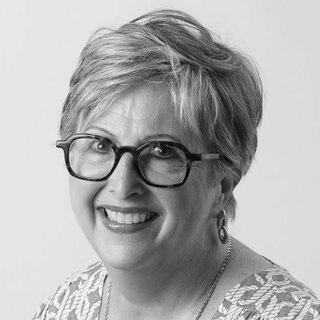
Students start to straggle into the University of Missouri–St. Louis auditorium around 8:45 a.m. Ten minutes later, Dr. Berit Brogaard walks down the long aisle, black boots hitting each step with a confident thump. A solid black outfit—jacket, top, and pants—emphasizes the pale blonde hair she’s pulled back with a scrunchy. Unpainted, her high cheekbones and wide lips look chiseled from marble.
She climbs onstage and sits down, pulling her phone from a sleek gray messenger bag. Absorbed in her email, she chews gum absent-mindedly, lips slightly apart. When it’s time to teach, she rises, walks to the podium, gazes coolly out at her students, and asks, “Is sex ever really wrong?”
Brogaard guides the undergraduates into a nuanced discussion of what is exploitative, what qualifies as informed consent, and how various philosophical positions differ. She’s hardly the typical philosophy prof, though. She keeps one foot in the psychology department, is a member of the Center for Neurodynamics, and holds a medical degree in neuroscience. Her Brogaard Lab for Multisensory Research collaborates with researchers in London, Vancouver, Finland, and her native Denmark.
She’s studying synesthesia—a rare crisscrossing of sensory experience—and its links to both genius and autism. She’s tested a woman who sees people’s emotions as colors, a man who tastes sounds, another who smells rage and sees music in his head.
She describes these variations with such clinical distance, you’d never know she has a personal connection.
After class, Brogaard meets with Kristian Marlow, the grad student who manages her lab. Tests have to be scheduled for Derek Amato, a man who dove into the shallow end of a swimming pool and woke up days later with orchestrated music streaming through his head 24/7. And Brogaard is doing a presentation on blindsight at the University of Dublin and talks on perception in Munich and philosophy of language in St. Petersburg, Russia, and Oslo, Norway. Oh, and somebody’s coming to videotape an interview.
“What time will work, Brit?” he asks, using her American nickname.
“Super early is never great,” she reminds him. “I have to take Becky to school.”
They talk about the upcoming meeting of the American Philosophical Association’s Pacific Division, and whom they’ll hang out with. (The APA’s not so different from an Amway convention, when it comes to the power of networking.) “Alastair Norcross of the University of Colorado, he usually has a party,” Brogaard says.
“Or several,” drawls Marlow, still young enough to enjoy sounding worldly. His enthusiasm sneaks right back, though: “The Pacific conference is cool because you get to see what everybody’s currently interested in, and then you know what papers will be published a year from now. Sometimes two people will have a war with each other in the middle of a talk, and you’ll see a paper come out of that.”
“And co-authored papers start at the bar,” Brogaard adds dryly.
She’s written several hundred all by herself, and she just finished two books for the Oxford University Press: Transient Truths, dense with linguistic philosophy only her peers will understand, and The Illusion of True Love (working title), a romp through the biochemistry of romance that could change anybody’s life. This fall, she’s wrapping up a third, The Superhuman Mind: True Tales of Extraordinary Mental Ability, co-authored with Marlow.
She drives her research assistants as hard as she drives herself; Marlow says she didn’t even cut him slack when he broke his arm. Schedules synced, they talk about blindsight—the ability of someone with cortical blindness to discriminate between shapes and colors without realizing it. They’ve tested a man with deaf hearing, and they think it works the same way: Signals enter the brain, but they’re not fully processed, so the person doesn’t become conscious of them.
Marlow spins his laptop around to show her a brain scan for a man who couldn’t detect sounds, yet when they forced him to guess which of four sounds was being played, he got it right more than half the time—well over chance.
“This is parietal activity, right?” Marlow asks, pointing to a white blob. “Do you think if they adjust the regions of interest, we might get significant activity?”
“I’m thinking it’s probably just two different parts of the brain that are involved,” she says. “He probably hasn’t developed the part of the brain responsible for detection. So then it is analogous to blindsight: If some of the process isn’t taking place in the auditory cortex, the other areas of the brain can go in and help out. I think that’s the route we should pursue. So are you sending me another draft? Soon?”
“Yes.” He knows better than to hesitate. “As soon as possible.”
Thrumming with energy even as a child, Berit hated to go to sleep. Her mind still raced in the dark, and her toys morphed into monsters. One day, she heard somebody on the radio say that right before you die, you will see yourself. After that, she was terrified to fall asleep—what if she opened her eyes and saw herself?
As she lay there, blue eyes wide open and stinging, the landscape came: dark, murky blues and greens, with mountains that looked like they were made of crumpled paper—except they had peaks jagged enough to rip her skin. The hills and valleys rotated, moving at random, and then they started to spin, whirling faster and faster. She got clammy. Even a little bit faster, she thought, and I will die.
Berit dove under her comforter, clutching the pink-and-green striped cover her grandmother had sewn for her, and breathed the stale, trapped air as long as she could. Eventually the landscape faded, but it came back night after night as she lay there dreading it. In the morning, she’d try to tell her parents, and they’d nod with concerned interest. She could tell they didn’t quite believe her—or rather, they wrote it off as imagination.
She had a vivid imagination. At age 10, she wrote a novel about a woman on a train who picks up a large brown suitcase and later realizes it’s not her own. It’s full of money, not clothes. The woman keeps the money and winds up arrested for murder, because it was money paid to kill someone. At 13, Berit wrote a book about someone with locked-in syndrome—no connection with the outside world at all. She let her mother read the book, but no one else.
If she sounds like a dark child, she wasn’t. She danced and rode horseback and played in the forest and parks near their house, 6 miles outside Copenhagen, Denmark. Her mother designed dresses for Denmark’s Queen Ingrid, Queen Margrethe, and Princess Anne-Marie, now queen of Greece. Her father worked as a security guard. “He had an early interest in academics, but life took him in a different direction,” she says, and leaves it at that.
Berit was a perfectionist, but she burned off the anxiety by working harder. It worked—until she got scared. Then all control dissolved, and the murky landscape took over.
She didn’t tell her friends until high school, when she did a science project on what she had learned was called synesthesia. By then, they were mature enough to be curious, not mocking. Still, the picture that came into her head was hard to explain.
At 17, Berit published three collections of poetry, a young-adult novel, and a children’s book about Charles Darwin. “They were written in Danish, and only about 5 million people speak it,” she says. “I realized I’d have to do something else to make money.” She went to the University of Copenhagen to study biochemistry, language, and literature.
“She was a tall, blond, hippie kind of girl dressed in purple,” recalls her friend Christina Forsberg, emailing from Denmark. “She was so different from other girls—no bullshit, no intrigues or gossip, just sweet and straightforward and very funny. She wore small skirts, very heavy perfume—I think it was called Beverly Hills. I never reached her level—nobody did! But still, we made some assignments together, and had so much fun doing it! Before presenting our lecture, we went to the University Bar and drank a strong beer to calm the nerves 🙂 Even though she was way ahead of me, she never made me feel inferior.”
Brogaard went on to get a master’s in philosophy and linguistics. She really wanted to study the brain, but this was the 1990s: Brain imaging was still unsophisticated and exorbitantly expensive, and the equipment was reserved for medical doctors and established researchers.
Fine. She earned a five-year medical degree in neuroscience, doing clinical work at the Danish National Hospital. She left still unsatisfied: “The work that was common in Copenhagen was at the molecular level: neurotransmitters and how they bind. The theory behind that is fascinating, but the work is not, to me. I was interested in the bigger picture.”
She crossed the ocean to study cognitive linguistics at The State University of New York at Buffalo. She switched tracks and earned a Ph.D. in philosophy. And then, after a few years as assistant professor of philosophy at Southern Illinois University Edwardsville, then the University of Missouri–St. Louis, she flew to Australia to work as a research fellow at the Australian National University’s Centre for Consciousness.
Studying brain scans gave her the visual insight she’d been craving since childhood. “It’s as if you were a criminal profiler looking at faces,” she explains. She returned to UM–St. Louis in 2009 and began collaborating with researchers in neuropsychiatry, psychology, physics, and philosophy. Finally, she was closing in on what she wanted to know. Until then, she’d read about synesthesia as a hobby. Now she gathered research subjects from all over the world (she’s currently up to 2,000). As she pored over the data, two patterns stood out.
Many of those who’d acquired synesthesia later in life, after brain trauma of some kind, had also become savants, gifted with a single, extraordinary ability. And those who’d become savants had also acquired certain traits of autism: the focus on detail, the need for routine, the very particular subject matters.
If Brogaard could find a common denominator connecting all three conditions, she could deepen her understanding of synesthesia and perhaps home in on one of the causes of autism. She might even be able to show what she’d come to suspect: that there is potential for genius locked inside every human brain.
When Brogaard’s brother and sister-in-law visited her in Australia, they spent a day hiking in the rainforest in Queensland. Brogaard was heading down a narrow trail, her head shaken clear of work for once, her heart refreshed by the bright, wet greenery all around her. Without warning, the crumpled-paper mountains filled her field of vision, shifting and rotating, blinding her to everything else. She came to a dead stop.
The others caught up, and just as the dark blue-green world started to fade, she heard her sister-in-law yelp. Brogaard looked down and froze: A brown snake, one of the world’s most venomous, lay coiled along the path, less than a yard from Brogaard’s feet. Don’t run, she told herself. Don’t even move.
In time, the snake languorously unwound and slithered away. She’s still not sure exactly how her brain registered its presence. She likes to tell people her synesthesia saved her life.
Then, of course, she has to explain what synesthesia is.
Just as anesthesia means no sensation, synesthesia means joined sensations: A stimulus to one sense evokes a response from another, or an emotion triggers an involuntary sensation. Brogaard has “fear synesthesia”: Her brain reads the emotion of fear and produces a picture. Except for that day in the rainforest, she’s only ever seen the crumpled-paper mountains when she was already aware of intense fear. If her daughter were in danger, that could bring it on. Even the 1999 thriller In Dreams did (which was disconcerting; she hadn’t expected Annette Bening’s psychic visions to terrify her).
Other people have pain synesthesia; they might see certain colors when they feel pain. For linguistics professor Sean Day, it’s the sense of taste that crosses with vision: “Mango sherbet appears as a wall of lime green with thin wavy strips of cherry red,” he told a writer for the Monitor on Psychology. “Steamed gingered squid produces a large glob of bright orange foam, about 4 feet away, directly in front of me.”
Sometimes, synesthesia affects time perception: “The year has a shape like a tapeworm feeding on itself,” says one woman. “It’s transparent—it’s a calendar, with thin dividers for months, and each part of the year has its own tilt or curvature, and memories and upcoming events are embedded into the shape.” One of the individuals Brogaard studies can’t be in a crowd of people, because his visual field fills with colors, and he can’t see anything else. Another, Megan, listens to piano music and feels each note poke her face; violins vibrate in her chest; waves from a trumpet pass in front of her and sometimes buzz around her neck. For conductor Leonard Bernstein, musical timbre turned into color. Duke Ellington added texture: “If Harry Carney is playing,” he told biographer Don George, “D is dark blue burlap. If Johnny Hodges is playing, G becomes light blue satin.”
Many synesthetes are artists, and there may well be a connection to creativity—or the passionate obsession that fuels it. Synesthesia gives a half-turn to nuts-and-bolts logic, loosening it for metaphor. Author Vladimir Nabokov, who saw letters as colors, wrote, “In the green group, there are alder-leaf f, the unripe apple of p, and pistachio t. Dull green, combined somehow with violet, is the best I can do for w.” In his equations, Nobel Prize–winning physicist Richard Feynman saw “light-tan j’s, slightly violet-bluish n’s, and dark brown x’s flying around.”
That’s grapheme-color synesthesia. But there are many, many other variations.
Last year, Brogaard met Naama Kostiner, an Austrian psychotherapist, now living in Israel, who sees letters and numbers in color. She also, she announced playfully, sees people’s auras. Her face, doll-like under straight, dark bangs, grew serious, and she proceeded to describe the emotional state of every person on Brogaard’s team with startling accuracy. A few days later, she repeated the feat.
Brogaard started to wonder if Kostiner had what Emilio Gomez Milan, an experimental psychologist at the University of Granada, calls “emotional synesthesia.” His team has interviewed supposed healers and psychics, and identified many as having face-color synesthesia—they saw particular colors in response to faces—and mirror-touch synesthesia, in which they empathized with a person’s pain so intensely, they literally experienced it. This sensitivity can also make them adept at reading and feeling other people’s emotions.
“Your auras are probably real projections of your brain onto people you see,” Brogaard told Kostiner. “Most likely, they’re reliable indicators of features in people’s behavior or fleeting facial expressions that you’re picking up on unconsciously.” Brogaard held her breath, waiting for the younger woman to resist any suggestion that she wasn’t psychic. Instead, she seemed relieved.
Nabokov’s mother and son were both synesthetes, as are Brogaard’s father and daughter. There’s clearly a genetic influence. But some kinds of synesthesia seem to be formed in childhood, and Brogaard thinks memory might be involved.
“We now know memory’s not stored in fixed areas, but distributed all over the brain,” she says. “It could be that a child forms memory associations with colors as she learns the alphabet, and from then on, whenever she thinks of a particular letter, she reactivates the same sensory areas.”
A recent study gave her fresh evidence: Researchers compared 11 synesthetes’ letter-color associations to the colors of the Fisher-Price refrigerator magnets, and the smallest number of matches was 14 letters.
“This is an amazing result,” she exults. “The chance that 11 synesthetes would choose the same color for 14 letters of the alphabet is less than 1 in a billion!”
She’s not proposing a memory model for all synesthesia, though; she’s skeptical of any notion that a single cause will be discovered. Sometimes adjacent areas of the brain might get their signals crossed; sometimes the brain might reorganize itself early in life or its feedback loops might change, binding information from different sensory streams together.
And anybody can have synesthesia temporarily, if they take psilocybin (a.k.a. magic mushrooms or shrooms). Brogaard hopes to collaborate with neuroscientist Katherine MacLean of Johns Hopkins University School of Medicine; she wants to find out whether the synesthesia induced by shrooms, because of their effect on brain chemistry, ever becomes permanent.
She’s even more interested, though, in the cases in which synesthesia (“syn,” as she shortens it) is acquired in adulthood, after a stroke, mental illness, or brain injury.
After he was brutally assaulted, Jason Padgett—a furniture salesman who’d never been to college—began drawing mathematical fractals. Freehand. When Brogaard’s team tested him, they found out these drawings weren’t coming from the visual area of the brain at all, but from an area responsible for mathematical calculation.
In 2006, Derek Amato smashed the side of his head into the bottom of a swimming pool, and when he recovered, he saw black-and-white blocks scrolling across his mind, calling him to play them on a piano. He could hear the blocks; he could feel their music in his restless fingers. He sat down at a friend’s piano and played not his usual “Chopsticks,” but a fully orchestrated original composition. He took his mother into a music store, asked to borrow their piano, and did it again. She sat there listening to him play, tears streaming down her face.
He was diagnosed, if that’s the right word for it, with acquired musical savant syndrome and synesthesia. He says his brain hasn’t stopped racing since. “The energy’s intense. I see music now as the flow of my blood. I breathe it; I taste it. One doctor told me it’s like, if Beethoven was scoring 500 pieces a year, my brain is working at a pace that would create 2,500.” His hands can’t capture the full score: “I’m by no means a genius piano player. A girl I was dating brought me Music for Dummies, and I couldn’t even get through the first three pages.”
Brogaard wants to scan his brain while he hears music, to see how it’s being processed. She also wants a blood-serum analysis to see whether he has excess serotonin, because she’s thinking that’s the trigger for the music—and for the autistic traits that came along with it. He wears a stocking cap to blunt loud noises, and the flicker of fluorescent lights makes him sick.
“They think I crossed some wires and I’m overstimulating,” he says. “They wanted to slow that down with antiseizure meds. No! Why would I want to do that? Why would I cloud something so friggin’ beautiful?”
Lidell Simpson went to the 2012 Toward a Science of Consciousness conference hoping, but not expecting, to meet the Danish philosopher. Brogaard arrived late, and that evening, her grad students gathered in one of the hotel rooms. She invited Simpson to join them. When he met her, he heard dripping water. For Marlow, he heard drums; for Dr. Deepak Chopra, the sound of kernels popping.
Simpson has polymodal synesthesia: Everything that he hears, sees, touches, or smells “pings” in his brain as particular sound. This is all the more striking because he was born profoundly deaf. He’d been labeled retarded until a specialist realized he had a rare form of deafness—his ears were fine, anatomically, but there was nerve damage in the part of his brain responsible for hearing. Once he was fitted with electronic hearing aids, he soon learned to speak.
By then, his mind had already made itself a rich soundtrack—a sort of techno, outer-space music punctured by sound effects he associates with certain faces or experiences. Motion shows up as sound, too: He has his own private Doppler effect, with pitch increasing as an object comes closer. Even tastes come to him as sounds: He was once served a heavenly lamb shank, but “the restaurant quickly filled up with people, and the noise of the chitter-chatter was so great, I could no longer hear the taste.”
David Eagleman, a neuroscientist at Baylor College of Medicine and a Guggenheim Fellow, co-authored a paper on Simpson with Brogaard. They met at a conference on time perception and began talking about synesthesia—he’s written a book on it, and it’s one of his lab’s main research areas. When I asked whether she went into detail about her own experiences, he was startled to learn she has synesthesia herself.
What struck Eagleman about Brogaard was “how smart she was and how self-possessed.” She’s working in the new overlap between philosophy and neuroscience—territory that until very recently, neither philosophers nor neuroscientists were willing to enter. “There’s a lot of excitement at that intersection,” he says, “but it requires a certain bravery to be there, because you might fail.
“She’s not the first to do this,” he adds. “There have been people like David Chalmers. But she’s at the vanguard of a lot of what’s happening in philosophy now, what has to happen.”
Chalmers, though Eagleman doesn’t realize it, is one of Brogaard’s mentors; he directs the Centre for Consciousness at the Australian National University, where she did her postdoctoral research. “She is a master of bringing together ideas from different areas in surprising and powerful ways,” Chalmers tells me. Professor Barry Smith, who supervised her doctoral work in New York, calls her “the scientific equivalent of a charging lion—someone who takes new ideas and runs with them.”
I’m eager to meet Brogaard’s 9-year-old daughter. I dug up a YouTube video of her playing drums with a rock ’n’ roll band, her face serious, her timing perfect. “She’s like a little Brit,” Marlow tells me. “Precise in each neuron except the one that’s growing her [brown] hair.”
Marlow sometimes babysits Becky while Brogaard attends conferences. “It’s like a Brit that’s supposed to listen to you,” he remarks, “but still doesn’t.” Once, Becky demanded pad Thai. A more than competent cook, Marlow set to work. He set it before her 90 minutes later—and she asked him to rinse off “all the stuff on top,” because she’d only wanted the noodles.
We meet at Qdoba Mexican Grill—Becky likes it. Her tiny palm is damp when we shake hands. “What’s your mom like?” I ask, hoping to put her at ease.
“Nice. She doesn’t have that many rules. And she’s tall.”
“How are you two alike?”
“We both like cats.” Becky pauses and tilts her head. “Now that I think about it, we don’t have that much alike. I love hearing a fake fart or a computerized burp, and she hates it.”
Becky might be nervous about this interview, but she’s not shy. It dawns on me that I’ve always confused the two things.
I ask her to name one of her mom’s rules. “Don’t eat that many unhealthy things,” she parrots, and darts a sidelong look at her mom. “She keeps telling me she’s vegetarian, but almost every day I see her eat meat!”
Brogaard opens her mouth to protest. I quickly ask Becky if she’s ever been to Copenhagen. She nods and says she slept in her mom’s old bedroom. The city, she says, “smells like a doctor, really clean.” Her senses are sharp—and yes, she sees numbers, letters, even days of the week in color. “It’s Friday, right?” she says. “Red. And the number one is red, and it can also be blue. B is blue, C is light blue, X is turquoise blue. Saturday is pretty much my favorite day, and it’s in between purple and blue.”
Brogaard realized Becky had synesthesia when she was 2. On a long drive, they were practicing numbers by counting bridges. As they passed under the third bridge, Brogaard asked casually, “What color is 3?”
“It’s green,” Becky said.
Later, Brogaard gave her the standard synesthesia test. She has grapheme-color synesthesia, just like her grandfather. Neither will ever feel the terror of Brogaard’s surrealist landscape.
I ask Becky if she knows what kind of stuff her mom studies. “Not really. Sometimes she’s trying to make books.”
“You read my articles once in a while,” Brogaard reminds her.
“That only happened once. It was boring and long. Even though it was about cats.” She chatters about Teddy and Fluffy, which puzzles me, because one of Brogaard’s colleagues told me she always names her cats after philosophers. It turns out “Teddy” was the Humane Society’s name for the cat known as Roderick Chisholm, and “Fluffy” is named Bertrand Russell—who, in this incarnation, is indeed fluffy.
Brogaard’s still stuck on the meat-eating: “It’s definitely not every day.” Becky grins and scampers off to refill her water. “If she gets a 90 percent on a test, which is still an A, she’s upset,” Brogaard says. “It’s definitely not me, because I’m opposed to giving standards. She’s just naturally a perfectionist. And she doesn’t quit. If she starts something, she wants to finish it.”
Becky wriggles back onto her stool in time to hear that last sentence. “Sometimes I have anxiety if I don’t finish something,” she offers.
Her mother finishes everything, often working late into the night, sleeping maybe five hours. She participated in a sleep study at UM–St. Louis as a favor to a colleague, and the report said she didn’t enter as deep a sleep state as most people. She shrugged it off; neither do dolphins.
Becoming a single mother at 33 wasn’t a deliberate or feminist choice, Brogaard says, “just circumstance.” She never had that reflexive cooing, gushy baby-craving that other women profess; she loves her daughter fiercely, but it’s a thoughtful love, one that deepens as Becky becomes her own person. She says it wouldn’t make sense for me to interview Becky’s father, because his relationship is now with their daughter, not with her.
She laughs freely about her earliest experiences of dating in the U.S. “It was like the ’50s! People were inviting me on really old-fashioned dates, picking me up, taking me to ‘dinner and a show.’ It was different from getting to know people in ordinary ways. It made everything feel unnatural.” After a while, she started saying no; it all felt so contrived, everybody trying too hard. “There are cases of marriages where they haven’t ever looked as good as they did on their first date!”
In a wonderful bit of irony, she has since become something of an authority on romantic love—at least its effects on the brain. She knew all about fears and longings that sneak up on you, however hard you try to rationalize them away. So she set out to understand emotion’s role in the brain, and once she made some headway, she thought it’d be interesting to try to convey neuroscience’s insights in everyday language. She and relationship coach Catherine Behan co-authored a book called The Breakup Cleanse (“Chemistry got you into this mess. Use chemistry to get you out!”) and started a website, Lovesick Love.
“Ask Dr. Brit,” it urges. And oh, people do. “Tim,” for example, begs her to help him stop thinking about his ex-girlfriend.
“We see it all the time: It’s easy to get attracted to someone who is unavailable or unstable or unpredictable or a bad choice because the constant uncertainty fuels one’s feelings of attraction,” Brogaard replies. The roller coaster of uncertainty destabilizes the brain’s dopamine levels, so “we go from feeling ecstatic to feeling empty and unable to move.” Meanwhile, a drop in serotonin leaves us anxious and obsessive. Our brain interprets these chemical changes as “being in love.”
“What can you do to get over your ex?” she continues. “Definitely stay away from her. The more exposure to her you get, the longer you will be addicted to her personality and behavior.” She suggests that Tim start going out more often with friends and family and “look for ways to meet new people. Read some books and watch some movies (thrillers or action, no love stories).
“It can also in some cases be helpful to simply refuse to think about one’s ex,” Brogaard tells Tim. “There is an old study showing that you think more about things you are not allowed to think about. But things tend to go a bit differently if you are strong-willed and take control of your own mind.”
In her book on love, Brogaard takes a more serious look at, as the website puts it, “how brain chemistry intoxicates, hijacks your mind, and sabotages your love life.” More than anything, she wants people to realize “that love, both in its beginning stages and after being heartbroken, has a biochemical profile that’s similar to what underlies anxiety disorders. It’s very natural that the irregularity will subside over time. In some cases, people feel the love is gone, when in fact it’s the disorder that is gone.”
The possibility of emotional mastery runs through the manuscript. Both love and hatred can exist below consciousness, she notes, but “there are ways we can control our unconscious life, proven techniques that can enhance or weaken the unconscious nerve signals in our brains.” Along the way, she weaves in all sorts of interesting facts. Why did girls’ aunts used to whisk them off to Europe when they were pining for an unsuitable suitor? A change of scene breaks the conditioning. Your brain stops expecting certain rushes of chemicals because their environmental triggers are no longer present.
Research shows a rationale for washing your hands, à la Lady Macbeth, or showering to “wash that man right out of your hair.” Physical cleansing literally rinses away negativity, doubt, guilt, and regret.
The same neurons fire in physical pain and emotional pain.
Hate really isn’t the opposite of love; there’s more rationality in pure hate, less inhibition of the frontal cortex.
About 85 percent of people who die of a snakebite don’t have enough venom in their bloodstream to kill them. They’re dying—as Brogaard once dreaded she would—of fear.
It is also perfectly possible to die of a broken heart: Researchers at Johns Hopkins University found that a weakening of the heart muscle after an unexpected breakup or death of a loved one—“stress cardiomyopathy”—can temporarily stun the heart and bring on chest pain, fluid in the lungs, shortness of breath, and heart failure.
I can’t help wondering whether Brogaard’s heart was ever broken badly enough to inspire this study. That evening, when I’m home typing up notes, another question occurs to me. Doesn’t analyzing brain chemistry take all of the fun out of falling in love?
“I don’t think it takes the fun away, as the feelings are the same,” she emails back. “But it makes a huge difference when it comes to dealing with love that cannot—or should not—be sustained. Continuing being ‘in love’ in those circumstances can be extremely bothersome, if not painful. Knowing the biochemistry can help you fall out of love, when it’s best for everyone to do so.”
Amy Broadway had a job as secretary of the SIUE philosophy department, “sharpening pencils,” when she met Brogaard. “I was a little intimidated by her,” says Broadway, who’s now finishing her master’s in philosophy at UM–St. Louis, thanks to Brogaard’s inspiration. “The more you get to know her, you realize she’s just able to learn things really quickly, and she remembers everything she learns.” Driven, uninhibited, and these days, relatively fearless, “she’s able to just do things.” She makes maximum use of technology, but she can ignore its pings long enough to concentrate. And because she lives and breathes her work, she sees connections everywhere.
For Brogaard, theory is real-world. Instead of shuttling back and forth between academe and pop culture, she finds overlaps that nobody noticed. She blogs for Psychology Today, writes articles for Livestrong.com, and fields questions from National Public Radio, Nightline, and the Mumbai Mirror. Yet, on the academic side? Pure rigor. When we first talk, she’s gearing up to defend Transient Truths at the next American Philosophical Association meeting. Three scholars—one of them the University of Oxford’s indomitable John Hawthorne—will conduct the ritual evisceration. Yet she can’t even bring herself to page through her new book to prepare, because she’s afraid she’ll see a typo.
Socially, there’s a slight reserve about Brogaard; she’s like somebody born into royalty, moving a little stiffly through a rowdy street party. That watchfulness, that lack of fluency, signal a brain so loath to shut down, instinct and impulse haven’t got much chance.
“People in the Midwest might perceive her as colder than she is,” says Broadway, “because she’s this tall, Nordic beauty. But she’s really quite a warm person. You don’t realize you’re on her radar, but she’s paying more attention than you realize. Last semester, I had this horrible breakup, and she was great at talking things out.”
Brogaard’s brother and best friend both mention how much she trusts other people—which seems an unusual trait to shortlist.
“Trusting people can make you vulnerable,” she admits. “But you can make up for that by being good at reading people. I’m not naturally good at reading people, but it’s something you can learn.” She loves Jeffery Deaver’s Kathryn Dance suspense novels, because Dance specializes in kinesics, reading people’s body language. “I think I master kinesics fairly well.”
A video team shows up to film Brogaard and Marlow for Askimo, an international library of expert interviews. The production’s low-budget and awkward, with no change in camera angle, so you can watch Brogaard’s face while Marlow answers. She looks stoic—either bored or endlessly patient—and every once in a while amused, like a politician’s wife who hasn’t learned to freeze her expression. When her turn comes, she answers matter-of-factly, without summoning smiles or animation for the camera.
She meets the world as-is. Disciplined and calm, she rarely gets ruffled. She can’t imagine being angry with her daughter, and friends say she hates to quarrel with anyone. “She tries to calm down people, or just avoids them,” Forsberg writes. “I have never heard her fighting with somebody. Actually, I think she’s incapable of it.”
Yet she parried every attack in her Transient Truths critique session. How did she learn to argue her points? “The hard way,” she says with a slight smile, “by realizing my grade actually might depend on it.” Philosophy, she adds pointedly, is still a male-dominated field.
She’s winning a place, though: She’s the first woman president of the Central States Philosophical Association. I ask whether she’s come to enjoy the verbal combat.
“To be honest,” she says, “I actually enjoy the few talks at conferences where there are mostly women.” Last year, she presented a paper on jealousy at the American Philosophical Association meeting—as both a contribution to feminist philosophy and a reprieve from the gladiatorial arena. “The discussion afterward, I thought, was a lot more pleasant and fruitful.”
At lunch, Brogaard forages at the salad bar, eating “as close to raw as possible”—then pops a Diet Coke. We talk about what she does for fun—taking Becky swimming at the Center of Clayton, or to the theater or the ballet; reading. She says she loves the existentialists and William Faulkner’s Light in August, but adds, “I usually don’t read my favorite authors. I read thrillers.”
When I quote a study that says Danes are the world’s happiest people, she nods. “It’s true when they live in Denmark. Everyone has a lot of money there, even if you work in a supermarket. Low-paying jobs pay really well. People do become happy—in the sense that will show on a questionnaire—if they are materially wealthy.” Yet doesn’t she want to go home? “No. I’d never move back. I wouldn’t have the same possibilities of doing research there.”
She’s writing a book with Simpson now, Sounds of Silence, and soon she’ll fly to Texas to do scans of Amato’s brain. She’d eventually love to get a serum analysis of his serotonin levels, too. She works nonstop. Broadway remembers her chatting at a party, casually slipping away with her laptop to do an in-depth interview with a synesthete, then returning to the lively party chatter without missing a beat.
“I have a little excess energy all the time,” Brogaard says, “and I don’t want to downregulate that, because it’s a little fun.”
Exhausted by her productivity, I ask, half teasing, “So what’s the meaning of life?”
“I have a very atypical view of that,” she answers instantly. “I actually think the meaning starts with the suppression of the fact that we have to die. The existentialists said suppressing that was bad. I think it’s a good thing. It’s what very young people do naturally. It’s only when people get older that they start to worry or fear death or get depressed.”
Unless, of course, a child is scared to go to sleep, because she might wake up and see herself and die…
But Brogaard’s outgrown her childhood’s triple fear. She sleeps without hesitation—just not that much. She’s turned her strange synesthesia into research that could solve its own mystery and several others. And rather than dwell on limits, losses, and her eventual death, she burns that energy thinking. She focuses on the scariest and most bizarre aspects of the brain, the slipperiness of reality, the impossibility of absolutes.
Part of her secret is seeing things fresh, without the inhibitions of convention. This makes her funny—sometimes unintentionally, Broadway’s convinced—and original. She describes stress hormones as “the little bastards that make your heart break dance.” She gives, as an example of emotion in language, “Gertrud is happy that Daddy is home from the nuthouse.” When she needs an example of emotions representing a slice of reality that’s outside of us, she chooses “douchebags,” noting that the word “represents, or is directed at, douchebags, people who have surpassed the levels of jerk and asshole but have not yet reached the level of tyrant or inquisitor.”
Her point? Ordinary language shows us that our emotions represent parts of the external world. And that just might explain why emotions last longer than other bodily sensations. The pain of childbirth gets forgotten; the rush of feeling when we first hold our baby in our arms does not.
Love, she believes, is an emotion that exists in degrees, not absolutes. That last daisy petal doesn’t decide the question, in other words. Someone who seems not to love us might be earnest but love-shy; someone who seems to love us might merely be temporarily intoxicated by his own neurotransmitters.
Consciousness, she points out, also exists in degrees. According to her Wikipedia page, she was the first philosopher in the world to note that the adjective “conscious” does not indicate an either/or, but can slide all the way to the palest, fuzziest gray borderline.
Autism exists in degrees, too, along a wide spectrum. People with autism are hypersensitive to stimuli—something as common as loud noise or bright light can cause extreme anxiety. The intense-world theory blames a hyperreactive nervous system. The brain’s unusually able to focus down on details—sometimes to the point of obsession—but easily overloaded by stimuli.
People with severe autism have long been branded as isolated and incapable of communication—but what if their “withdrawal” is just a coping mechanism, an attempt to shut out the painful stimulus? What if it’s simply perceptual overload, and not a lack of empathy, that makes it so hard for people with autism to read others’ emotions and understand subtle social cues?
Brogaard suspects that an excess of serotonin is the mysterious common denominator in certain kinds of autism, in synesthesia, and in savant syndrome. Even the temporary synesthesia caused by shrooms has been linked to the surges of serotonin it sends through the brain. And with savants, she says, “the hypothesis we’re working on is that when trauma kills brain cells, that causes serotonin to flood into the area, and it unlocks part of the brain that wasn’t active before.”
So we’ve all got bits of genius locked inside our heads, and all we need to do is find out how to access them? “Except that we couldn’t stand it,” Brogaard predicts. “They sit and study prime numbers for eight hours a day. Derek can’t go more than a few hours without playing music.”
Still, she’d like to know if there’s genius in all of us. And she’d especially like to know whether the intense-world theory of autism is correct.
“I would like to discover and validate the theory of it,” she says. “But as we go on, there will be other, bigger things.”