When you have to get from Point A to Point B in the sprawling St. Louis metro, and you don’t have a car, sometimes the only easy solution is a taxi or a rideshare service. Both buses and MetroLink only run limited hours and can sometimes mean complicated journeys with long waits between trip segments.
But taxis and Ubers aren’t cheap. And for a growing swath of the St. Louis suburbs, the Via Metro “microtransit” service is now an on-demand alternative. While many public transit advocates aren’t fans, and some local politicians are skeptical, experts say the service can be a helpful feeder into the transit system when done right. Expanding the service could keep more money in the pockets of working people without the cost of MetroLink or bus rapid transit.
Get a fresh take on the day’s top news
Subscribe to the St. Louis Daily newsletter for a smart, succinct guide to local news from award-winning journalists Sarah Fenske and Ryan Krull.
See also: I drive for Uber and Lyft—and I’m doing the job buses used to
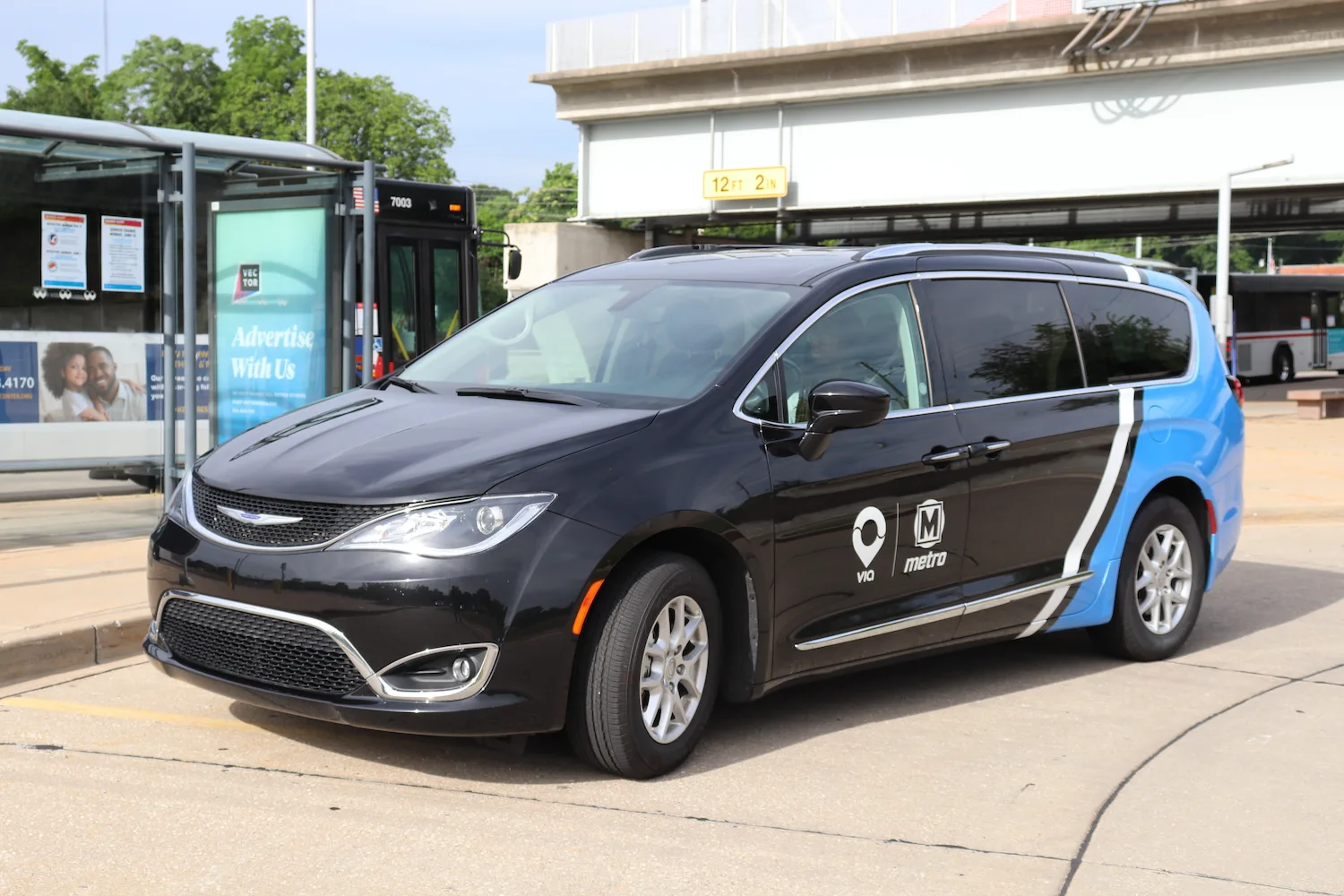
The region’s current microtransit program is a partnership between regional transit authority Bi-State Development and the for-profit transportation services firm Via. Its app allows riders to hail a low-cost rideshare-style vehicle from within three discrete pockets of the region, with a maximum distance of seven miles.
Riders hop in a minivan and for $2 can share rides with others in small footprints within three areas—North County, West County, and South County—that aren’t covered well by bus or MetroLink. The North County zone covers parts of Florissant, Bellefontaine Neighbors, Hazelwood, Old Jamestown, Black Jack and other small cities in that part of North County. The West County zone stretches along I-64 from the eastern edge of Chesterfield towards Town and Country, with the Metro’s Ballas Transit Center sitting on its eastern boundary.
The most vast zone is the southern one, making a V shape that covers parts of Fenton, Valley Park, Shrewsbury, Marlborough, Affton, and Lakeshire.
“In the case in which Metro has utilized microtransit, it came on the heels of the service being reduced,” Bi-State’s general manager of paratransit Lewis Lowry acknowledges. “There are changes that were taking place, but yet there was still a demand for service, and so the compromise was to at least put some service out there that provides transportation for individuals within those defined zones. So, they can travel in those zones, but they also have the ability to connect to bus lines, if they decide that they want to travel beyond the zone.”
Since Via and Bi-State first partnered on microtransit in June of 2020, the user base has grown dramatically. In its first year, Via hosted an average of 2,000 rides a month. Now, its 50 vehicles handle an average of more than 25,000 rides a month.
Lowry acknowledges the sometimes labyrinthine set of transfers that riders must take to get from Point A to Point B, but likens the process to a connecting flight, saying mass transit requires compromise.
“You know, back in the day, you probably had more direct flights, but that’s no longer the case in the world that we live in,” Lowry says. “For public transportation, it’s always been that way. You have multiple bus lines where a person has to navigate and connect.”
St. Louis first partnered with Via amid a wave of pandemic-era pilot programs across the U.S. that were designed to compete with options like Uber and Lyft. So widespread was experimentation that transit advocacy organization TransitCenter noted in 2020, “You can’t throw a dart at a map of the U.S. without hitting a ‘microtransit’ pilot.”
The number of cities adopting microtransit options has only continued to grow, according to research published in Cities. Some places are all in: Gwinnett County, Georgia, has gone from offering several microtransit zones to expanding to the point that, according to a recent report from the Baltimore Metropolitan Council, it should cover the entire county by 2033.
Not everyone is pleased. St. Louis County councilwoman Shalonda Webb, whose district is the northernmost part of the county, says Via’s presence represents a bait and switch. As she tells it, the pandemic led to Bi-State cutting three bus lines in her district, replacing them with a pilot program for Via that was supposed to be temporary.
Webb sees the growth in Via ridership less as a sign of its strength, and more a reflection of a lack of other options.
“That’s comparing apples and oranges,” she says. “‘I don’t have a bus service. I don’t have another option, I have to get to my job. I have to get to the doctor. I can’t get that real bus, I can’t afford an Uber so, of course, I’m gonna pick up the phone.’ It’s like saying, ‘Oh, well, everybody likes mustard.’ Well, if there is no mayo, you’re going to eat what you have.”
Webb says the county continues to pay Bi-State as much as ever and wants to see the agency work to restore bus service.
Bi-State confirms it made drastic cuts in North County, but says much of that service has since been restored. “North St. Louis County service was restored sooner and more completely than other parts of St. Louis County, although it does not look exactly the same as before the pandemic,” says Bi-State spokesman Jerry Vallely. “For instance, some MetroBus routes are operating on different streets and areas than before COVID-19 due to changes in demand and travel patterns.”
Asked further about the changes to North County, Vallely identifies the north and south zones of Via service as “more difficult to serve with a bus,” and says Via was piloted there to “test this new mode of microtransit and learn how it could complement Metro’s fixed-route service.”
Many transit advocates also criticize microtransit as a concept, saying that it comes at the expense of better funded “fixed-route” services, like bus lines and trains. (Currently, Via is only a fraction of Bi-State’s $340 million operating budget for fiscal year 2026, at $6.3 million annually.) Even those critics, however, acknowledge that there are niche use cases where microtransit makes sense. Transit consultant Andrew Miller says services like Via should be thought of as a way to get people from a relatively transit-lite area, such as the suburbs, to a bus or train route.
“That’s where micro transit works best,” Miller says. “Not running a fixed (route) to a small area, but having a shuttle travel through these non-transit-optimized suburbs. They’re cul de sacs and they’re dead ends, but have them all feed into higher order transit.”
Why It Matters: The cost of transportation weighs especially heavily on the poorest Americans. Inequality.org noted in 2022 that decades of investment in roadways at the expense of public transit has ensured that poorer people will spend far more of their incomes on transit than others. “A transportation system where people have to rely on their own vehicles doesn’t merely exclude those who don’t own vehicles—it imposes a severe financial burden on poorer households that do own vehicles,” the authors wrote.
U.S. Bureau of Labor Statistics data shows that the poorest 10 percent of Americans spend more than 20 percent of their income on vehicles. That presents a major challenge to upward economic mobility: Whether you’re spending a high percentage of your income on Uber rides or to maintain a car, that’s money you can’t use to pay down debt, earn a degree, or start a business.
The growing adoption of Via in the region’s most car-dependent zones suggests that the region could grow its transit service to better support residents who don’t live near transit lines—and do it much more affordably than light rail expansion or bus rapid transit.
What’s Next: Lowry says that Bi-State is open to expanding the Via service, but would need to hear more from riders, or potential riders, who are currently choosing other options.
“You can pretty much design anything, if you want, but it certainly takes … riders to say, ‘I want more direct service, or I’m willing to pay $30 a trip to do that,’” Lowry says. “We have to be wise in terms of how we do things, and we have to ensure that we provide at least the best level of service that we can give to our customers. Is it always going to be great? Probably not, but we strive every day to do the best we can and meet the demands of our customers.”
Lowry adds, however, that Bi-State is looking to expand Via by allowing people to drive their personal vehicles for the ridesharing service, bringing the cheaper, publicly-subsidized alternative to Uber and Lyft even closer to those private sector competitors.