
There’s a square-ish census tract in west St. Louis County that, at ground level, feels typical. At both its northern edge (which is Highway 40) and its eastern edge (which is Route 141), it has office parks and apartment complexes. Its interior is pure upscale suburbia: brick houses, precise lawns, curvy roads with names like Summer Blossom Lane and Sugarwood Trail Drive. SUVs hulk in asphalt driveways. It’s calm, and it’s very white.
But this tract, which consists of a chunk of Chesterfield and a sliver of Town & Country, is unusual in this respect: It has served for decades as an engine of upward economic mobility for low-income Black St. Louisans. Such a dynamic is not evident to the casual observer. It took a group of economists now affiliated with the Harvard University–based nonprofit Opportunity Insights several years and reams of data to notice.
Stay informed on the area’s civic issues
Subscribe to the St. Louis Solutions newsletter to learn about public problems and possible fixes.
Those economists, among whom was Raj Chetty, the Harvard professor and MacArthur “Genius Grant” recipient, obtained from the U.S. Treasury a trove of data pulled from the tax returns of millions of Americans over decades. The returns were de-identified. This meant that no names or Social Security numbers were visible. But the economists could see how much people earned and, crucially, where they lived. Chetty and his colleagues focused on people born in the early 1980s. They looked at that cohort’s incomes, ranked them, then used the records to link that cohort back to their parents, looked at the parents’ incomes, and ranked those, too. They discovered a pattern: parents’ income rank was strongly predictive of their children’s income rank.
That ran counter to the narrative that the United States is a “land of opportunity”—that if you work hard, play by the rules, and do your best for your kids, they’ll grow up to be better off than you were. Such is the American Dream. And once upon a time, things did work that way: 90 percent of Americans born in 1945—the oldest baby boomers—grew up to outearn their parents, according to Opportunity Insights. But among Americans born in 1985, only half saw that kind of intergenerational success.
The researchers grew curious about that successful half. They noticed that the leaps forward were not evenly spread across the country. Rather, they seemed to vary by region—even by neighborhood.
The researchers created a national online map called the Opportunity Atlas, which allows you to filter for certain demographics. For example, you can filter the map so that it shows the spots in the St. Louis region where low-income Black kids who were born in the early ’80s grew up and ended up doing better than their parents. The filter tells the tale: This occurred in very few places. But one place it did was in that West County census tract. Such kids—who presumably spent most of their childhood in the apartment complexes on the edges of the tract and may have numbered only in the dozens or hundreds—grew up to earn, as thirtysomethings in 2015, $44,000 a year on average, a near two-thirds increase over their parents’ income in real terms. For that demographic, such earnings ranked in the 98th percentile nationally, and only a handful of tracts in St. Louis saw a better result. So in that context, it was impressive.
Why did it happen? The Opportunity Insights researchers concluded that all over the U.S., certain neighborhoods were directly lifting the lifetime earnings of the youth who grew up there. You could see this thanks to the many household moves by families with children of varying ages. If parents with, say, two daughters moved from a low-mobility neighborhood to a high-mobility one, the younger daughter was likely to earn more money as an adult. This suggested a dosage effect: The younger daughter spent more time in the high-mobility neighborhood, so she derived a greater benefit.
But that didn’t answer the question of exactly how the neighborhoods were lifting incomes. The researchers saw certain common denominators of the upwardly mobile areas—traits that may or may not have been causative but were at least correlative. One trait was relatively low poverty overall. Another was high-quality schools. A third was the prevalence of two-parent households. A fourth was a high degree of “social capital,” a term social scientists have long used to refer to the strength of a person’s relationships with friends, family, and the broader community.
And one component of social capital—cross-class interaction, or the day-to-day mixing of people with different incomes—has proved crucial to making these intergenerational leaps forward, Chetty noted during a presentation at WashU in October. “This turns out to be the single strongest predictor of economic mobility that has been identified to date,” Chetty said. “In places where low-income people interact more with high-income people, you have significantly higher rates of upward mobility.” And it’s “not merely correlational,” he added. “There’s a clear causal effect here.”
Quantifying such social mixing has been a tough task, but Chetty and his colleagues tried to do it with big data. They collaborated with scientists from the tech giant Meta and focused on an age cohort with a high Facebook usage rate—specifically, people who’d attended high school between roughly 1990 and 2015—to explore a key question: If you were a low-income kid at a given high school, how much of your social circle would typically be filled by high-income kids?
A few St. Louis–area high schools scored high on this metric. One of them was Parkway West, which scored in the 93rd percentile nationally. And Parkway West happens to sit within the West County census tract described above.
This is about as far as the Opportunity Insight research goes. It hasn’t fully clarified why cross-class interactions at Parkway West might boost the earnings of below-median-income students as they age.
But you can glimpse some clues from the trajectory of Nehemiah Colyer.
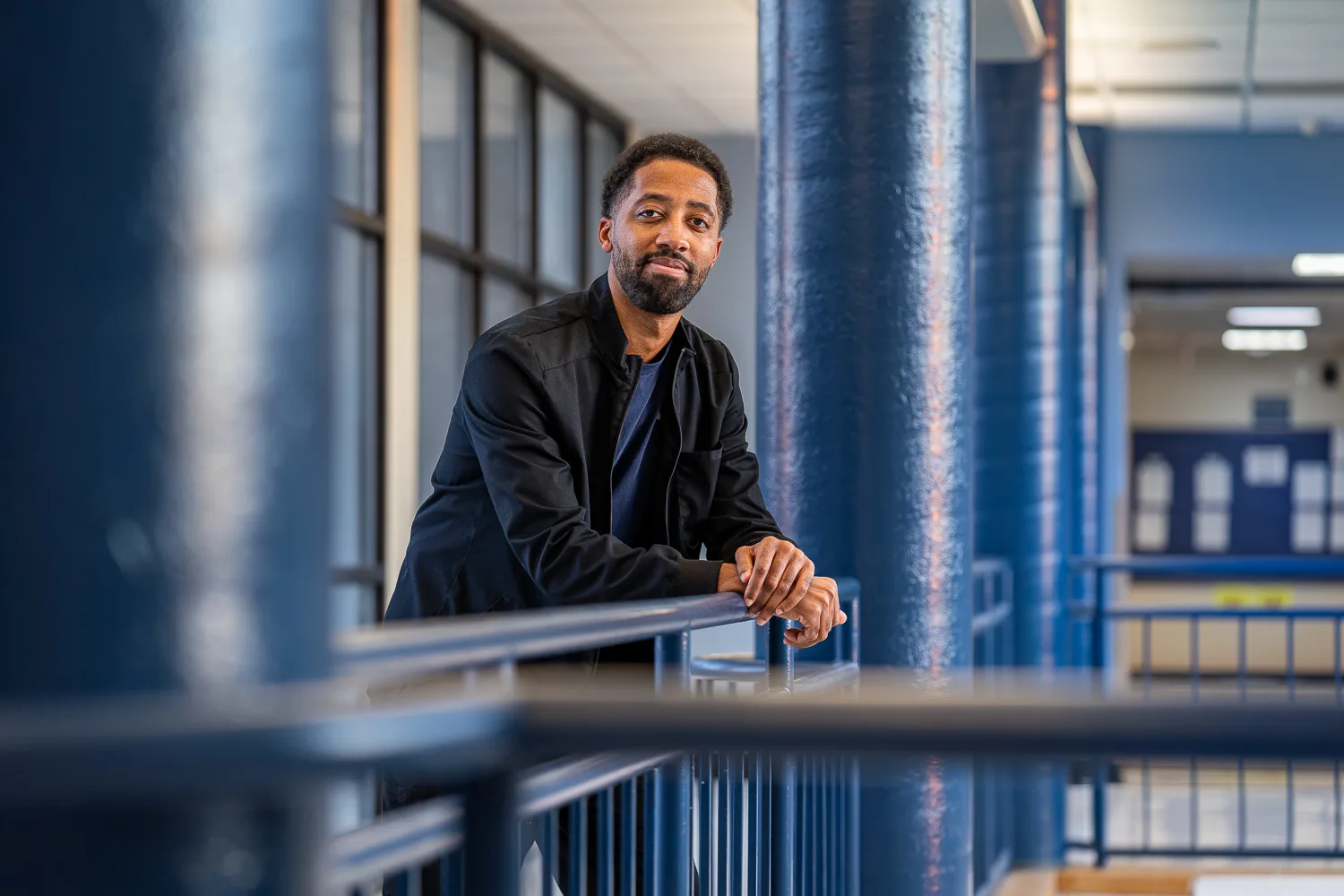
Nehemiah Colyer may not be the best example of how a kid from a lower-income milieu can get a lift from a higher-income one. In some ways, according to those who knew him, he elevated Parkway West, rather than the other way around.
Growing up in Bellefontaine Neighbors, he’d been a knowledge-thirsty kid who could easily chat with adults early on, recalls his dad, Robert. Neither Robert, who works in agricultural processing, nor Nehemiah’s mom, Latundra, a pharmacy technician, had gone to college. But they knew that Nehemiah aspired to. So they kept him and his twin brother, Joshua, busy: homework after school, sports (baseball, football, swimming, track), Sunday services at Radiant Life in Christ Apostolic Church. Their neighborhood was nice, Robert says, but did have “negative paths” for boys idly roaming the streets, so the family maintained a rule: “There was always a purpose to leaving the house.”
One day in June 2013, a friend called Robert and told him to turn on the news: The Missouri Supreme Court had just decided that students from unaccredited school districts could transfer to accredited ones. Nehemiah and his brother had always attended the Riverview Gardens School District, which in 2007 had lost its accreditation because of serious academic and budgetary problems. Robert felt the district had tried to do everything it could for his boys, but he feared its lack of accreditation would jeopardize their college prospects. The family applied for a transfer, and, by lottery, secured admission to Parkway West—then one of the highest-performing public districts in Missouri. Both sons enrolled there for the fall 2013 semester.
Nehemiah chose to play freshman football. He was quiet at first, recalls teammate Cole Buehler, who had grown up in the district with most of the other players. But Nehemiah soon emerged as a leader on the squad—one who easily made friends both in the locker room and in the hallways between classes. The following year, he began sleeping over at Buehler’s family’s house near Queeny Park on Wednesday nights to make it easier to get to 5 a.m. football practice on Thursdays. He would continue to do this into senior year, to the point that he felt like family. Nehemiah was already aspiring to become a physical therapist. He took honors biology and other classes that required more work than he’d been used to at Riverview. Buehler recalls how he’d post up at the kitchen island, tune out all extraneous stimuli, and lock into his books. “It pushed me to study for stuff,” Buehler says.
By his senior year, Nehemiah was a captain of the football team, a star hurdler, a six-foot-tall sweetheart with a big smile and an infectious positivity in attacking any challenge. He was nominated for the Founder’s Award—Parkway West’s highest honor, which is voted on by faculty and staff and given to the student who best exemplifies the school’s values. In a video of the nominations meeting, one guidance counselor described Nehemiah as a “tender warrior.” “I’ve observed things about Nehemiah that I’ve never seen in other students before,” she said. “He’s usually one of the last to leave the cafeteria, and he’s always patiently listening to someone telling him a story—and he’s friends with all types of kids. It’s not always the popular kids or the cool kids; it’s any kid. And it’s not just that he’s kind of listening to ’em. He’s really their friend.” He would instinctively pick up trash when no one was watching, the counselor said, and at one football game, when he came across a teacher he knew, he pulled off his helmet and kneeled down to introduce himself to the teacher’s 2-year-old son.
Nehemiah ended up winning the Founder’s Award. That spring, he received a track scholarship to attend Central Methodist University, in Fayette, Missouri. Over the next few years, he’d earn a physical therapy assistant degree.
But Parkway West’s social capital really kicked in for him at the next stage. In the COVID summer of 2020, before his senior year at CMU, Nehemiah knew that if he wanted to be a full-fledged physical therapist, he’d need to apply for graduate school—and he didn’t know how to go about it. No one in his family had taken that step. “I didn’t have a blueprint,” he says. For a time, he considered not applying.
So he turned, in large part, to his social circle from Parkway West—a community where going to grad school is commonplace.
He talked to Buehler, who cheered him on. “I don’t think he’s ever failed at something he put his mind to—that’s probably the gist of how I said it,” says Buehler, whose parents had both gone to grad school. Nehemiah also took to heart some advice that he’d heard from Buehler’s grandfather, Harry Cole, a neurosurgeon who’d studied at WashU Medicine. The boys had sometimes gone over to Dr. Cole’s house to swim during their high school years, and the surgeon had assured Nehemiah: Getting into a graduate program is the hard part. After that, all prospective employers care about is whether you finished the degree, not what your grades were. That, Nehemiah says, inspired him to power through the tedious application process.
Nehemiah also met up several times at Queeny Park with a group of other Parkway West classmates. In between games of sand volleyball or jaunts along the trails, they’d talk about their futures. Jamie Poppen, like Nehemiah, was considering applying to grad programs in physical therapy. Andrew Engelmeyer was trying to land a job in the management-consultant industry, and he and Nehemiah bonded over their challenges. “We had the same mentality of pushing ourselves and doing the hard thing,” Nehemiah remembers. “It gave me motivation because it was like, OK, I’m not the only guy putting in the work. It was great bouncing ideas off him. It kept me accountable.”
Nehemiah also consulted his former Parkway West hurdling coach, Kristen Witt. She recalls how, when she’d first met him years earlier, “He was the nicest, kindest, most polite teenager you ever met. There was something different about him.” She agreed to take a peek at his admissions essays and sent him edits in Google Docs.
Nehemiah wound up applying to three programs. In March 2021, he was accepted to WashU. He earned his doctorate there in physical therapy in May 2024. He posted a photo of himself in full academic regalia, grinning and surrounded by his brother and his parents, adding the note: “Dr. Nehemiah Colyer PT, DPT.”
Now he works at SSM Health’s DePaul Hospital in Bridgeton, doing shifts on the cardiac-telemetry floor and in the neuro step-down unit (a transition program for people exiting intensive care).
He’s certain that Parkway West’s relatively rigorous academics are part of the reason he made it to where he is today. More important, though, was his social circle there: “I felt like I had people in my corner the entire time I was out there.”
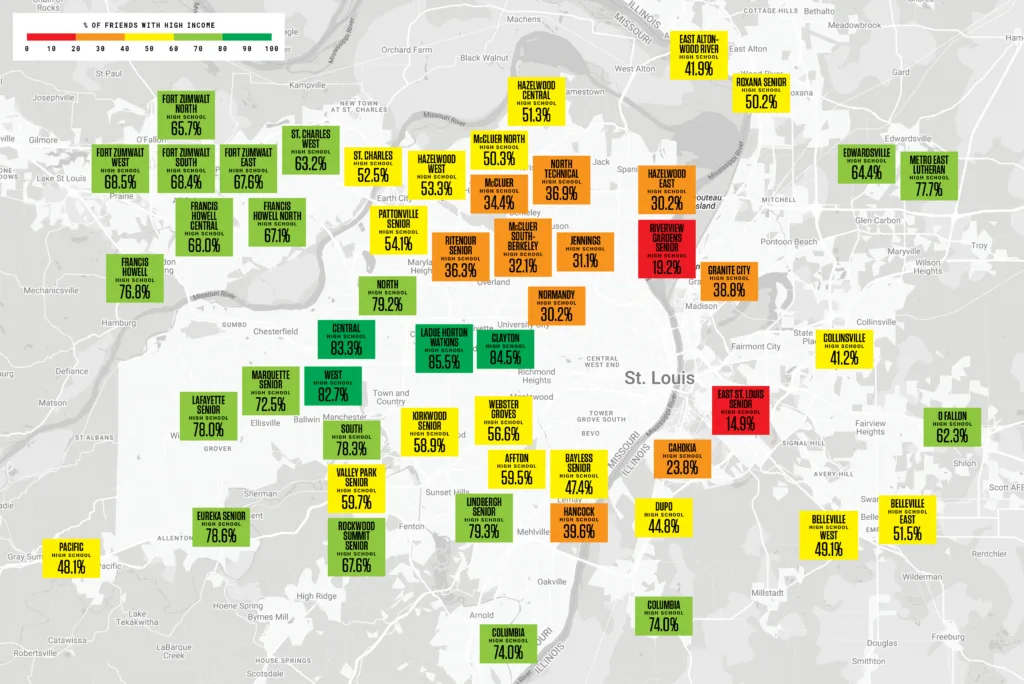
“Economic connectedness” is achieved when people who have money mix socially with those who don’t. Studies suggest such intermingling can provide a boost to low-wealth people over time. The Harvard University–based nonprofit Opportunity Insights used the Facebook data of 25–44-year-olds in 2022 to ask the question: At a given high school, what portion of the social circles of below-median-income students was taken up by above-median-income students? This infographic shows the results for select public high schools in the St. Louis region. Green denotes a school with a lot of economic connectedness; red denotes a school with little. Source: socialcapital.org
In some ways, Nehemiah Colyer’s success is unique. Yet if scientists can isolate its key factors, then in theory, that success could be replicated for kids of similar or even more challenging backgrounds—and the region has no shortage of those: According to recent census estimates, more than 80,000 minors in the St. Louis metro area live below the poverty line. (For scale, that figure would nearly fill two Busch Stadiums.) Posits Nehemiah: “There are a lot of bright minds out there that don’t have the opportunity that I had.”
Some interventions have already shown promise. One study by Chetty and others looked at the Moving to Opportunity experiment of the 1990s, when the federal government helped a subset of Section 8 housing-voucher recipients relocate to places that had lower poverty levels. At first, the policy seemed like a dud because the adults who moved didn’t seem to gain much. But decades later, Chetty and his colleagues took a fresh look by focusing on those adults’ children, who’d moved with their parents and grew up in these lower-poverty regions. And sure enough, compared to the children of similarly situated families who hadn’t moved, the children in the experiment earned higher incomes for every year they spent in the new locale.
But moving kids to new neighborhoods is not the only option. The Opportunity Insights researchers have also looked at place-based investments—specifically, the HOPE VI program, in which the federal government invested $17 billion to spruce up 262 public-housing sites. They found that children who grew up from birth in those revitalized sites saw 50 percent more in future earnings—but only if the site abutted flourishing neighborhoods. If the HOPE VI investment was surrounded by poverty, it triggered no earnings boost. The upshot: In the right circumstances, you can shrink poverty not by pushing people toward an upward ladder, but rather, by pulling the ladder toward them.
Pursuing any of this, of course, would require broad-based support. In today’s polarized political climate, that’s hard to fathom. But during Chetty’s visit to WashU in October, he told the crowd that it’s not as far-fetched as it may seem—particularly if you frame the possibilities as being about opportunity rather than disparity, however related those two things may be. “I show the same set of slides—the same presentation—to Republicans, to Democrats, folks in the White House,” he said. “You find pretty universal acceptance of the principle that everyone should have a chance of fulfilling their potential no matter their background, regardless of political affiliation.”
Maybe it’s no coincidence, then, that the voting precincts that roughly correspond to the West County census tract where Parkway West is located showed that in November 2024, the ballots for president were about evenly split between Donald Trump and Kamala Harris—and yet, despite that partisan divide, this is where Nehemiah Colyer found nothing but acceptance. Asked for his thoughts on that, he says: “It goes back to something my dad always says: ‘Good people love good people.’”
Editor’s Note: An earlier version of this story misstated the number of children in the St. Louis living below the poverty line. According to recent census estimates, more than 80,000 minors in the St. Louis metro area live below the poverty line, not 585,000, which is the total number of minors living in the area. We regret the error.

The Economic Mobility Lab at St. Louis Magazine was founded on the premise that many St. Louisans yearn for a better life—for themselves and their children. Jobs that pay more. Nicer places to live. Stronger schools. Better ways to get around. Secure retirements. And for the region to flourish, those yearnings must become realities for more people—especially for those who don’t have much. With generous support from the James S. McDonnell Foundation, our team of reporters will be exploring factors that lift locals up and ones that hold them back, with the hope of identifying solutions that create a region where everyone can thrive. Learn more about the Economic Mobility Lab.