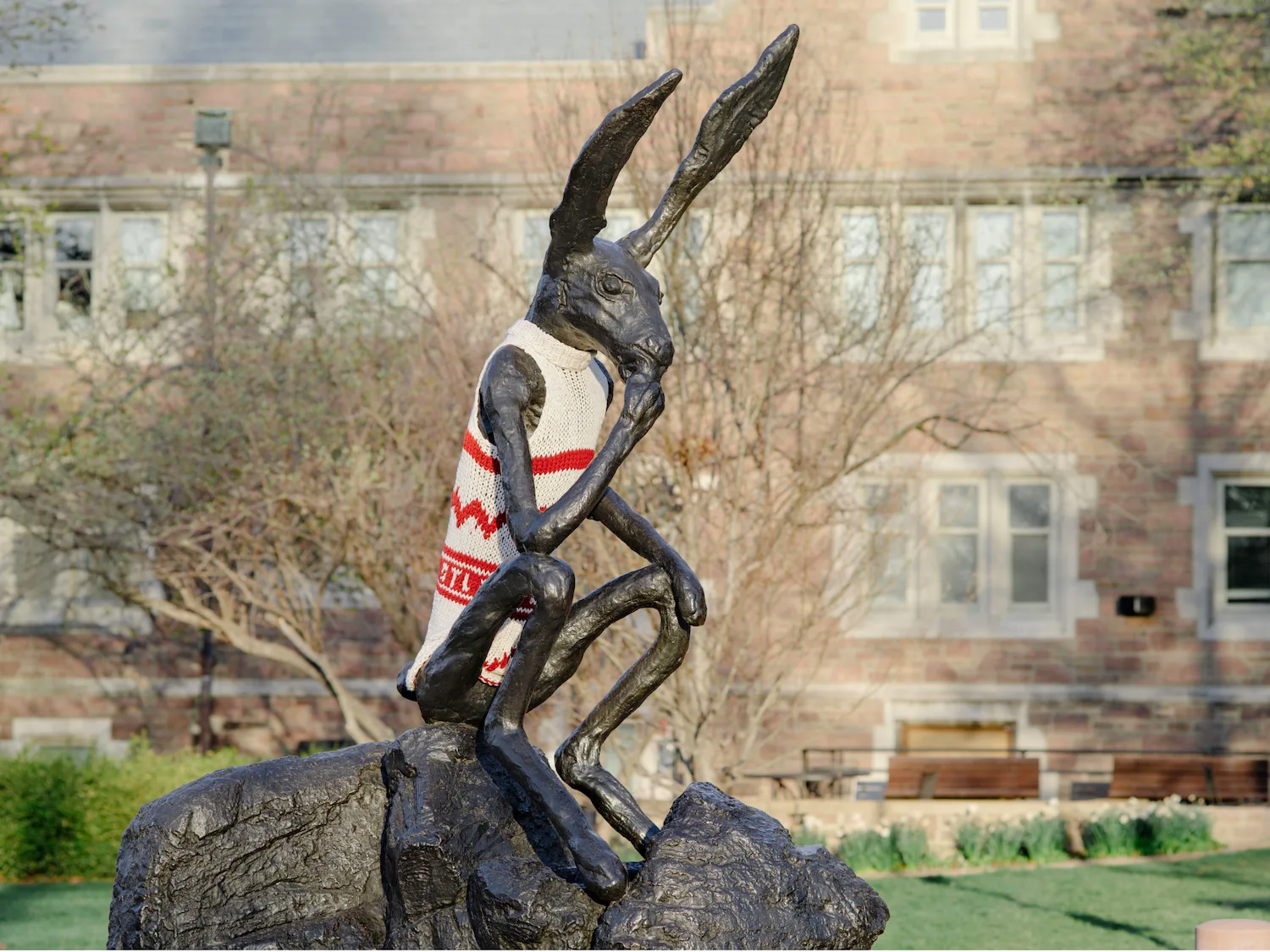
Sixteen years ago, St. Louis aldermen passed an ordinance requiring that 1 percent of budgets for construction projects done by the city be earmarked for public art. But despite tens of millions of dollars in development in the decade and a half since, no money was ever actually set aside. Now a group of arts advocates want to try again on a public art ordinance—this time, with teeth.
The Board of Aldermen passed the bill purporting to create a dedicated pot of money to fund public art in 2010. It called for 1 percent of the budget of all city-funded construction, renovation and “site improvement” projects—as well as an amount equal to 1 percent of the tax breaks given to projects receiving tax increment financing in the City of St. Louis—to be set aside for the fund. Back of the envelope, if the letter of the bill had been followed, there could easily be millions of dollars in the pot by now.
Get a fresh take on the day’s top news
Subscribe to the St. Louis Daily newsletter for a smart, succinct guide to local news from award-winning journalists Sarah Fenske and Ryan Krull.
But despite the bill becoming law under then-Mayor Francis Slay, none of that ever happened. A spokesperson for the city comptroller confirms that a Public Art Trust Fund was set up, but no money went into it.
Alderman Shane Cohn, a co-sponsor of the bill, called it “another good concept but … poorly written and difficult to execute.”
Specifically, he said, the funding came from getting that sliver of capital budgets or tax breaks, both of which are appropriated by ordinance. So if 1 percent for the arts isn’t written into each individual ordinance, he says, “Then it’s not going to happen.”
The bill also called for the Regional Arts Commission to undertake a survey of all art in the city. Chloe Higgins, the grants manager at RAC, says that as far as she knows the organization never completed this inventory in the manner called for by the bill.
As it turns out, the failure to launch at City Hall is not uncommon.
“It’s a feel-good thing,” says former Alderman Joe Vaccaro, another of the bill’s co-sponsors. At the time, Vaccaro represented the Lindenwood Park area. He suggests there is a whole subgenre of legislation that on paper appears like it will direct money to this or that purpose, but in reality is unlikely to do what’s written in black and white. “Unless somebody who was supposed to get the money comes back and says, ‘Where’s the money?’ It doesn’t happen,” he says.
Cohn seconds that, saying, “These types of legislation generally require the aldermanic sponsor to hand-hold implementation or at least pressure the Admin and/or E&A, (or whichever agency), to follow through.”
The new push to put the idea back on the table originated with the Volunteer Lawyers and Accountants for the Arts, a nonprofit that provides free arts-related legal and accounting assistance. The effort began under longtime executive director Sue Greenberg, who left her post in January. Greenberg, along with a group of Saint Louis University Law School students, began looking into getting the city to invest more in the arts. It was this research that surfaced the long-inert 2010 ordinance.
Right now would be the logical time to take another crack at the ordinance, given that the forthcoming consolidation of St. Louis Lambert International Airport terminals will run into the billions. VLAA’s current executive director Nathaniel Carroll says that even a fraction of that would “go a long way and give people something to look at.”
Higgins, with RAC, seconds Carroll’s ambition. “I have always been for writing a version of [the 2010 bill] that we were able to implement,” she says.
VLAA drafted a new version of the bill, and Carroll says that the organization had conversations with the Board of Public Service last year. They didn’t go great. “My impression is that it was a nonstarter,” he says.
But maybe the effort isn’t dead. Last week, SLM spoke to a mayoral staffer on whose desk the issue of the 16-year-old legislation had just landed. Oddly enough, it was the third such time this month that some sort of City Hall mishigas from long ago suddenly became Mayor Cara Spencer’s problem to deal with.
As SLM reported, it was 18 years ago that the Federal Railway Administration began telling city leaders they would begin instructing train conductors to blow their whistles at city railroad crossings if the city did not improve the painting and signage at those crossings. These emails were not followed up on and, over time, the people they were being sent to left City Hall for other jobs or retirement. The situation suddenly came to a head in early September when the railroad agency told conductors they needed to start sounding their whistles at all 88 ground-level crossings in the city. Residents who live near these crossings, which see train traffic at all hours of the night, have understandably grown sleep-deprived and frustrated as the city hustles to get the crossings into compliance.
“It’s the nature of the beast,” said one person familiar with the dynamics of City Hall, referring to a current mayor fixing problems created under previous administrations.
The staffer whose desk the VLAA matter landed on noted that the mayor’s office also just became aware of an ordinance passed several years ago by aldermen requiring the city to retain certain janitorial staff when they switch from one cleaning vendor to another—an ordinance that, coincidentally, could also have something to do with Lambert, which recently brought on a new firm for cleaning services. “Yeah, it would be nice to have some heads up on this stuff,” the staffer says.
Hear more about this story from Ryan Krull on The 314 Podcast.