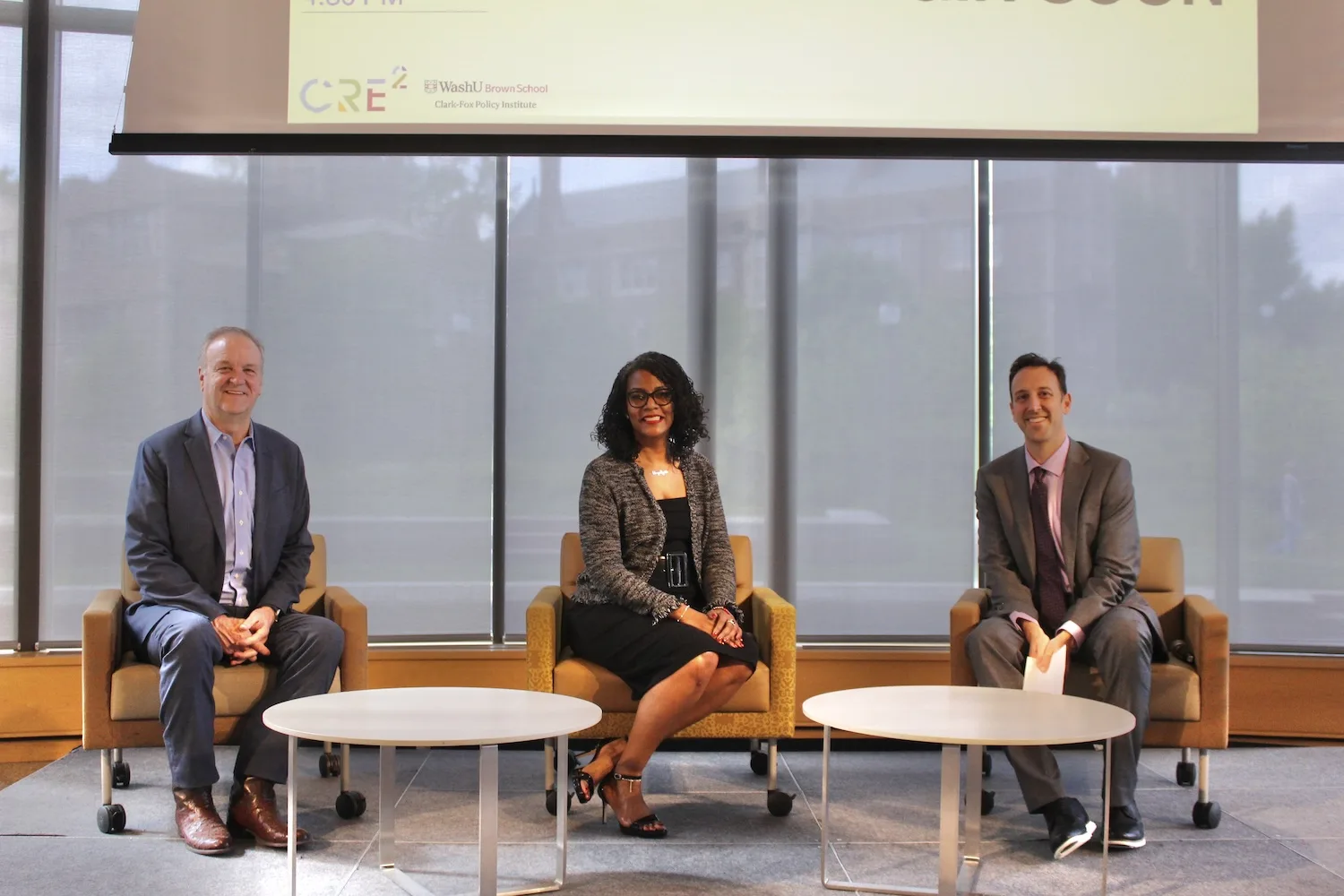
Tishaura Jones landed back in St. Louis Wednesday morning, the latest flight in a busy semester spent, in her words, “jet-setting between Cambridge and St. Louis.” By 4:30 p.m., the city’s former mayor was on stage at WashU’s Hillman Hall with St. Louis County Executive Sam Page, capping off one of two university fellowships she had this spring.
“It has been one of the greatest experiences of my life,” she tells SLM.
Get a fresh take on the day’s top news
Subscribe to the St. Louis Daily newsletter for a smart, succinct guide to local news from award-winning journalists Sarah Fenske and Ryan Krull.
This spring, Jones was a resident fellow at Harvard University’s Institute of Politics, within a cohort of five others as well as two visiting fellows: former Transportation Secretary Pete Buttigieg and former House Speaker Kevin McCarthy.
At Harvard, Jones led an eight-week study group, mentored undergrads, and held office hours. Her study group focused on the intersection of race and gender in American politics, discussing topics like misogyny and double standards. On their last day together, Jones said she brought her students—about half of whom were Asian—to meet Boston Mayor Michelle Wu, the first woman and person of color elected to the office.
Without any advance coordination, Wu told them stories similar to what Jones had shared about her own experiences as St. Louis’ first Black female mayor. Jones said her students could recognize the dynamics they’d been discussing. “And I told them I was counting on them to call it out,” she said, adding that her students are compassionate, bold, loving, and smart. “When I see kids like them, I am hopeful for our future. I’m hopeful that they are going to break this awful cycle that we find ourselves in time and time again.”
Jones says she brought in a Republican colleague to a different session to ponder the questions: Is bipartisanship dead? Why is compromise a dirty word? “When we really pull back the layers, people are really more pragmatic than they appear on TV,” she tells SLM.
Flying back to St. Louis throughout the semester, Jones was also the inaugural visiting distinguished fellow in residence at Washington University’s Center for the Study of Race, Ethnicity & Equity. This fellowship involved four events on campus where she was able to reflect on her time in office and what she would have done differently, her leadership style, and hopes for the future.
At the final event Wednesday, Jones and St. Louis County Executive Sam Page shared the stage in a fireside chat-style conversation—perhaps surprisingly, a first for the two of them, Jones said—that ran the gamut: from the role of data in political decision-making to what big issue they would tackle if they could team up to support families and children in the region. (Each had the same, short answer: early childhood education.)
Outside of her work in academia, Jones launched her own consulting firm, Oneda Consulting LLC, last December. She tells SLM she wants to connect cities with technology that can “help them do more with less, and help them work smarter, not harder.” This involves visiting different cities and talking to their leaders “to find out what their pain points are, and try to figure out how we can help them with the technology that we have access to.” (She didn’t specify which technologies.)
During the Q&A portion of Wednesday’s event, several audience members asked Jones and Page about a city-county merger. (In March, Page floated the idea of the city rejoining the county as a way to address the region’s budget challenges.) Jones said that, having been away from office, she’s been able to take “a 10,000-foot view of our region.”
She fell short of explicitly endorsing a merger and suggested that some of the conversation around the idea has been counterproductive, later telling SLM, “Doing things over and over and over again and expecting a different result is the definition of insanity.” She adds, “if we really want to move this region forward, … everybody’s going to have to give up something.”
Jones said there seems to be resistance to simply working together, which was why she found it so important that she and Page worked together on matters ranging from COVID-19 responses to Save Lives Now, a regional crime reduction initiative. “There are things that we can do right now, but again, we have to do something different, because it is literally holding our region back,” she says.
Reflecting more broadly, she says, “We’re in our own way, and we can’t seem to get out of our own way.” While at Harvard, she said there were many people who would “light up” after she introduced herself as the former mayor of St. Louis, recalling wonderful experiences or family ties. And yet, “we seem to just be the ones that always tear each other down,” she says. “We have to change that narrative.”
Editor’s note: Freelance writer Kelly Smits is employed by WashU’s Office of Public Scholarship, which was not involved in Wednesday’s event.