In 1864, the memoirs of a private in the Union Army described his Civil War experience at the Battle of Winchester in Virginia, where he was wounded and looked his Confederate attacker in the eye.
I experienced a stinging sensation creeping through my whole system. I, at first, thought a snake had bitten me. I felt the blood trickle down my right leg, my knees shook as if paralyzed… I knew that I had been wounded, but slightly, sideways in the calf… I next looked where that shot came from and there, not 10 yards from my right, lay John [slang for a Confederate soldier] with his gun still smoking and he grinning at me. I was mad. It seems the rebel soldier had been wounded himself as he lay flat on his stomach outstretched with his head raised behind a pretty good-sized stump. Was I mad. I was close to firing, then I wanted to save my ammunition. I just reversed my gun, not caring for anything or anybody, I had my gun clubbed ready to beat his brains out, but a look from those eyes which looked at me in such a sullen and unflinching way, he was a young fellow almost a boy not over 15 years old, as I looked in those eyes I was fascinated, the same as I have read of snakes charming animals. Something in me said don’t harm this helpless poor being who simply did his duty. He might have a mother who lovingly expected him.
Get a fresh take on the day’s top news
Subscribe to the St. Louis Daily newsletter for a smart, succinct guide to local news from award-winning journalists Sarah Fenske and Ryan Krull.
That private’s name was Ignatz Hartmann. He was my great-great-grandfather. He would go on to marry and raise a family of 11 kids in St. Louis, operate a retail clothing business for 35 years on South Broadway, and serve as a commander in the Grand Army of the Republic, the most prominent Union veterans organization. He died in 1902.
I didn’t know a word of this until I began researching the history of the Confederate Memorial in St. Louis. I’m not sure what prompted me to wonder about my own connection to the Civil War, but I’m glad I did.
For one thing, it’s nice to know that my ancestors were on the right side of history. That’s just luck. I could have just as easily been a descendant of a Confederate soldier, like Harry Truman or millions of other Americans.
More important, it opened my eyes to how connected many of us are to the most painful chapter in American history, the Civil War, whose saving grace was putting an end to the ugliest chapter in our history, that of course being slavery. I’m stunned to learn that my own family is part of this story.
Here I am, a century and a half later, writing about the same topic that my great-great-grandfather wrote about in 1864. But the similarities quickly come to a screeching halt. He risked his life as a soldier on the battlefield for our country. My biggest risk is offending someone as a media guy.
So here goes.
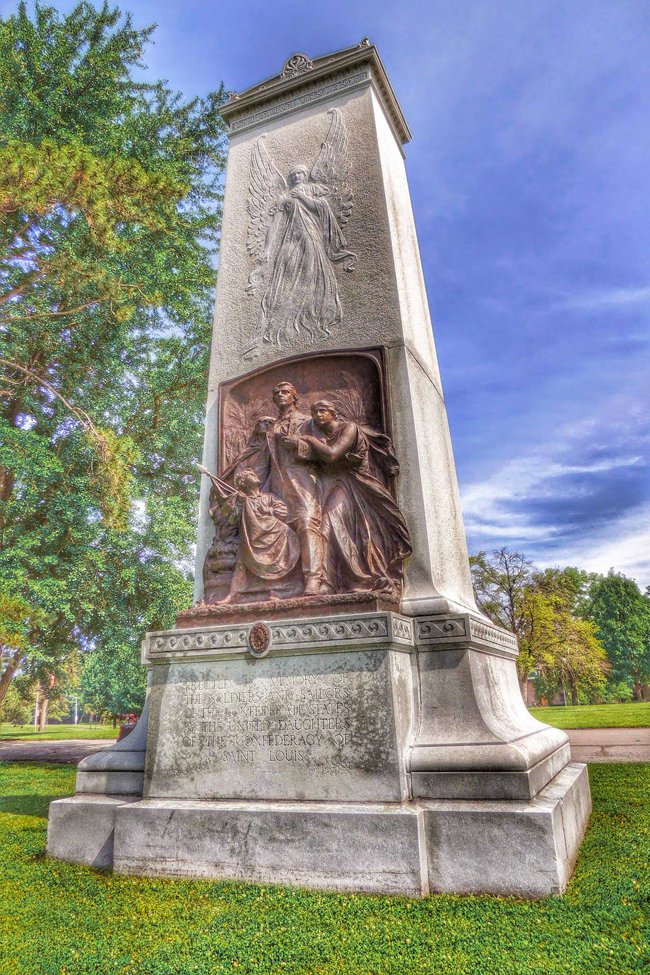
I have it on good authority that among the hottest of hot-button issues facing new Mayor Lyda Krewson is what to do about the Confederate Memorial in Forest Park. There’s a growing sense of urgency to remove this 32-foot-tall structure, which has stood in the park since 1914. That’s 102 years and counting.
Now, for the first 100 of those years, few people in St. Louis even knew that the sculpture was there, and if they did, they just thought of it as a very large piece of artwork. I doubt many have bothered to read its propaganda-laden inscription, much less be moved by it. I certainly haven’t, have you?
I can’t say this clearly enough: For literally a century, the Confederate Memorial was not a thing in St. Louis. It received virtually no attention. If its mission was to spread some revisionist message, putting lipstick on the pig that was the Confederacy, then it failed miserably. Few people have shown interest in this obscure monument until recently, unless you count 1994, when—on the watch of our city’s first African-American mayor—it was given its first significant renovation by a Forest Park preservation group. And nobody uttered a word of complaint in the media about it at the time.
So why is it a burning issue now? In June 2015, a white supremacist monster named Dylann Roof slaughtered nine people in the Emanuel African Methodist Episcopal Church in Charleston, South Carolina, one of the most heinous crimes on record. Roof claimed that he wanted to start a race war. He actually ignited a racial justice conversation.
Throughout the nation, there has been great momentum toward removing at least some of the racist symbols that are said to have helped warp Roof’s mind. Those include more than 1,500 symbols of the Confederacy in public spaces, as well as Confederate flags, a publicly supported presence for the Confederate flag in six former Confederate states, and nine official Confederate holidays in six states, as well as 109 schools and 10 military bases named for Confederate figures.
I don’t think they’re all the same. To me, the Confederate flag as an official public symbol—or part of one—should be a nonstarter, unacceptable, verboten, all of the time. It should fly nowhere in public spaces. To African-Americans, it is the ultimate insult and horror, not only because the Confederacy fought to preserve the despicable institution of slavery but also because it was proudly flown by racists for more than a century after the Civil War as a symbol of ongoing racial oppression.
The Confederate flag is to African-Americans what the swastika is to Jews like me who lost relatives in the Holocaust. Though its existence in private use is certainly protected by the First Amendment, any official display or sanction of it should not happen. Never. I’d put official holidays celebrating the Confederacy right up there with it. And naming schools and military bases for Confederate heroes can’t be far behind.
Now, let me walk the progressive plank. I don’t think monuments like the one in Forest Park, honoring those who died in the war, are quite in the same category, at least not across the board. There were Americans—including Missourians and St. Louisans—on both sides of the Civil War. That’s why it was called the Civil War. A monument honoring their sacrifice, especially without promoting that flag (and slavery) is not in the same category. That isn’t to say that I like Confederate monuments. I don’t.
But, as my great-great-grandfather seemed to understand, there was a human side to those Confederate soldiers, so many of whom were kids doing their duty. And it’s not like everyone who fought for the Union or whose relatives did was always concerned about civil rights and equality; after the war ended, a great many of those same people, alongside their erstwhile Confederate enemies, spent the ensuing century-and-a-half oppressing African-Americans.
Like it or not, the memorial is history. The Ladies’ Confederate Monument Association commissioned famous sculptor George Julian Zolnay to create it at a cost of $23,000 (the equivalent of more than $500,000 today), raised over the course of 15 years, and expressly refrained from including a Confederate flag or any military weapons. Spending $100,000 or more to remove it from a spot where no one noticed it for more than a century seems like a waste of money. (That said, renaming Confederate Drive in the park to almost anything else ought to be low-hanging fruit.)
A microbrewery in South City, Earthbound Beer, recently garnered a few minutes of fame when the owner offered to demolish the memorial for free. My fellow progressives cheered. Racist white supremacist groups (largely from outside St. Louis) launched a cyber-vandalism campaign to give the brewery one-star reviews on Facebook, prompting many more five-star reviews from our side.
The best thing to come out of the digital skirmish was a blog post from the Riverfront Times, proclaiming: “For years, the citizens of the Confederacy have vowed to rise again. And today they finally did, unleashing a hellstorm of one-star reviews on a St. Louis–based business. The horror.”
That made me smile. But don’t talk as a progressive about historic preservation—or free speech—if you’re fine with putting a wrecking ball to a 102-year-old monument because its message has recently become intolerable. That’s progressive? Really?
You want to talk about racial justice in the context of policing, education, transit, housing or civic power? Let’s do it.
Want to obsess about this monument? Sure, go ahead. But start the revolution without me. I’m actually proud that my great-great-grandfather didn’t kill that kid.
SLM co-owner Ray Hartmann is a panelist on KETC Channel 9’s Donnybrook, which airs Thursdays at 7 p.m.
The Confederate Memorial: A Brief History
December 1914: Confederate Memorial dedicated.
April 21, 2015: On his blog, Mayor Francis Slay asks whether the memorial should be removed.
June 23, 2015: The Confederate Memorial is vandalized.
June 29, 2015: Congressman Lacy Clay sends a letter to Slay’s office demanding that it be removed.
June 30, 2015: Slay notes he’s asked a committee to look into the memorial’s removal. The group later reports it could be moved to storage for $129,280, but funding is elusive.
July 2015: Ald. Lyda Krewson proposes changing the name of Confederate Drive. That proposal is later put on hold.
April 27, 2017: Earthbound Beer’s owner offers to demolish it for free. Online spat ensues.