Detainees being held by ICE at the Ste. Genevieve County Jail will soon be able to attend mass and receive communion. The change comes about a month after the jail was sued by the Archdiocese of St. Louis, which alleged that the jail’s no-contact policies prevented the detainees—many of whom are Hispanic and Catholic—from receiving a sacrament essential to their faith, a violation of their religious rights.
Now the jail is set to allow priests to celebrate mass beginning on Monday, November 23. The detainees can view the priest via tablets while the communion host will be passed through a hole in a steel door.
Get a fresh take on the day’s top news
Subscribe to the St. Louis Daily newsletter for a smart, succinct guide to local news from award-winning journalists Sarah Fenske and Ryan Krull.
The new protocols are according to an affidavit filed on Thursday by a major in the sheriff’s office that runs the jail in the city of Ste. Genevieve, which is said to house around 150 ICE detainees.
The Archdiocese of St. Louis filed its lawsuit against the jail the first week of October. Attorney Christopher Schmidt of Bryan Cave Leighton Paisner alleged that the visitation protocols at the jail made it impossible for priests to properly administer communion because of a plexiglass barrier between detainees and visitors. The communion wafer had to be handed to a guard, who then handed it to the detainee. The suit also alleged that a lack of privacy at the jail prevented priests from taking confession. The Archdiocese sought an injunction from a federal judge ordering the jail to stop preventing detainees from exercising their First Amendment rights to practice their religion.
The Archdiocese sought a hearing on its request for an injunction. Judge Matthew Schelp postponed that hearing over the Archdiocese’s objections, instead directing the two sides toward mediation.
“After repeated requests to permit access to priests and the sacraments were ignored and outright rejected for months, the Archdiocese of St. Louis brought suit to secure basic religious freedoms,” said Brecht Mulvihill, executive director of communications for the Archdiocese. “The archdiocese welcomes the opportunity to mediate and remains resolute to secure complete relief either via mediation or further court proceedings.”
The date for mediation is also set for November 23. The Archbishop of St. Louis, Mitchell T. Rozanski, is scheduled to be in Rome on that day for work. Judge Schelp last week ordered Rozanski to attend mediation via video conference or for the parties to schedule a different date.
Schelp’s order also signals that the Archdiocese’s demands may face headwinds in court. In a footnote, the judge writes that some of what it’s asking for seems “broader than necessary to remedy” problems at the jail. The federal judge also indicated that he doesn’t buy the Archdiocese’s argument that an injunction is still needed despite the jail’s changing its policies. “The modified policies absolutely bear on the question of whether preliminary relief is appropriate here,” wrote Schelp, referring to the Archdiocese’s argument otherwise as “myopic.”
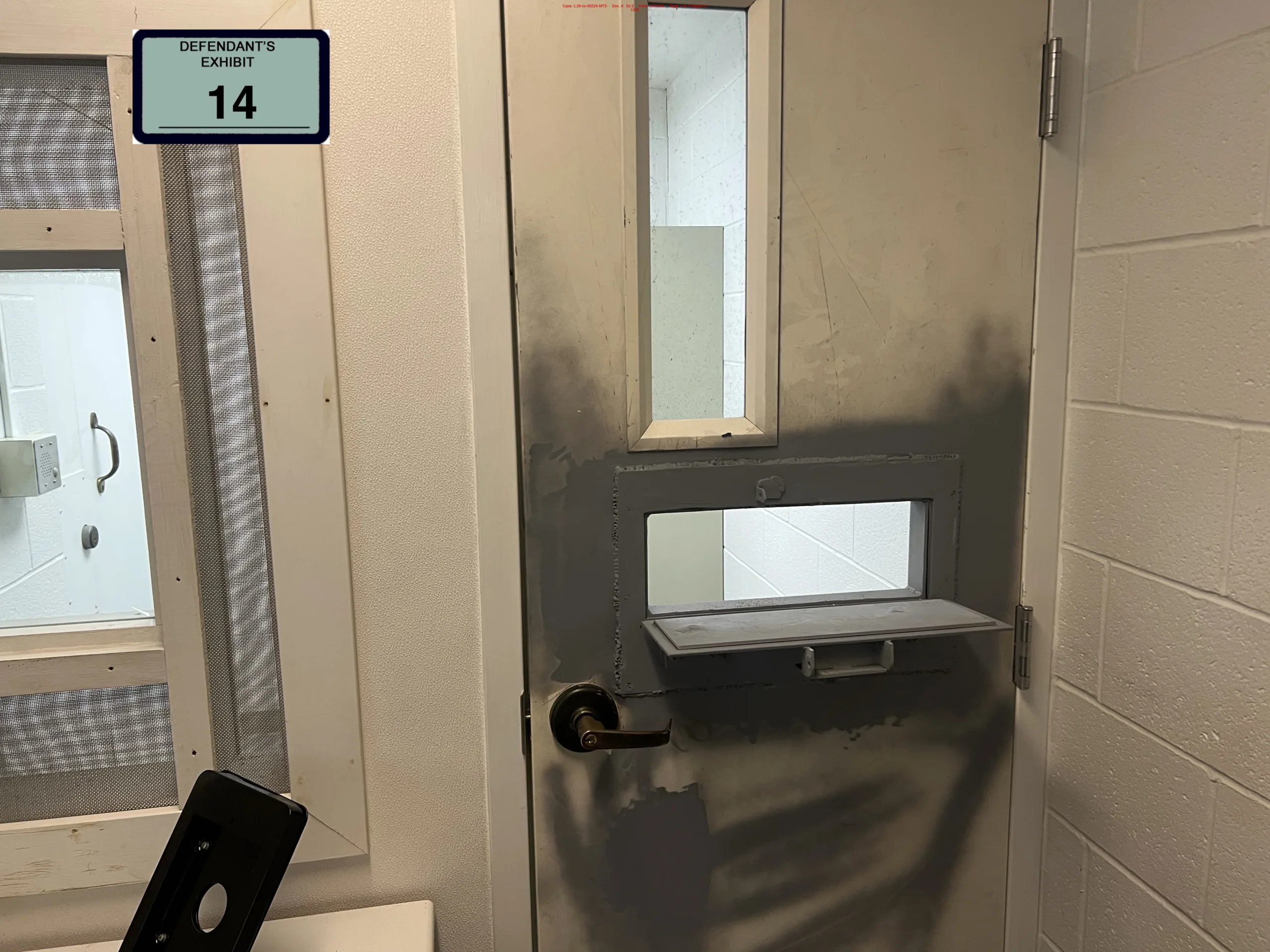
The procedures set to be implemented are outlined in an affidavit filed in the lawsuit on Thursday by Jason Schott, a major and the chief deputy of the Ste. Genevieve County Sheriff’s Office. Schott wrote that the steel doors in two attorney-client meeting rooms have been modified with steel flaps that allow for contact with visitors and through which “communion may be directly administered.”
In that same affidavit, Schott says that starting on Monday of next week, detainees who wish to participate in mass will be able to do so, “provided that a Catholic priest is available and wishes to conduct the service.”
That mass, conducted by the priest from an interview room, will be livestreamed to jail housing blocks and viewed by detainees via their tablets. After that portion of the service, a jail guard will escort the priest to each of the housing blocks, where detainees who have signed up to receive communion can do so.
Employing both jailhouse jargon and liturgical lexicon, Schott describes the protocol: “At each designated housing block, Detention Center personnel will open the chuck-hole door to permit the priest to administer the consecrated host directly.”
The sheriff’s affidavit doesn’t explicitly address how the county plans to allow detainees to participate in the sacrament of reconciliation, which requires a priest to be in person with the person confessing.