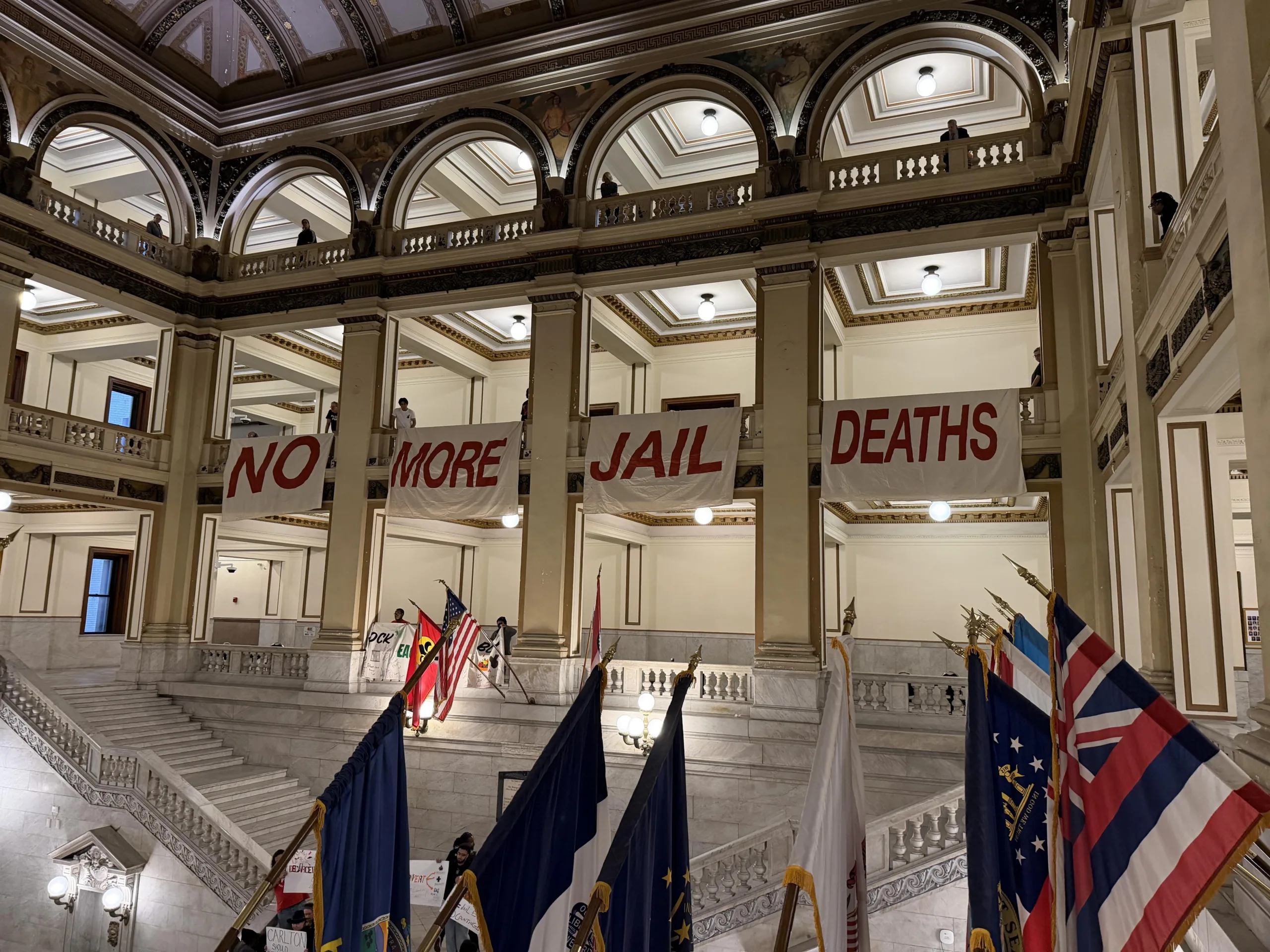
Administrators of the city’s jail had the tough task of defending operations in the long-troubled facility yesterday. Not only that, but jail commissioner Nate Hayward had to make his case in front of a room full of people who want to see the facility undergo systemic reform or shut down completely.
Hayward told an aldermanic committee that the jail has revamped its use-of-force policy, increased access to tablets, and allowed detainees to see medical staff within a day of entering the jail. He estimated that there have only been about 20 use-of-force incidents in the last 60 days.
Get a fresh take on the day’s top news
Subscribe to the St. Louis Daily newsletter for a smart, succinct guide to local news from award-winning journalists Sarah Fenske and Ryan Krull.
Yet virtually all the answers that Hayward gave to questions from the aldermen on the committee drew guffaws from the audience, who at times shouted accusations at Hayward of dodging questions.
Hayward, who came from the St. Louis County jail and took over city jail operations in September last year, was speaking to the city’s Aldermanic Public Safety Committee. The room packed with activists, people who were formerly incarcerated, and relatives of people who died in the jail. For nearly two hours preceding Hayward’s remarks, the committee heard testimony about how awful the city jail is.
Twenty-two detainees have died at the City Justice Center since 2020, including four by suicide, 11 by medical emergencies, and four by drug overdoses. The other deaths had no records, said Mike Milton, the executive director of the criminal justice reform organization Freedom Community Center. He said the average stay in the jail is 365 days, with 23-hour-a-day lockdowns being the norm and detainees regularly denied access to attorneys.
It is worth noting that almost all of those deaths preceded Hayward’s time, and many credit the jail becoming less deadly to procedures he’s implemented. However, Hayward’s performance before the committee didn’t exactly seem to meet the moment.
Prior to the hearing, someone in the audience predicted to a reporter that Hayward would resign in two weeks. By hearing’s end, that same person amended their prediction to one week. A recurring motif in the testimony given by the community was that the jail is a terrible place not only to be locked up but also to be employed at. That’s no doubt true, and begs the question of who would want to replace its commissioner if he does indeed quit.
In her testimony to the committee, activist Tracy Stanton with Action St. Louis accused the jail of “cruel, inhuman, and intentional neglect.” She was referring specifically to the death of 32-year-old Carlton Bernard, who died while locked up in 2023 of dehydration and a lack of insulin.
One man previously locked up in the jail testified about being denied medication for a bleeding ulcer. Another said he had to wait 11 days to get medical treatment for a severe spider bite he got while in the facility.
Anita Washington, the mother of Samuel Hayes Jr., who died at the jail after being put in a restraint chair in July of last year, also spoke, saying, “Someone needs to take accountability for what happened to my son.”
A particular point of contention between Hayward and the crowd was how grievances get filed by detainees. Some people in the crowd were under the impression that detainees had to pay to file grievances or that detainees could only file them at designated times, leaving them having to choose between meeting with family members and attorneys or getting to file those grievances.
Hayward noted that he is the one who instituted the grievance process, but struggled to rebut the more specific concerns of the crowd and the aldermen. At one point, the retired Fox-2 journalist-turned-Facebook provocateur Elliott Davis turned around in his seat in the room to say, “I have no idea what he’s talking about.”
Nor were Hayward’s answers up to snuff in the eyes of Bret Narayan, the alderman who chairs the Public Safety Committee. About 30 minutes into Hayward’s testimony, Narayan seemed to suggest that the committee wasn’t getting any real answers. “I want answers, actual answers, specific numbers,” he said. “If you don’t have the data, say you don’t have the data.”
Narayan said that the committee would meet again in one week and that Hayward should be back with specifics.

Soon thereafter, Hayward and deputy commissioner Tammy Ross exited the hearing room. Activists crowded around them, yelling. The commissioner and deputy unwisely chose to take the elevator, which activists crowded around and prevented from closing.
The hearing, which will have a sequel, was already a sequel or sorts to one held two weeks ago before the same committee, in which many of the same activists showed up, as did Public Safety Director Shawn Dace. However, Dace was unable to answer some of the questions put to him. Thus the meeting Thursday.
In his comments prior to Hayward’s, Milton called for more people’s cases to be handled via diversion—-a broad term for when defendants have charges dropped in exchange for meeting conditions such as getting and staying sober. Milton also told the committee that his organization wanted to see better conditions at the jail, including access to health care and attorneys and detainees no longer being locked up for 23 hours a day.
He cited his own organization, Freedom Community Center, as an example of an alternative to locking defendants up as their cases make their way through court. He said that defendants granted bond who work with FCC while awaiting trial have an incredibly low rate of missing court or getting arrested for something else.