This story was commissioned by the River City Journalism Fund.
In one of his last acts as Kirkwood’s chief administrative officer, Russell Hawes did something unusual.
Get a fresh take on the day’s top news
Subscribe to the St. Louis Daily newsletter for a smart, succinct guide to local news from award-winning journalists Sarah Fenske and Ryan Krull.
On October 10, 2025, Hawes signed a contract with Stages St. Louis to remain as the Kirkwood Performing Arts Center’s marquee tenant for the next 16 years. What makes this odd is that city contracts are normally signed by the mayor.
What’s more, the final version of the contract—in contrast to the expressed wishes of council members—extended Stages’ control of the $30 million theater by an extra three weeks annually, to 25 weeks. It also slightly raised the weekly rent that Stages would pay during a production run—last set in 2017—to $3,183, a bargain compared to what other similar-sized theaters charge tenants.
But what’s most interesting about the contract is what didn’t happen with it.
Seven weeks earlier, in August, the Kirkwood City Council met during a closed work session to discuss the Stages contract. The city Procurement Department didn’t provide a market rate study to determine if the proposed Stages contract was “still advantageous” to the city, as required under the municipal code.
Hawes didn’t receive written authority from the council to sign the contract, which is required by the charter.
The council didn’t authorize the lease agreement with an ordinance, as the charter requires with city property leases.
Finally, Hawes didn’t give the council the final Stages contract to review before voting on it. The council voted 7-0 to approve it anyway, setting the stage for Hawes to sign it two months later.
“We’re sitting in this conference room,” says Al Rheinnecker, a council member at the time, of the August meeting. He recalls Hawes’ low-key presentation: “One more thing to talk about. This Stages contract. I’m going to make a few tweaks, minor things here and there. No big deal.’”
During that meeting, Rheinnecker says, Hawes failed to mention that his daughter Madeline worked for Stages’ marketing department.
Hawes’ actions still rankle City Councilmember Paul Schaefer, who was elected to the council in April 2024. “I can say this wasn’t fully disclosed to us,” Schaefer says.
“I trusted him,” Schaefer says of his initial interactions with Hawes. “In my 30 months [since being elected to the council] I learned to ask a lot more questions.”
For his part, Hawes denies there were any irregularities surrounding the Stages contract, which he describes as a clarification of an existing agreement. Hawes denied that voting on the contract in closed session was an attempt to avoid public scrutiny.
“The city code allows us with clarifications to existing contracts to execute them through a closed session,” he says.
As for Rheinnecker’s assertion that council members weren’t allowed to read the final pact with Stages, “I don’t know what they could or couldn’t read. There was a unanimous vote to execute it. So I really couldn’t say they could read it or not.”
As for the fact he did not tell the council about the fact his daughter was working at Stages, Hawes said he was not obligated to tell them, though he says he did inform Mayor Liz Gibbons shortly after his daughter started working there.
An October 4 St. Louis Post-Dispatch story about KPAC and its cost to Kirkwood contained criticism of Hawes from ethics experts for his failure to disclose his daughter’s role at Stages while he negotiated a new contract on behalf of the city. (To the River City Journalism Fund, Hawes insists he had little to do with the Stages negotiations, which he said were handled by the city’s legal team.)
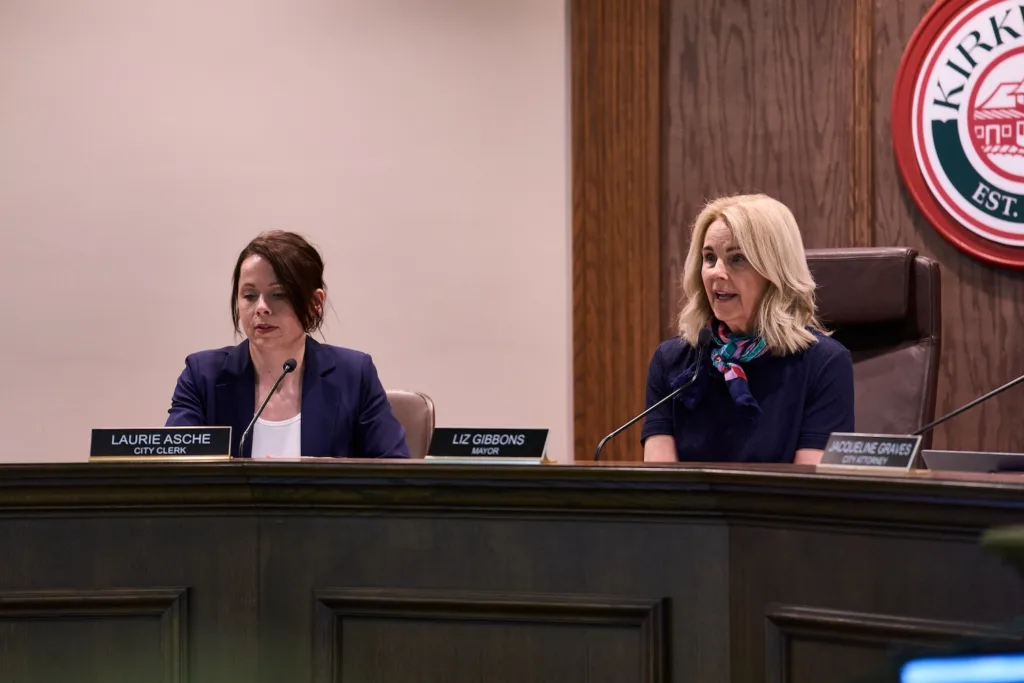
Also defending her actions to the Post was Mayor Liz Gibbons, who voted to approve the Stages contract despite the fact her husband Michael, a former state senator and now a lobbyist, fills an unpaid seat on the Stages board. In an email, Mayor Gibbons denied to the Post that her husband’s “unpaid volunteer service” on Stages’ board represented a conflict. (Gibbons has declined to comment to the River City Journalism Fund.)
As events of the past year have underscored, Kirkwood city leaders have shown a penchant for playing fast and loose with their own rules and policies, as well as allowing the chief of the Electric Department—by far the city’s largest budget item—to spend tax dollars with little oversight.
Now a moment of reckoning is finally occurring in the affluent St. Louis County suburb, as three separate efforts have taken shape to launch forensic audits aimed at city finances. A lawsuit filed last month alleging the city violated Missouri’s Hancock Amendment, which bans tax increases without a vote of the people, could further shake things up.
Schaefer acknowledges that many Kirkwood residents are upset, but he isn’t worried about what the various probes could reveal.
“I’m pretty simplistic,” he says. “If it’s fair and it’s right and it’s just, and it’s legal and it’s not a lie, then why are we not telling people the truth all the time? Why?”
Probing the mistakes of the past
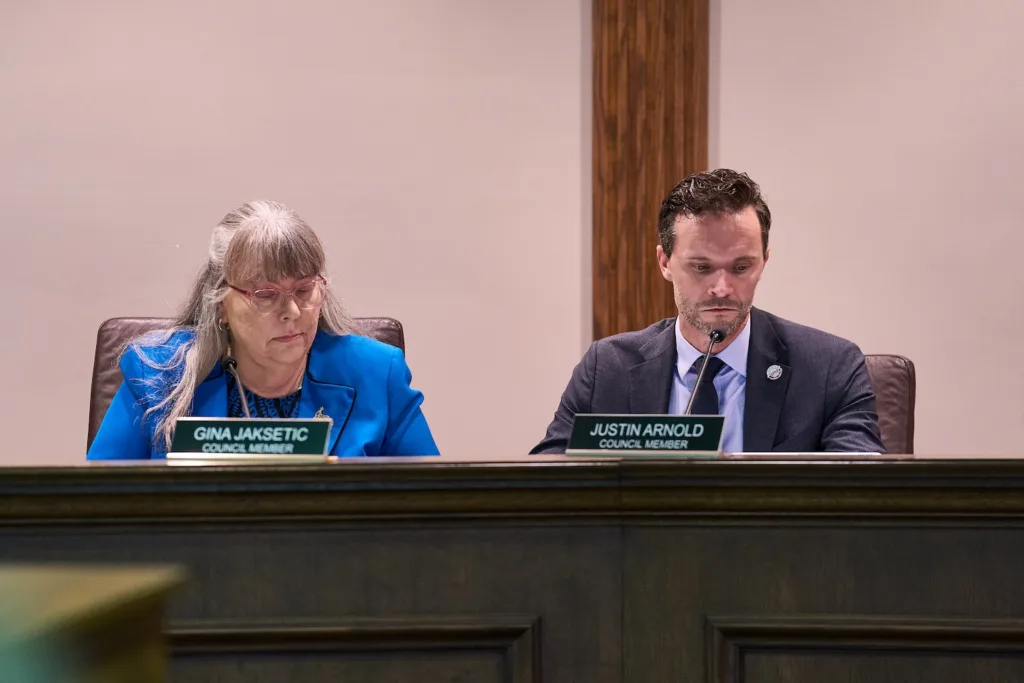
For Justin Arnold, an attorney elected to the city council in April, the story of the Stages St. Louis contract illustrates one of the biggest reasons Kirkwood’s financial situation is so fraught. The municipality is saddled with more than $68 million in bond debt—$106.6 million if interest is added—amassed in less than a decade. Most of the debt came from what are called certificates of participation, a type of bond debt that only requires a majority of the seven-member council to pass.
Then there is the city’s “very bad habit of moving money around with interfund transfers,” Arnold says. “That has gotten us in a lot of trouble and put us in this financial position.”
He adds, “I think when you don’t have to face the public, it alleviates you from a lot of accountability. That has been a problem for Kirkwood going back years.”
Arnold is one of three council members elected in April on a reform ticket aimed at reining in city spending and getting to the bottom of the $15.6 million Electric Department deficit that emerged a year ago.
The department’s overspending led the council in October 2025 to raise city electric rates nearly 15 percent, the second major rate increase in three years, to replenish city fund reserves. Credit rating agency Moody’s responded by lowering the city’s bond rating by two notches. More recently, an austerity program has led to delays in street repairs and park improvements.
Since joining the council, Arnold has pushed for a forensic audit of Electric Department spending going back at least five years. His efforts recently paid off.
The city is now negotiating a contract with Plante Moran, a Chicago-based accounting firm with a 25-year track record of forensic investigations of a broad range of public agencies. Previous price estimates ranged between $250,000 and $300,000.
During a November 5 meeting, the council voted to exclude the four council members who were in office during the Electric Department overspending fiasco from parts of the upcoming forensic audit. The move was meant to assuage some residents’ concerns that the four excluded leaders are too closely linked to people and events at the heart of the investigation and might try to influence its findings.
On November 12, however, the council voted 5-2 to exclude all council members from speaking directly to auditors during the investigation in a bid to build citizen trust in the auditing process.
But a forensic audit overseen by the city still won’t go far enough for Kirkwood resident Craig Wilde. He’s organized a signature-gathering drive for a petition to bring in State Auditor Scott Fitzpatrick to examine all interdepartment transfers going back at least five years. The petition drive needs 1,845 signatures of residents. So far they’ve collected more than 1,300, Wilde says.
There’s also the lawsuit filed by the Holy Joe Society, a conservative nonprofit. In the suit, Fonda Fantroy-Richards and Al Rheinnecker allege that the rate hike was unlawfully passed because it violates the state Hancock Amendment, which requires voter approval for certain tax increases. (Rheinnecker, a former council member, voted for the raise but now says he had no choice because the city faced a financial crisis if the rate increase didn’t replenish city reserves.)
Among other remedies, the lawsuit requests that an independent auditor be appointed to examine the books of the electric and water departments from 2015 to present.
More litigation might follow, according to Holy Joe litigation director Robert Dierker.
“Perhaps there will be a later suit against the officials who were responsible for the financial mismanagement,” Dierker says. “If the city is broke because it was using Kirkwood Electric as a piggy bank and the piggy bank is now empty, the City will have to be like any other government entity and fill the gap by reducing expenses or increasing revenue.”
“It was just the culture of this place”
The Electric Department spending debacle—which a RCJF investigation revealed in July stemmed from a secret spending binge, enabled by the failure of the city’s internal financial controls and oversight—led the council to fire Electric Department Director Mark Petty in late September 2025. Members also voted to fire Hawes a month later, though he was allowed to stay on the job another two months.
For his part, Wilde is hoping forensic auditors focus not just on city spending associated with KPAC, but also two other things: the fact city council members did not receive quarterly financial reports for nearly two years from a new financial reporting system the city bought through Tyler Technologies, and the city’s October 2023 purchase of a local warehouse as the new home for its public works offices.
Kirkwood later renewed its contract with Tyler, but the purchase of the 85,000-square-foot A-Mrazek Building has generated questions from residents.
The city bought the building for $12.5 million—four times its fair market value, and twice its appraised value—as the new home for city public works departments. No feasibility study was performed to examine moving city public works departments under one roof. The council plans to spend about $9 million retrofitting and expanding the structure.
What’s more, Hawes transferred the $12.5 million for the purchase without council approval from two sources: the Electric Department, to the tune of nearly $5.3 million, and then another $7 million from the Parks and Stormwater Improvement Fund, which was then reclassified as a loan to the Electric Department.
Wilde also wants the audit to look at the city’s lack of long-range financial planning, leading it to pile on new debt even as it faced huge bills for other infrastructure projects.
When the city council approved the $24.1 million bond issue in 2017, the Electric Department had already launched a $33 million upgrade of its electric grid. Even so, the Electric Department loaned $3 million to the Parks Department to pay for KPAC’s construction. That’s even as the city was coming to grips with what has proved to be an estimated $90 million bill to replace the city Water Department’s outdated network of cast iron pipes.
“All I’m saying and the purpose of the audit is, ‘You guys need a full accounting of what the f— you got going on. And nobody’s done it,’” Wilde said. “And you need to pause, you need to stop the bleeding now until you can figure that out.”
For Rheinnecker, the former council member, the past 15 months have been a roller coaster.
Like the other council members at the time, Rheinnecker spent 2024 and 2025 fighting for quarterly financial reports withheld by Hawes.
Then, during a secret emergency council work session on August 29, 2025, Hawes revealed the scope of the city’s financial crisis. It was far worse than anyone had imagined. Rheinnecker was also at the council meeting six weeks later in which Hawes justified the nearly 15 percent rate increase by calling it a “perfect storm” of external factors
Rheinnecker voted to fire Petty and then Hawes in October 2025, and bit his tongue when Mayor Gibbons and other city officials referred to their forced exits as “retirements.”
In looking back, Rheinnecker doesn’t let himself off the hook.
“I have to accept some of the responsibility for not digging more,” he says. “But it just wasn’t the culture at these meetings.”
He adds, “It was just the culture of this place. They were so used to doing whatever the f— they wanted to do. We were just supposed to go along with it. And for years people had gone along with it.”
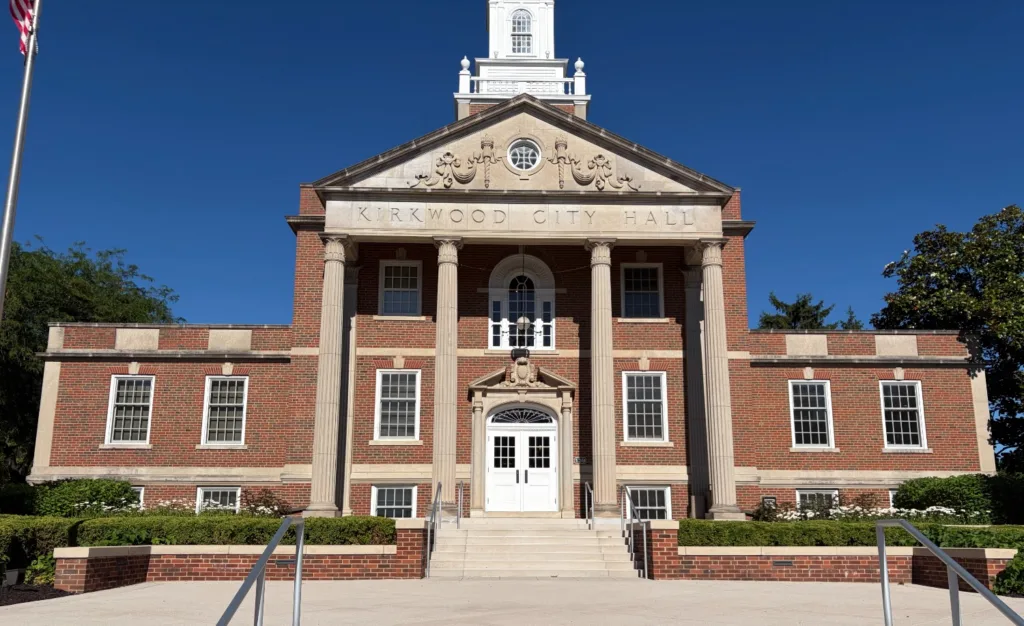
A big project to make big changes in Kirkwood
Kirkwood leaders had long debated the idea of building a new standalone theater. The two theatrical groups housed at the city community center—Stages St. Louis and the Kirkwood Theater Guild—had outgrown their surroundings, while the aging center needed an overhaul
In 2017, the city council passed a certificate of participation to issue bonds for $23.5 million. The implicit assumption was for the money to be split evenly between a new theater and new community center.
But within just a few months, Hawes, Mayor Tim Griffin and other council members—without input from the public—decided that the bond issue should go entirely toward a theater that could attract high-profile performers and Broadway shows, luring affluent visitors to downtown Kirkwood.
During a February 2018 council work session, Griffin beat the drums hard for the new theater. “This is going to change not just a part of downtown Kirkwod; it’s going to change Kirkwood,” the Webster-Kirkwood Times reported. “My thought is we do this as best we can.”
At the same meeting, Councilmember Bob Sears, a Griffin ally, acknowledged the public’s disappointment. “I will go ahead and address the elephant in the room and say that this started as a community center project, and there were expectations at the time that we would have a new community center.”
The theater is “now taking the lion’s share of the money that is available to spend on the two projects,” the newspaper reported Sears saying. “It just shifted more and more until there was less left over to do the community center.”
Under the city’s 2017 agreement with Stages St. Louis, the nonprofit theater group would donate $2 million for construction, plus a 50-50 split of naming rights, a deal that has yielded more than $1.2 million in revenue for Kirkwood, records show.
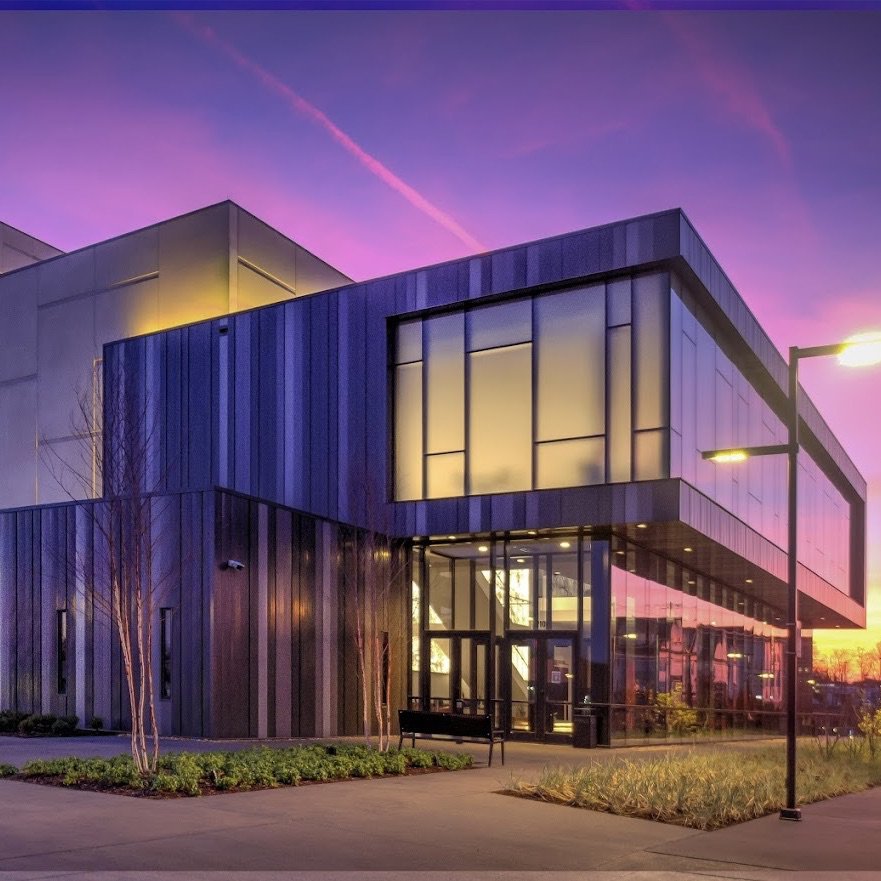
Groundbreaking on the 679-seat theater occurred in November 2018. For the next two years, as KPAC’s glass and steel walls rose above the former site of the city salt dome, many residents saw the theater as a symbol of hope a decade after the worst day in Kirkwood history: The February 2008 City Hall mass shooting that left six people dead, including two council members and two police officers.
This decision to go all-in on a performing arts center, with a new community center put on hold, was made even though a 2016 Community Survey found that residents prioritized “the maintenance of the parks, the quality and condition of the community center facilities, and city recreation programs.” There was no indication in the report that residents wanted a performing arts center.
In early 2016 the council commissioned New York-based Webb Management Services to begin a feasibility study for the proposed performing arts center. Its report, released in April 2016, found that “city staff” wanted “to add an entertainment venue to the downtown’s current mix of restaurants and retail outlets and their interest in drawing new foot traffic to the downtown’s south end.”
The report’s conclusions about the market for a new theater were based on confidential interviews with 41 local residents. Seven were identified as Stages St. Louis employees, including then-Executive Producer Jack Lane. Only six were “Kirkwood community members,” with other interviewees including Kirkwood officials, several of them big proponents of the proposed theater.
Griffin saw the theatre as an economic boon to the city, a way to “bring people who were also going to spend money in the community.”
Griffin’s big idea is indeed taking hold, according to Liz Crabtree, KPAC’s general manager. More than 81,000 people visited KPAC last year, with attendance increasing 30 percent since 2022.
And although KPAC is still operating in the red, it’s recovering a greater share of expenses, from about 68 percent in fiscal year 2024 to more than 75 percent in 2025.
KPAC is also attracting developers of high-end housing. Mark Mehlman is about to open the 41-unit Aria, which will feature a restaurant and spa, across the street from the theater. And Andrew Juiris plans to build 200 housing units on the site of the city’s old Public Works buildings now surrounding KPAC. Both developers told the Webster-Kirkwood Times that KPAC is a big reason they are coming to Kirkwood. “Downtown Kirkwood is one of the most vibrant and desirable suburban downtowns in the St. Louis area,” Juiris said.
And yet some residents grumble. Some tell River City Journalism Fund that they only learned belatedly that the city’s $24.1 million bond issue was only going to pay for the performing arts center and not a new community center.
Griffin defends the decision to spend the money on KPAC instead of recreational facilities.
“My perspective, of the council as a whole, is to look at the big picture on everything,” he says. “That was a council decision to maximize the performing arts center not for today, not for tomorrow, but for 10 years, 20 years, 25 years down the road.”
The recreation facilities did eventually get attention. The city between 2024 and 2026 spent more than $16 million overhauling the 60-year-old community center and upgrading the ice rink, with funds coming from a special half-cent sales tax, federal COVID relief funds, and a bond issue.
As for criticism that the city did not get enough public input, Griffin notes that Kirkwood has 29,000 residents. “And probably 10 percent—this is not good or bad—know what’s going on. The others are living their lives.”
Even so, Kirkwood officials’ actions have undercut voter trust, as Mike Wilkinson demonstrates.
Wilkinson admits that he spent almost his entire life not paying attention to local politics. But on a Saturday morning in late September, Wilkinson walks east along Argonne Avenue, toward downtown Kirkwood. A volunteer collecting signatures for the petition to bring in the state auditor, he says he was inspired by the city council’s lack of transparency about city finances.
”And it baffles me because my own instinct is it’s not malfeasance, so much as it’s incompetence,” Wilkinson says of the city’s financial woes. “And when you make a mistake you should just say, ‘I screwed up.’ But it’s been damage control, damage control, trickle, trickle.”
This story was commissioned by the River City Journalism Fund, which seeks to advance local journalism in St. Louis. See rcjf.org for more information.