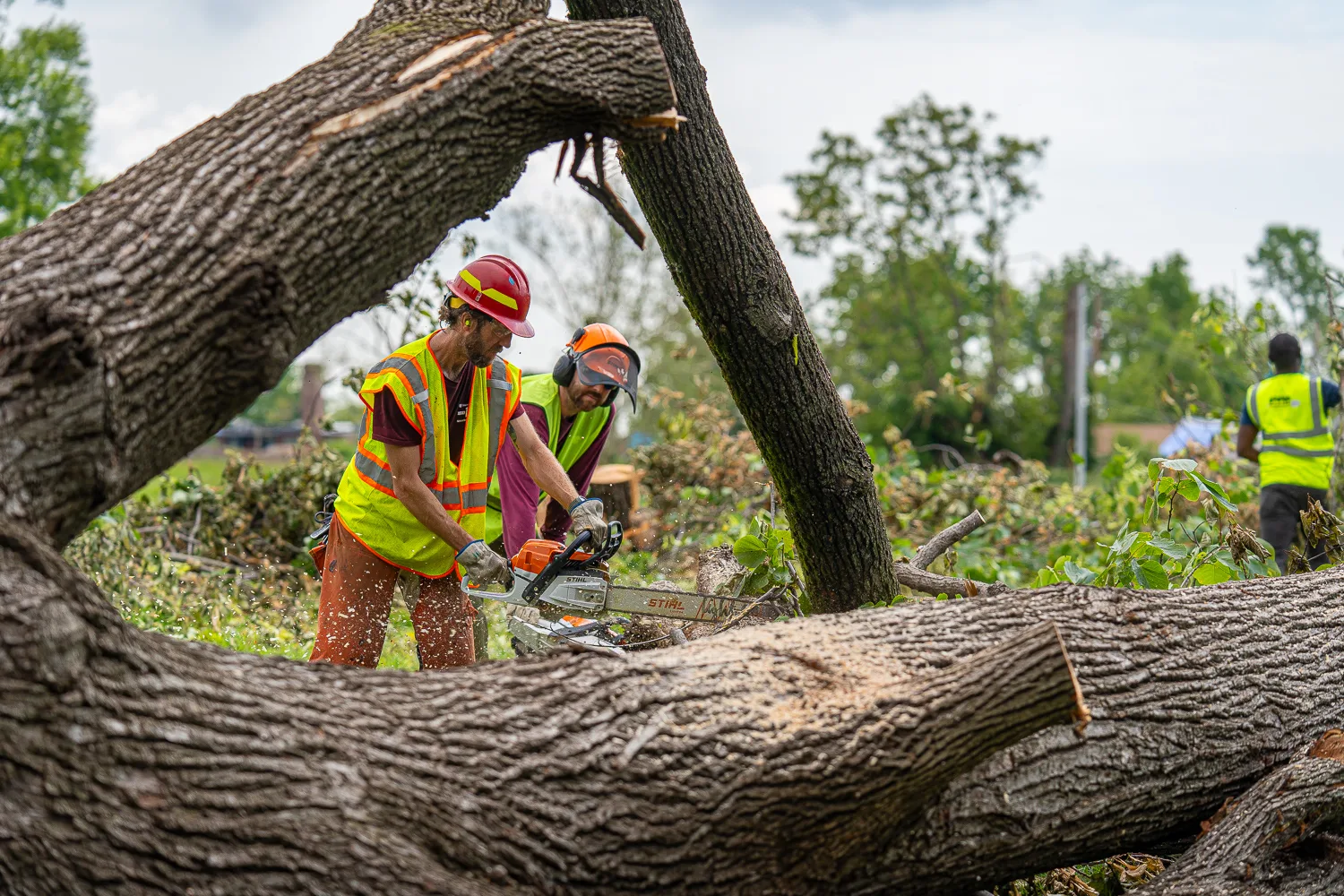
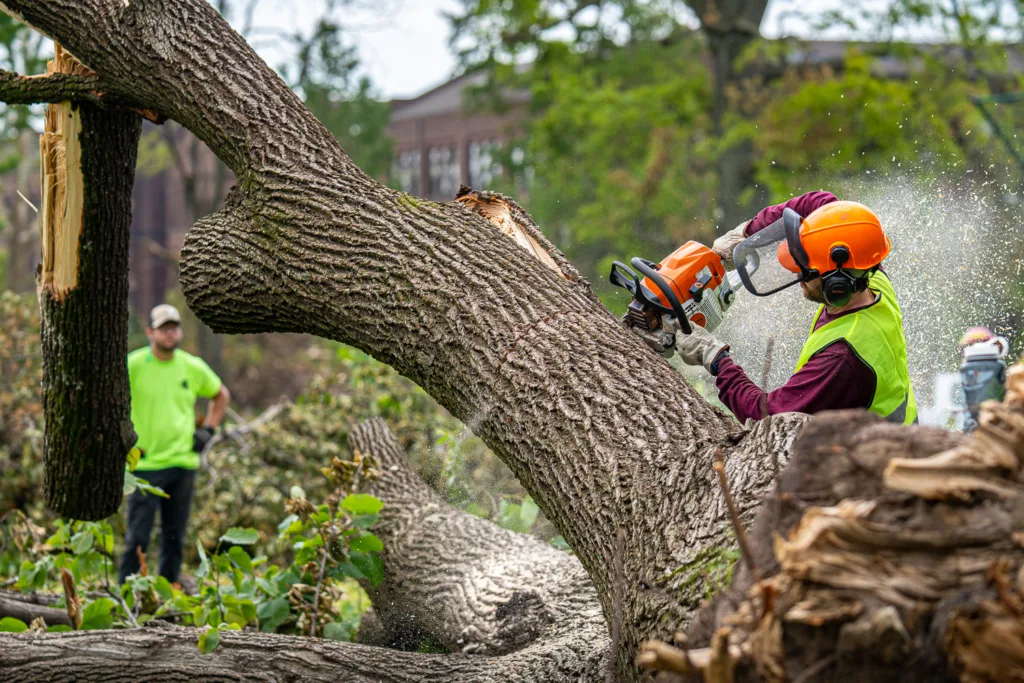
Last week, 34 staffers from the Missouri Botanical Garden, Great Rivers Greenway, and Forest ReLeaf convened to clear out the trees uprooted and broken by the May 16 tornado in two North City parks. It’s a tough job that’s even harder when you really love trees.
“It’s just heartbreaking because, as somebody who knows the science and the investment that it takes to get these mature trees to be as majestic as they are, to see all of that go down with one storm is just … the burden feels really heavy,” says Meridith McAvoy Perkins, executive director of Forest ReLeaf. “Every tiny tree that we plant, it’s going to take decades for it to even be close to the size that so many of these trees were.”
Get a fresh take on the day’s top news
Subscribe to the St. Louis Daily newsletter for a smart, succinct guide to local news from award-winning journalists Sarah Fenske and Ryan Krull.
That doesn’t mean storm-ravaged neighborhoods will look denuded for decades to come. Within 10 years, Perkins says, a tree starts to look “pretty legit.”
“In 10 years, we’ll have something where you’d be like, ‘Oh, OK, this is a tree-lined street,” she says.
Both Forest ReLeaf and MoBOT are dedicated to helping that happen in the months and years to come—not just replanting, but also nurturing young trees when they most need the support.
And for all the devastation, Ivory Perry Park, where staffers removed trees last Thursday and Friday, showed that all is not lost, says Andrew Wyatt, MoBOT’s senior vice president of horticulture & living collections.
“You can actually see some of the smaller trees that Forest ReLeaf planted a few years before, and those are fine,” he says. “Those just bent in the wind, and they stood back up again. And those will be the next generation of trees that fill in for the larger trees that came down. It’s sad to lose some of these very, very old specimens, but there’s hope for the future.”
At the park, Wyatt noticed an oak that had fallen over—clearly in bad condition even before the storm. “You could see clear all the way through the trunk until the top of the tree was rotted out,” he says. “One of the things that we forget is that tornadoes are part of the natural environment, and that is kind of nature’s way of weeding through some of the weaker trees.” Wyatt adds, “Potentially, it cleans out some of the older material and makes way for new life.”
For Perkins, who remembers planting at Ivory Perry Park in 2019, seeing those trees survive shows how the work her organization has done in recent years will pay dividends.
“It was really validating to look at that site and be like, ‘Hell yeah,’” she says.
Indeed, Forest ReLeaf intends to double down on the tree planting it’s been doing across the city in the months, and years, to come. MoBOT plans to assist with that work where it can, Wyatt says, with a focus on helping individuals who lost trees select, plant, and nurture new ones through its Kemper Center for Home Gardening.
But for some tornado survivors, the question of replanting is less a matter of how than why. Even before the storm sent trees through roofs and crashing on top of cars, Perkins says Forest ReLeaf encountered people who were tree skeptical, if not outright hostile. Its Priority ReLeaf initiative focuses on financially underserved neighborhoods, as well as those who’ve been hit with natural disasters. Those residents haven’t always been convinced of the benefits.
More affluent neighborhoods may view trees as a thing of beauty, but when you’re struggling to maintain your house and yard and your resources are limited, a tree can easily seem like just another burden. Seeing the damage from a storm only exacerbates that, Wyatt notes: “It gets a bit raw after an event like this.”
Perkins sees part of her job as helping people understand that the benefits (cleaner air, cooling shade) really do outweigh the problems.
“Once we have those conversations and people feel like they’re informed,” she says, “then all of a sudden they’ll be like, ‘Oh, okay. I’ll take one.’”
Because the summer can be harsh for saplings, the planting won’t begin until fall. Right now, Perkins says, the focus should be on people who need help—and that gives organizations like hers time to strategize, plan, and care for the seedlings being prepared for planting.
Come autumn, the focus will shift to getting young trees in the ground.
“We’re growing more trees than we have ever grown before out at our nursery, thankfully,” she says. “And I think this storm really proved that we need to be doing as much as we can, and that that might not even be enough.”
She says, “In order to respond to something like this, it’s going to take all the players. Forest Park Forever is going to be stepping in. Fairground Park For All is going to be working, the individuals who lost trees in their yards are going to start replanting. We’re just going to have to continue inspiring and reminding people that trees are an asset, and the value they add is worth that investment.”