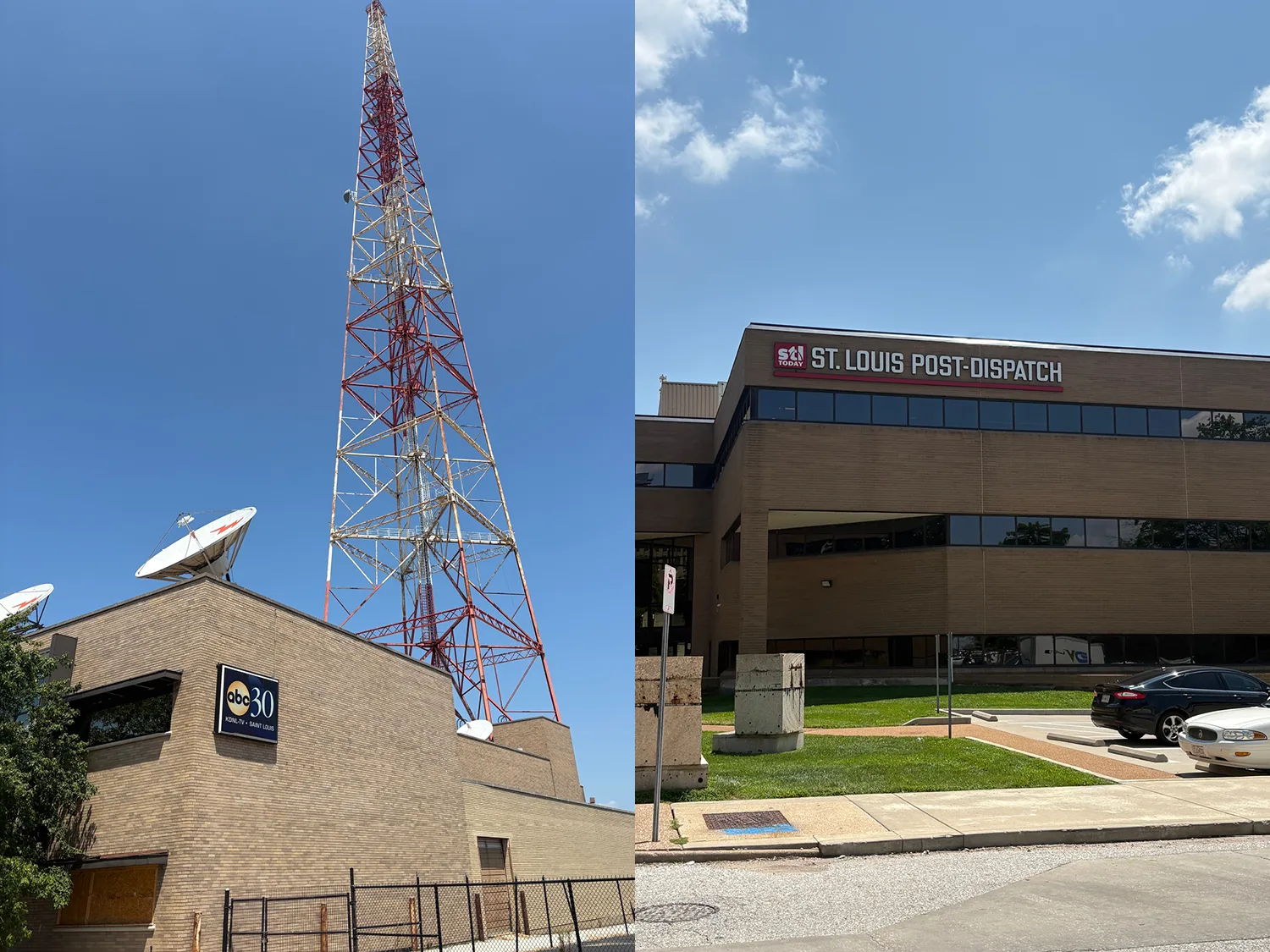
It’s very possible that by the end of this year, perhaps as soon as the end of this summer, the city’s largest newspaper and its largest news/talk radio station will be owned by the same man. At the same time, the companies that own St. Louis television stations could consolidate to the point that two corporations effectively control all five of the city’s primary local TV newscasts.
Those changes stem from three separate business deals now playing out in St. Louis media.
Get a fresh take on the day’s top news
Subscribe to the St. Louis Daily newsletter for a smart, succinct guide to local news from award-winning journalists Sarah Fenske and Ryan Krull.
Billionaire David Hoffmann, the owner of the St. Louis Post-Dispatch, has announced plans to purchase Audacy’s St. Louis stations, which include news powerhouse KMOX (104.1 FM). Nexstar, which owns KTVI (Fox 2) and KPLR (Channel 11), acquired Tegna, the company that owns KSDK (Channel 5), and is hoping to integrate the operations of the two. And ABC has decided to move its St. Louis affiliation from Sinclair Broadcast Group-owned KDNL (Channel 30) to Gray Media, which already operates KMOV (Channel 4).
At first glance, all three look like examples of media consolidation. But lumping them together misses something important. One deal is likely to mean fewer independent newsrooms. Another could actually expand local news in St. Louis. The third is, like all things involving Hoffmann, more mercurial.
The one most likely to shrink local journalism
Most of the time when you’re watching broadcast television, you’re really watching the product of two companies. There’s the network—ABC, NBC, CBS, or Fox—and then there’s the local affiliate that owns the station and produces the local news. Two of the country’s biggest station ownership groups, Nexstar and Tegna, are now one company.
The effects of that have so far been minimal. But if Nexstar succeeds in integrating with Tegna (the matter is held up in court), three of St. Louis’ largest television stations would ultimately be run by one company. For decades, FCC rules generally prohibited one company from owning more than two of the top four stations in a market. But under President Donald Trump, FCC Chairman Brendan Carr has signaled the commission’s willingness to either do away with that rule altogether or at least approve on a case-by-case basis mergers and acquisitions that once would have been off limits.
Former journalist and media professor Stacey Woelfel says that he believes that several lawsuits seeking to stop the merger, including ones filed by Democratic attorneys general, have little chance of success.
The concern, he says, isn’t that viewers will suddenly see identical newscasts on different channels, but that over time, the combined stations will likely employ fewer journalists. That seems likely to be the case in St. Louis.
Scott Diener, the recently retired news director at KMOV, has seen that firsthand. Before coming to St. Louis, he managed two stations operating under common ownership in California.
“They’re probably not going to put the exact same six o’clock news on both stations,” he said. But they don’t need two news directors or two reporters and two photographers at every City Hall press conference.
During his time managing a duopoly, Diener says it was common to send one reporter to cover a news conference and then have that reporter on one station at 5 p.m. reporting the story, then reporting it again on the other station at 6.
“Why send two reporters and two photographers to the same news conference?” he asks.
Woelfel says that’s the most likely outcome.
He outlines as the most likely scenario something like: “Before we had between both newsrooms, we had 30 reporters. Now we’re going to combine newsrooms. We’re going to have 20 reporters. So that’s not great because fewer reporters on the street is less reporting going on.”
He says there’s a best-case scenario in which most of the cuts happen behind the scenes. There’s also a worst-case scenario in which the operations become almost entirely unified.
“You can watch it on channel 99, or you can watch it on channel 98, and it’s the same thing.” he said
Not everyone is convinced consolidation necessarily means diminished journalism.
Broadcaster McGraw Milhaven has been in local media for more than two decades and currently holds down the morning shift on locally-owned KTRS as well as hosts the nationally syndicated America at Night in the evening. He points to the long-running Fox 2/KPLR partnership as evidence that shared ownership doesn’t automatically produce worse local news.
“It’s how they use the resources,” he says.
Four stations don’t necessarily need to send four crews to every burned-out building, he says. If one crew can cover that story for multiple stations, perhaps another reporter is freed up to chase something a bit off the beaten path.
“Everyone’s skittish, because you always think the worst,” he said. “But Channel 2 and Channel 11 did a good job consolidating and there’s more news over there than ever.”
The deal that could actually create more local news
Gray Media’s acquisition of the ABC affiliation looks like yet another story of consolidation.
Experts say it really isn’t.
For years, ABC programming in St. Louis has aired on Sinclair-owned KDNL, a station that produces essentially no local news.
“It’s been kind of shameful that St. Louis hasn’t had news on its ABC affiliate for decades,” says Woelfel.
The relationship between Sinclair and ABC became unusually salient last year when comedian Jimmy Kimmel drew the ire of President Donald Trump and FCC Chair Brendan Carr over a joke he made following the assassination of Charlie Kirk. The conservative-leaning Sinclair stopped broadcasting Jimmy Kimmel Live! in the markets where they are the ABC affiliate for about a week, including here.
Even though the controversy has long since blown over, it’s possible that we’re seeing the downstream effects of it in St. Louis. The affiliation between ABC and Sinclair was due to expire for the St. Louis market and observers suggest that the experience with Kimmel getting pulled off the air may have led ABC to look for a new local affiliation.
Gray Media, which operates CBS affiliate KMOV, threw its hat in the ring. It won the right to also carry ABC programing in this market, which it will soon offer along with local news programming on Channel 32, in addition to KMOV’s home on Channel 4.
Normally that might raise concerns about consolidation. But Diener says the comparison between this and the Nexstar deal misses the mark.
“Sinclair wasn’t willing to invest in a news department in this market,” he says. Gray, however, has already said it intends to launch local news on its new ABC station.
Exactly what that looks like remains to be seen. Diener suspects Gray could create locally produced programming after Good Morning America or before Jimmy Kimmel Live!
If that happens, St. Louis could actually wind up with more local news than it has today, not less.
“We’ll have to wait and see if that happens,” says Woelfel. “But I think it’s good. Are you going to go from having three three newscasts in St. Louis to kind of three and a half, is the best way to look at it.”
The wildcard
Billionaire David Hoffmann certainly has an affinity for legacy media, having bought local newspapers all around the country before late last year purchasing Lee Enterprises and its flagship, the Post-Dispatch. He now intends to purchase Audacy’s radio stations in St. Louis.
It’s the KMOX acquisition that has gotten the most attention, though, as the station has long been a major player in the local news scene, albeit a much diminished one in recent years. Its status as the Cardinals broadcaster also brings a fair amount of cache.
Woelfel said he doesn’t expect dramatic changes for listeners, primarily because the station right now leans more heavily towards talk than news. This, in turn, means fewer of the sort of layoffs that can often occur when two similar businesses become one. Even if you have Post-Dispatch reporters on call, you still need someone to host the afternoon drive-time.
Woelfel adds that he sees potential value if the stations and newspaper can share content and reach audiences that each currently misses. “If it helps them explore ways to get Post-Dispatch content out to people who aren’t receiving it, and vice versa, that’s good,” he says.
Milhaven notes that his outfit is already effectively partnering in a way that the Post and KMOX might. Currently, KTRS broadcasts audio newscasts versions of newscasts created by KMOV.
The longtime radio man also says that, perhaps counter-intuitively, he was thrilled when he heard that Hoffmann was buying KMOX. Despite the station being a competitor, he was all for a person with deep pockets and local ties buying the station and returning it to local control. New York City-based Audacy, by contrast, owns more than 200 radio stations across the country and had recently eliminated the position of the station’s market manager, forcing St. Louis staff to report to someone in Kansas City.
“Even though KTRS and the old folks stations are fierce competitors, I was excited,” Milhaven says. “I’m rooting for St. Louis.” Of Hoffmann’s purchase of the Post, he adds, “If we don’t have a thriving local newspaper, there’s no chance for the region.”
However, Milhaven did have one word of advice for the billionaire.
“If I was advising this man, I would say to stop forcing the newspaper to write glowing stories about him and put him on the front page.”
He adds, “If he does what he says he’s going to do, he’s going to get plenty of praise.“