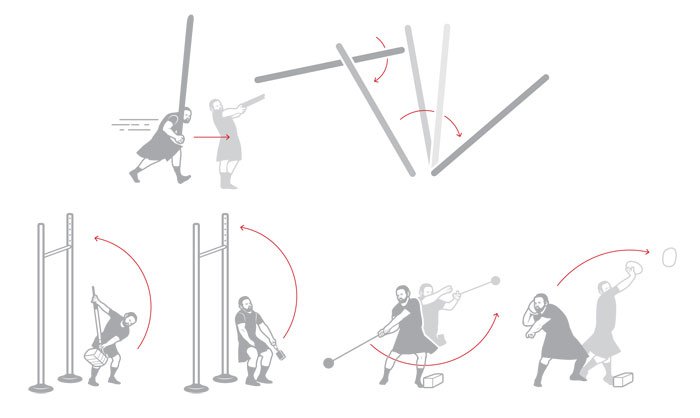
In medieval Scotland, military training was forbidden under British rule, so Scotsmen disguised their Highland warrior training as strongman competitions. The skill required for the weight-for-distance event could be used to break open formations of British soldiers in battle, and the weight-over-bar event was essentially practice for throwing a grappling hook.
St. Louis Scottish Games and Cultural Festival celebrates the Highland tradition of sporting subterfuge in Chesterfield September 23 and 24. The 70-some athletes expected to compete in the festival on Saturday are split into groups by age and gender. Each must complete all nine events and wear a traditional kilt while competing. (Undergarments are also required.)
Get a fresh take on the day’s top news
Subscribe to the St. Louis Daily newsletter for a smart, succinct guide to local news from award-winning journalists Sarah Fenske and Ryan Krull.
We asked Charlie Rivers, athletic director for the festival, to explain the competitions you’ll see at the games:
Caber Toss
In this iconic event, athletes flip into the air a 20-foot, 110- to 140-pound cedar tree trunk, called a caber. Each attempt begins with the strongman hugging the narrow end of the caber as it stands upright. He then walks his hands down to its base, picks it off the ground, takes a few steps, then dramatically hoists it end-over-end into the air so the part he just handled lands 180 degrees away from him. Highest scores are given for flips that land at “12 o’clock,” or, in a straight line from where they were tossed.
Hammer Throw
Although what they throw doesn’t resemble much of a hammer anymore—it’s just a heavy ball at the end of a 4-foot wooden shaft—the event began as a competition among blacksmiths tossing sledgehammers. Watch for shoes with saber-like toes that are dug into the ground to help athletes maintain balance while whirling the hammer around their heads. They throw twice, with 16- and 22-pound hammers.
Weight for Distance
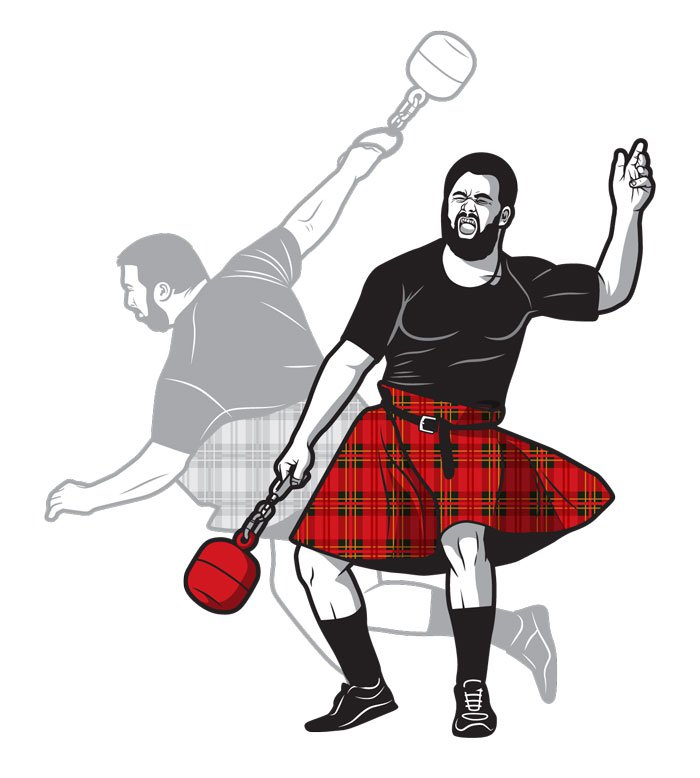
The genesis of the modern Olympic hammer throw, this event is played twice: once with a 56-pound weight and a second time with a 20-pounder. Athletes pick up a weighted ball linked with a short chain to a metal handle, spin to build momentum, then let it fly.
Weight Over Bar
Athletes use one arm to toss a 56-pound weight over a bar. The key to a good toss, according to Rivers, is exploding forward with your hips like an Olympic weightlifter.
Sheaf Toss
This event traces its roots to the agrarian tradition of heaving hay bales into a second-story barn window. Competitors use a pitchfork—Rivers says vintage models are best because of their springy steel—to stab a burlap sack stuffed with 20 pounds of twine, then fling it over their shoulder to clear a bar. Winners in the highest division will toss it upwards of 40 feet.
Braemar and Open Stone Toss
Rather than a uniformly round and consistently heavy Olympic shot, the 22- to 26-pound braemar stones and 16- to 20-pound open stones are slightly different in shape and weight at every tournament. Athletes must determine the balance point on the spot.