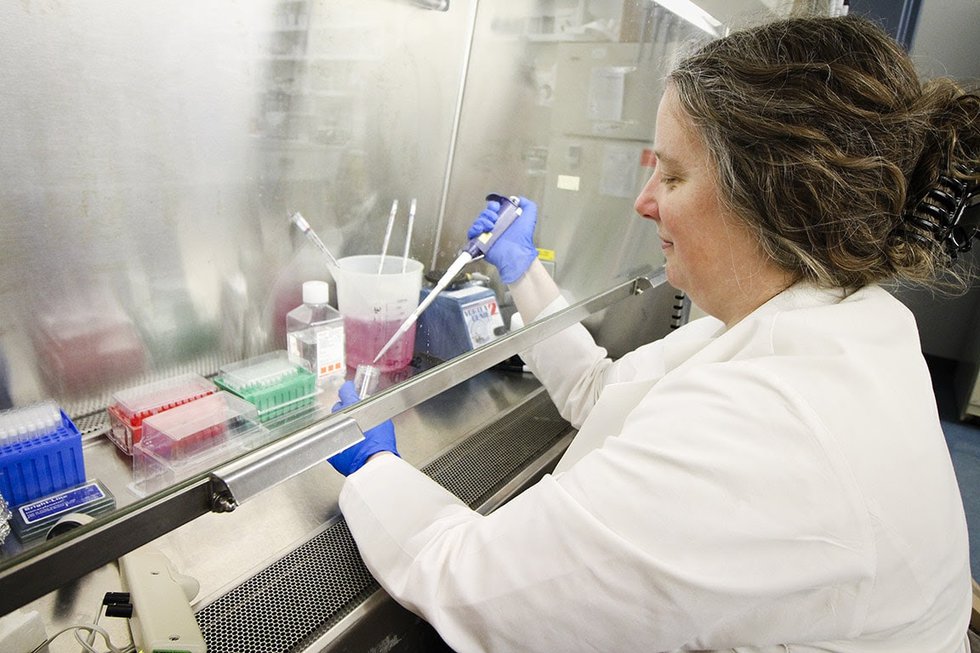
When the National Institutes of Health announced on Wednesday that a clinical trial of remdesivir showed that the antiviral drug shortened the recovery process for patients with advanced COVID-19, it was the first bit of good news Dr. Sarah George had received since the global pandemic started. George, an associate professor of infectious diseases at Saint Louis University, is the principal investigator of the remdesivir trial at the school, treating COVID-19 patients at SSM Health Saint Louis University Hospital. SLU was one of 68 sites worldwide to participate in the NIH-sponsored trial.
“This is the first time we’ve had something that we knew actually did work,” George says. “There’s been a lot of small studies of X, Y, and Z, most of which didn’t really show much of an effect or you couldn’t be sure it was real because it was so small and it wasn’t properly controlled. This is the first time we’ve had good solid data.”
Get a fresh take on the day’s top news
Subscribe to the St. Louis Daily newsletter for a smart, succinct guide to local news from award-winning journalists Sarah Fenske and Ryan Krull.
Remdesivir, manufactured by Gilead Sciences, was shown to shorten recovery time for COVID-19 patients. Patients who received the drug recovered in 11 days; those who took a placebo recovered in 15. Dr. Anthony Fauci, director of the National Institute of Allergy and Infectious Diseases, stated that remdesivir should now be standard of care for patients hospitalized with COVID-19. Gilead has stated that it will now mobilize to manufacture the drug. It expects to produce 1 million rounds by the end of this year. The Food and Drug Administration is also expected to issue an emergency use authorization for the drug.
The drug works, George explains, by directly attacking the COVID-19 virus’s ability to replicate itself. “The COVID-19 virus, like every other virus, the way it causes disease and spreads is it gets into our own body’s cells,” she says. “It basically hijacks them, takes them over, and turns them into virus factories. So the virus reproduces itself and kills our body cells, and, of course, we’re spreading it to other people during that time.” Remdesivir, in essence, prevents the virus from making more of itself.
Still, George says, there’s a long way to go in fighting COVID-19. George, who has studied infectious diseases for almost 25 years, has seen pandemics before, including HIV, H1N1, Ebola, and Zika. None were as bad as the novel coronavirus, which is spread mainly through respiratory droplets and highly infectious. She calls it the most intense pandemic situation she’s been in—as well as the most intense pandemic situation the world has been in since the 1918 flu.
“We deal with viruses, common colds, and that kind of thing,” George says. “But this one, people can seem like they’re getting better, and then they will just crash. Or they will seem to be fine, and then they’re literally dying within hours. We still don’t understand that.”
Health care professionals and researchers are learning new things about COVID-19 every day—and on the fly. The illness can manifest in many different ways. “Initially we thought, respiratory virus, causes kind of a flu-like illness, and some people progress to a pneumonia, which can be fatal,” George recalls. “We now know that there’s a lot higher rate of kidney failure than we should normally see. We still don’t understand that yet, but it’s possible this virus actually attacks our kidneys directly.” She lists other mysteries the virus causes: heart failure, skin rashes that look like frostbite that are appearing in children even though it’s not winter.
“We’re not going to beat this until we get a vaccine,” George says. But she adds that the silver bullet could come in less than a year. Currently, a study is looking at a COVID-19 vaccine that appears to be working in monkeys. Researchers think that part of what is needed is neutralizing antibodies against the viral spike protein, the protein the virus uses to invade human cells. “That’s at least part of what we need in a vaccine—maybe it’s all we need,” George says. “Nobody knows yet.”