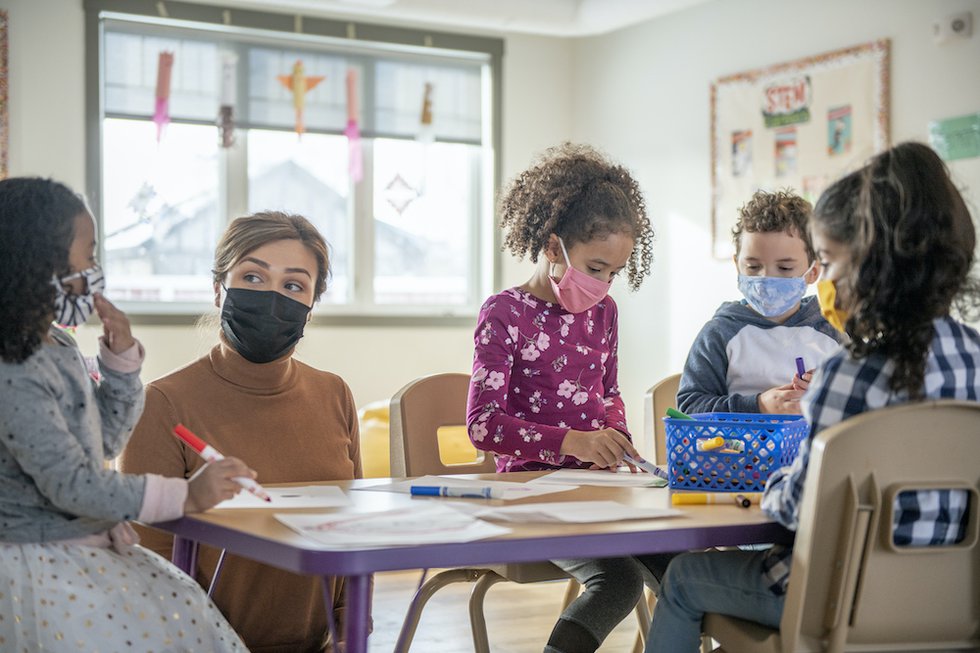
Rochelle Bea weighs and measures her students at the start of every school year. The founder and director of Beginning Futures Learning Center, located in Walnut Park, wants to see which kids might be under- or overweight so she can talk to their parents about healthier food options—though accessing those foods isn’t always easy in a neighborhood where stores selling a variety of fresh produce are few. It also gives Bea the chance to make sure that children who still need a car seat have it. If they don’t, she’ll help parents find one. Still, she makes the weigh-in fun. “We’re bridging home, school, and community, but with a learn-through-play process,” Bea says. “Now this little one knows that they are 40 pounds.” She pronounces “40” slowly, accentuating the syllables, the way you’d teach a child a new word. “Let’s count to 40,” she says, pretending I’m the student.
Earlier this year, in September, the state of Missouri launched its Office of Childhood. The name conjures images of 4-year-olds typing away in cubicles. What it actually is, is a new state agency that combines early childhood services from three separate agencies: the Department of Elementary and Secondary Education (DESE), Health and Senior Services, and Social Services. The goal is to streamline the system for families who need these services and to eliminate some duplications—though no staff members were let go—so the state can feed the money saved back into communities. Now, families can visit one site, earlyconnections.mo.gov, and find information about childcare and early learning needs, family supports like Temporary Assistance for Needy Families, and more.
Get a fresh take on the day’s top news
Subscribe to the St. Louis Daily newsletter for a smart, succinct guide to local news from award-winning journalists Sarah Fenske and Ryan Krull.
Dr. Pam Thomas is the assistant commissioner of the new Office of Childhood. She says that what catapulted the three agencies into thinking about more coordination was a pair of grants the state was awarded in 2019. Thomas is a fan of implementation science. She gathered 15 people from the agencies into a room with a chalkboard. “I like to say, ‘Crazy ideas on the chalkboard,’” Thomas says. “We started talking about, ‘Let’s completely coordinate and streamline our professional development system.’ ‘Let’s talk about how we can use data from the systems that we’re all using.’ We had this big idea of the hub, like, ‘Let’s bring everyone together in the local community, and let’s all help support and fund that.’”
Those regional hubs—one aspect that the Office of Childhood will oversee and which launched last year—are places throughout Missouri that coordinate parent education, home visits, preventative services, social services, and preschool. The state turned to Oregon, which has hubs in 16 regions, for advice on how to implement them. Currently, there are 30 hubs throughout Missouri. The St. Louis Regional Hub includes the nonprofit United 4 Children and the Rockwood School District.
The argument for investing in early childhood care and education is a strong one. According to the Center on the Developing Child at Harvard University, for every dollar invested in early childcare and education, you can expect a return on investment of $4–$9. Some researchers say it’s even higher. According to a report from the Clark–Fox Family Foundation, spending on early childhood education correlates with less spending on things like special education or certain government benefits. One study found that children who attended preschool had a 42 percent higher income in adulthood, and they were significantly less likely to be incarcerated or receive government assistance. When Governor Mike Parson gave his 2021 State of the State address, he called children “the workforce of tomorrow.”
According to the National Institute for Early Education Research, Missouri spends more than $22 million on its two public preschool programs, the Missouri Preschool Program and the Missouri Pre-K Foundation Formula. The Missouri Preschool Program met 10 out of 10 quality standard benchmarks; the Pre-K Foundation Formula met 5 out of 10. Still, those programs only enrolled 6,874 children statewide in 2019–2020—that’s 1.5 percent of 3-year-olds and 7.4 percent of 4-year-olds.
To create more seats, especially in St. Louis’ most underserved neighborhoods, organizations like the STL Pre-K Cooperative, which Bea’s Beginning Futures is part of, is helping community-based early childhood education centers and K–12 educators work together to tap state funding. The Clark–Fox Family Foundation found that in St. Louis, there are 20,576 children ages 0–4 and only 11,814 slots in accredited and licensed facilities in the city. To enroll in the cooperative, 3- and 4-year-old students must be eligible to receive free or reduced-price lunch. A report from the consultant IFF titled “The First Step to Equity” found that of all the children in St. Louis who are eligible for such subsidized care, only 45 percent have an open slot at a learning center or provider in their neighborhood. Out of those children, only 19 percent have an open slot at a learning center or provider that has met requirements beyond licensing, which is an indicator of program quality.
“Navigating the system of how to find pre-K as a privileged child in affluent geographies in St. Louis is very difficult,” says Anne Miller, a consultant who helped create the cooperative. “It can be very expensive, and if you are a child living in traditionally underserved communities, you can only imagine some of the barriers that these families face to accessing pre-K.”
There are barriers to creating the seats, too. Every school district in Missouri is eligible to receive funding as part of the state school funding formula for a number of pre-K students equal to 4 percent of their total enrollment of students eligible for free and reduced-price lunch. In the 2019–2020 school year, educators in St. Louis left some $2.3 million in state funding for early childhood education on the table. That’s because, in addition to uncertainty in navigating the funding stream, schools might not have space or qualified educators for pre-K. “By partnering with the community-based organizations that know how to do pre-K and do pre-K well, it’s a win-win for everyone and especially the families who now have access to free seats that were not being offered before,” Miller says. Around 260 students are part of the co-op, which currently only operates in the city.
City Garden Montessori School, a charter school that serves families in the Botanical Heights, Forest Park Southeast, and Shaw neighborhoods, is part of the cooperative. For years, says CEO and executive director Christie Huck, the number of applicants to City Garden has increased, so in 2018, it set out to make a new strategic plan for growth and decided to start with early childhood. The cooperative was able to help City Garden navigate that expansion by ensuring it tapped available funding streams and helping it become an accredited child care provider, which allows access to additional funds through a subsidy. The school was able to increase its 3- and 4-year-old enrollment from 50 to 220. “As a member of the Pre-K Cooperative, we now are able to serve other charter schools who don’t have pre-K programs,” Huck says. “We have begun by partnering with Atlas Public Schools, which is a new charter school, and are enrolling a few students from Atlas in our early childhood program. We will continue to build off of that and hopefully partner with other charter schools as well.”
KIPP: Wonder Academy, in Marine Villa, is another school in the cooperative that has been able to expand and provide pre-K seats. In this case, SouthSide Early Childhood Center operates the programming for 3- and 4-year-olds out of four classrooms at KIPP. Chris Frills, KIPP: Wonder Academy’s founding school leader, says joining the cooperative was a logical next step for KIPP. For years, it operated out of a church on Jefferson, down the street from SouthSide, and SouthSide early learners often came to KIPP for kindergarten—in a way, the two were already partners. KIPP wanted to somehow expand into the pre-K arena. The cooperative made it easier to do that. This year, it opened 80 pre-K spots. The waitlist, however, is in the hundreds, which illustrates the need to grow year after year, Frills says.
But with its four rooms, KIPP and SouthSide are likely maxed out. Frills calls this a “big, hairy, sticky problem.” As an example, he points out that there’s a little girl who lives across the street from the school and who is on the waiting list. “Every day, at [our school’s] arrival, she’s getting in the car to go to another place, to be dropped off at Grandma’s house, and she says, ‘I want to go to that school,’” he says, meaning KIPP.
One could understand the appeal. On a tour of the four pre-K classrooms, we stop to look at the school’s pet lizard, Lizzo. The reptile recently celebrated a birthday, and handmade cards from students decorate the wall behind her glass tank. (One young learner couldn’t stop talking about Lizzo at home but made no mention that she was an animal, not a human. A parent called to see if they really had a classmate with the same name as the singer.) In each of the classrooms, students enjoy breakfast at tot-sized tables before moving to a carpet where they sing songs and do some affirmations. In one room, students take turns looking out the window and reporting to their classmates what they’ve observed about the weather. It’s dreary this morning, so they break out into a song about rainy days. It’s also bookmobile day, and soon the St. Louis County Library’s mobile library will roll up, and the kids will file outside to check out new reading material.
At Beginning Futures, Bea’s STEAM curriculum is designed to help children learn through play. They participate in seven stations, or centers, a day, interacting with their peers, exploring, and growing into social and emotionally healthy little people. Officially, it’s all about kindergarten readiness. But Bea goes further.
“We do a great deal to make this program a cornerstone of the community,” she says. “When you pull around the corner from the north, south, east, or west, you see a beacon of sunshine. You see beautiful flowers, you see cut grass, you hear the noise from a joyful playground. You see parents coming into a safe haven, and they feel comfortable here. They see qualified educators who are ready to meet and greet them every day, to give them the standard that their family and their children need to thrive and survive.”
“Survive” isn’t hyperbole. Fall has just begun, and the cooler weather is fast approaching. Families in Bea’s neighborhood sometimes have to use alternative ways to warm their homes, she says, such as space heaters. Tragically, a family that lived behind Beginning Futures suffered a home fire, and three children died. The school holds an annual fire safety week to honor them. Bea’s staff helps each family create a fire safety plan—what they’ll do in the event of a fire at home—and takes an inventory of who needs smoke and carbon monoxide detectors. They give the information to the local fire department, and together with the school’s maintenance staff, the firefighters come to the homes of families in need and install the alarms.
STL Pre-K Cooperative would like to expand into St. Louis County, but challenges still exist: attracting more talent and securing even more funding. Bea has built an educator pipeline by fostering a relationship with Central Methodist University, but she stresses that philanthropic support is needed to take Beginning Futures to the next level. Not that she’s letting it slow her down—she’s working on a new location of the early childhood education center.
“We are tapped out here—we have used every bit of space,” she says with a laugh. “I’m about to move my office and work out of a shed outside just so we can get more students in.”