St. Louis is no stranger to the dangers of lead exposure, and in the aftermath of the May 16, 2025, tornado, people were worried. What does all that disturbed matter mean for people’s health? That question has sprung a team of academics into action over the past few months, testing soil for lead, and standing up further initiatives to proactively respond to the ongoing tornado recovery effort.
Jeff Catalano, a professor of earth, planetary, and environmental sciences at Washington University, had questions. After fears of the potential risk for lead paint exposure following last year’s Palisades fire in Los Angeles, Catalano and others at WashU had the same thought following the tornado. “The thought was: well, this tornado dispersed a bunch of building material, maybe that’s also a hazard,” he says. That concern is shared by some residents and organizers in the tornado’s impact area, and local officials have also voiced concern.
Get a fresh take on the day’s top news
Subscribe to the St. Louis Daily newsletter for a smart, succinct guide to local news from award-winning journalists Sarah Fenske and Ryan Krull.
But the researchers, so far, have found lead exposure to be more of a historic problem in the region. They say it doesn’t seem, yet, that the tornado exacerbated lead exposure in St. Louis.
That doesn’t mean the risk is zero; it just suggests the problem areas pre-date the tornado.
Soil tests so far in the zone of impact have yielded “splotchy” results, Catalano tells SLM. Some spots test well below the normal threshold, while others are significantly higher.
“What I think we’re finding is that I don’t think the tornado introduced any lead of substantial amount … but I think there’s a lot of lead in the city, just from these historical things. It’s this legacy problem,” Catalano says.
The project is part of a broader project organized by WashU’s Brown School. CLEAN STL started by testing vacant lots owned by the city’s land bank, the Land Reutilization Authority, then moved on to test lots with buildings on them through partnerships with local organizations like Better Family Life, 4theVille, and LOVEtheLOU. They found a pattern, Catalano says. There were some “hot spots” on the empty lots, reaching 3,000 parts of lead per million. Catalano says Missouri soil usually has around 30 ppm in it, naturally, and a typical range is between 10 and 50 ppm. But some lots with structures saw as much as a potentially aberrant 10,000 ppm. A more typical high spot was in the middle thousands.
The highest concentrations of lead followed what researchers call the “drip line,” he says, the band along a structure where ice and water drip down from gutters. Lead was also particularly high along curbs, where exhaust from vehicle tailpipes would collect in the days of leaded gasoline. Alleyways and picket fences with leaded paint also are common places where lead collects. The pattern they’ve found so far is one Catalano thinks would also be true in other parts of the city, even those not impacted by the tornado.
“Some of it seems to move through the air, like hit the walls of buildings, stick, and then get washed down into the soil by rain,” Catalano says of lead contamination. “[A] legacy of decades of use have left a lot of lead in cities. … The longer you’ve had human activity, at least in the post-industrial era and industrial era, the more lead you have.”
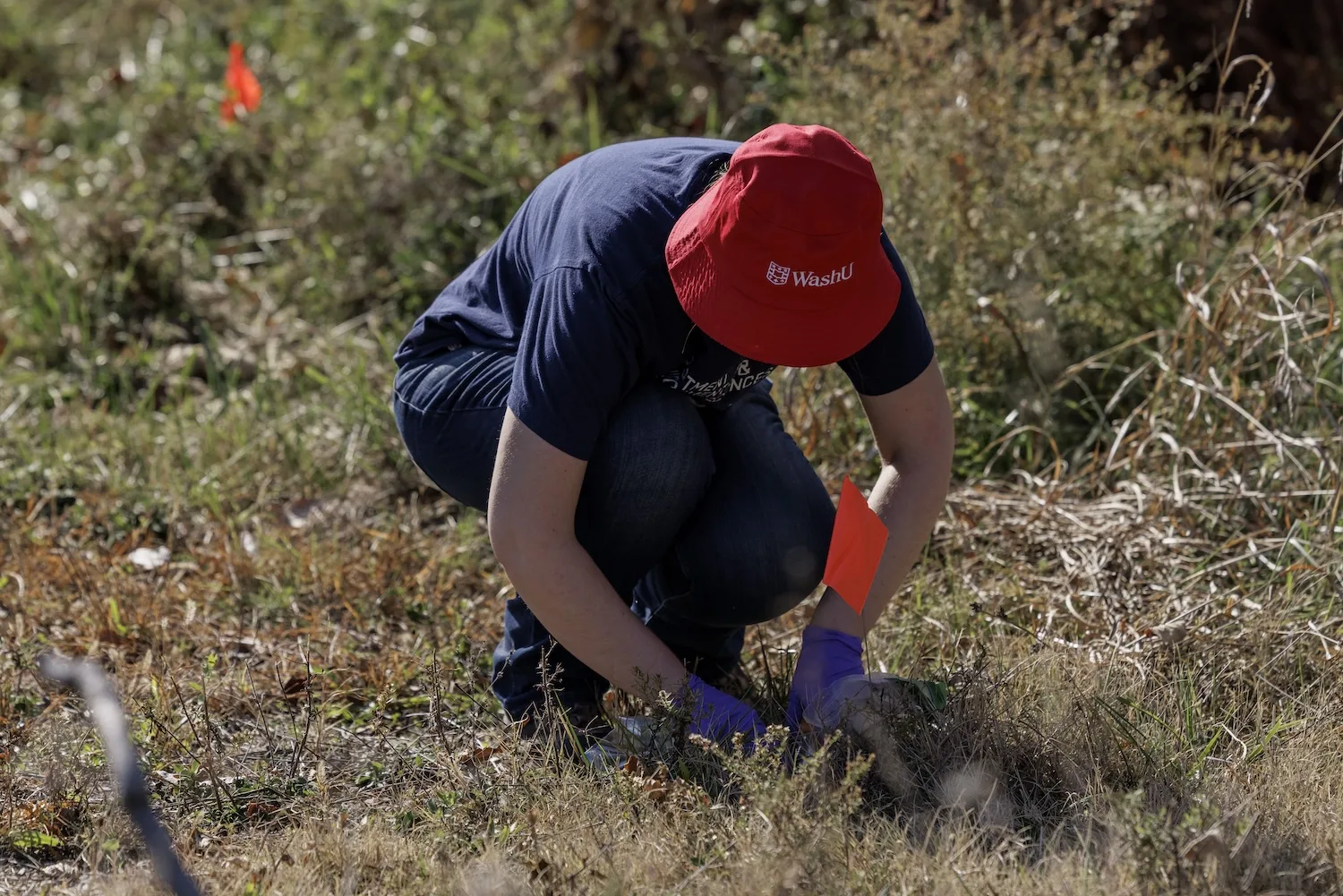
Finding that the tornado may not be a direct catalyst for increased lead exposure isn’t stopping work on the CLEAN STL project. Catalano estimates that his research team has collected just below 400 soil samples, with more to come. Students grind the samples by hand to create a fine mixture similar to flour, a labor-intensive process. That allows an x-ray to pass through the samples, called “x-ray fluorescence,” to measure the lead content. “It’s about 10 minutes of grinding,” he says.
Chris van Bergen, the executive director of WashU’s Public Exchange, says the work will expand to more neighborhood organizations in the next year to 18 months. On the engineering side, van Bergen says the researchers will set up air quality monitoring stations, particularly in areas that will see a high rate of demolition, to ensure contractors are following proper demolition procedures, like wetting and treating concrete.
Air and soil testing differ in some key ways, van Bergen says. While soil testing measures the amount of lead in a sample, air testing will measure the amount of dust in a certain area, but not necessarily “what’s in the dust.”
“When you demolish a building, it’s kind of everything,” he says, adding that testing can help hold contractors accountable.
The work, he says, is crucial.
“It, really, was born out of a lack of actual information, because people were really working with fear and rumor and speculation,” he says. “They were being approached by developers to pay pennies on the dollar with the assumption that the soil is toxic. … [We’re] really wanting to create a project where we could arm people with solid information.”
The Brown School launched its Public Exchange last year (CLEAN STL is its first project) to bring researchers and their focus directly on local problems, tearing down a barrier between entrenched academic institutions and the broader community. Van Bergen was brought on as its first executive director, leading cross-disciplinary work based on emergent and continuing local challenges. The program was launched by Brown School dean Dorian Traube, who came to St. Louis from Los Angeles’ University of Southern California, home of the first public exchange concept.
“[Van Bergen] really did a listening tour in the community of things that people were most worried about,” Traube says. “Anything we wanted to do, we wanted to make sure it was salient for St. Louis, and not that it was being imposed upon [people]. We were saying, ‘We have resources for you, we would love to help solve.’ The thing that kept coming up was the tornado.”
While there are longer-term plans, Catalano stresses to SLM that he is looking for ways to speed up the data collection and transmission process, instead of a months-long wait from sample collection to testing to getting data. That delay doesn’t help people with serious, ongoing worries, he says.
Why It Matters: Lead exposure concerns in St. Louis aren’t new. The National Resources Defense Council in 2024 listed the city as the seventh-highest for “service lines known to contain any lead pipe.” Lead poisoning can cause especially serious developmental problems for children. Its effects range from from behavior changes brought on by low levels of lead in children, to serious, potentially fatal ones, according to St. Louis Children’s Hospital. Reducing lead exposure is a key step towards helping kids thrive—and, in time, increasing their economic mobility.
What’s Next: More soil and air testing is coming from WashU—and, potentially, some sort of strategy to combat the problem of historic contamination. Catalano suggests that lead in the soil could be a surface-level issue. Throughout the summer, the researchers will begin looking at lead levels by depth, in the hopes that there could be cost-effective solutions by potentially mixing deeper soil with less lead with the surface soil, or other dilution strategies.
“I feel obligated … to come up with some sort of solution,” he says. “We can’t just dump it in the lap of the city, like, ‘Hey, there’s another problem you have,’ you know? … We can maybe make more practical recommendations that would be in the spirit of how the EPA would clean up a site.”