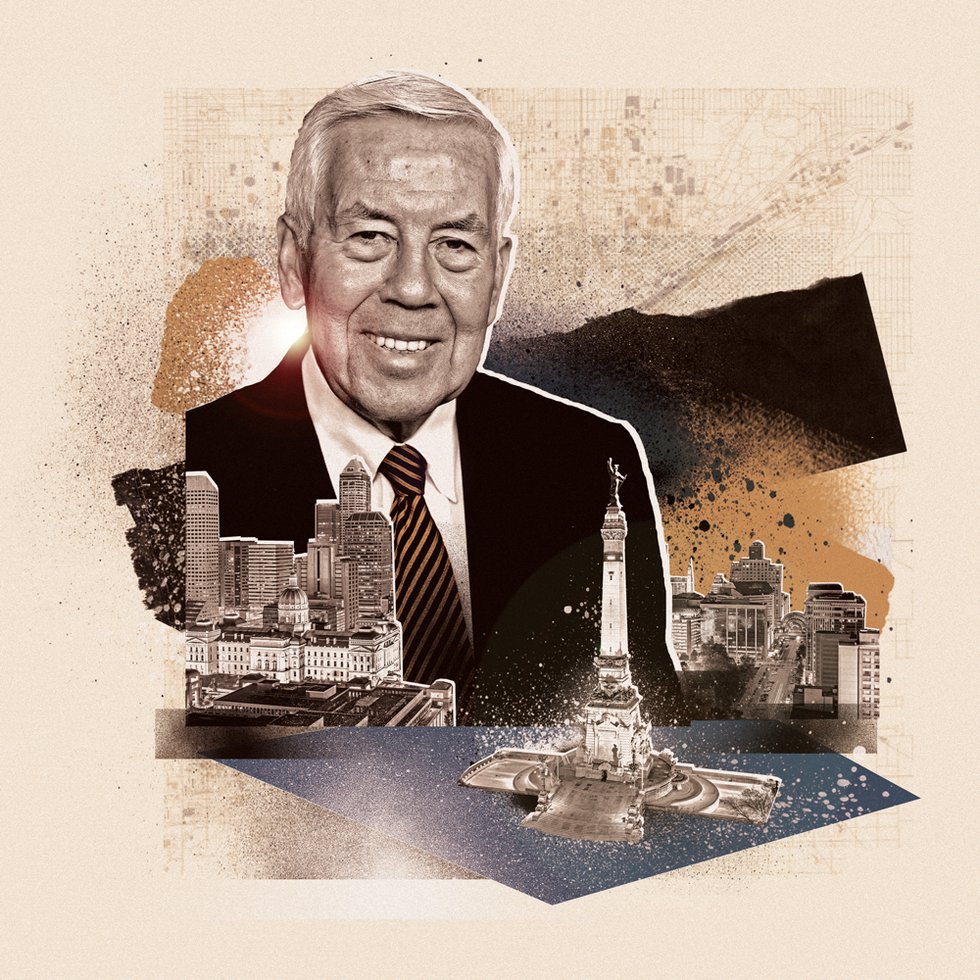
Things are going to get better,” says John Krauss, an attorney and mediator from Indianapolis, “but they’re not going to get better immediately. Everything’s supposed to be like never-never land? No, it isn’t.” In the late 1960s, Krauss worked with former Indianapolis Mayor Richard Lugar (pictured) to create Unigov, or “unified government,” a consolidation of the city of Indianapolis and neighboring Marion County. It was during a period of history—the 1950s and ’60s—when mergers were taking place everywhere. Jacksonville, Florida; and Nashville were two other major cities to enact city-county mergers at the time. Fifty years later, Better Together is proposing something similar.
Stats & Stories
Get a fresh take on the day’s top news
Subscribe to the St. Louis Daily newsletter for a smart, succinct guide to local news from award-winning journalists Sarah Fenske and Ryan Krull.
Better Together’s members use stats from other cities that have consolidated a city and a county government, such as Indianapolis and Louisville, Kentucky, which underwent a merger in 2003, to illustrate why they believe that St. Louis should do the same.
“Research revealed that the per capita cost to fund municipal services in Indianapolis–Marion County was $1,208.11 and $1,094.76 in Louisville–Jefferson County,” reads a regional spending update by the nonprofit. “The St. Louis region was spending between $609.60 and $714.95 more per capital [sic] than these comparable regions.”
Statistics and personal accounts say the Indianapolis merger was a success. According to research by Jeff Wachter, who studied the impact of the city’s consolidation 40 years on, population grew while those of cities of similar size (including St. Louis) declined. Employment rose every year through 2011. The city’s tax base became larger, and Indianapolis completed more than 50 development projects, including work on the zoo, the children’s museum, the city market, and the now-demolished Market Square Arena. It also attracted an NFL team, the Colts.
In 2005 and 2007, the police and some fire districts consolidated even further. Bart Peterson, who served as Indianapolis’ mayor at the time of the merger and now works as CEO and president of nonprofit Christel House International, says Unigov changed the outlook of the population. “The psychological effect was to tie the people outside the core of the city to the city and to give them a common destiny,” he says. “We didn’t see ourselves as a big city before Unigov, and one census after Unigov, we were the eighth-largest city in the country because our population almost tripled… All of a sudden, everybody’s fates were intertwined. That changed everything—it changed the way the city looked at itself, the whole way it acted to the outside world. It built our confidence as a city enormously.”
Never-Never Land
There’s little doubt that Unigov saved Indianapolis from declining growth. As Krauss says, however, it’s not never-never land. When he and Lugar started the consolidation, in 1969, Marion County comprised 23 cities and towns and nine townships. Its population was less than St. Louis County’s, at 697,567 in 1960. Unlike the Better Together proposal, the police weren’t in the running for consolidation—it was too politically risky. (As in the Better Together proposal, fire and schools weren’t considered.) One big difference: Instead of putting it up to a referendum as Better Together plans to do, Lugar went through the Indiana General Assembly. (Upon learning that legislative action isn’t an option here, Krauss exclaims, “So [St. Louis is] going to let people who don’t live there have a say? Oh, jeez.”)
The 1968 state races in Indianapolis and Marion County were incredibly important. Lugar, a Republican, traveled around Indiana, campaigning for candidates in his party and asking favors—and he was successful. In 1968, Republicans controlled the mayor’s office, the Indianapolis City Council, the Marion County Council, both houses of the General Assembly, and the governor’s office. Unigov passed in the Senate 28 to 16 and in the House 66 to 29. It went into effect January 1, 1970. Overnight, the city grew from 82 to 402 square miles and increased its population from 480,000 to 740,000. (Four cities—Lawrence, Speedway, Beech Grove, and Southport—were excluded.)
So what made the plan work—and what lessons should St. Louis glean from it?
“You can’t overpromise,” says Krauss. “You don’t eat a whole pizza at once.” The plan must work for the whole city-county, he says. Because you can’t eat the whole pizza, “try doing some smaller steps,” such as unified planning.
If you want to merge police departments, he says, you have to find a way to keep everyone’s job and pension. At the same time, he recognizes that a city can’t have countless captains. Currently, St. Louis County has more than 50 independent police forces, as well as the county police, who work in unincorporated areas and partner in municipal contracts. In early February, Florissant Mayor Thomas P. Schneider said the town’s police force was its best asset and that “we would like to continue to be protected by police whom we know and trust.” Better Together’s director of community-based studies, Dave Leipholtz, says the appointed police chief will decide how the consolidation process will unfold if the legislation passes.
Indianapolis essentially underwent a two-phase consolidation: first, the cities, towns, and townships, in 1970; then the police and some fire departments, in 2005 and 2007. Does St. Louis’ plan to make a go of all of it at once raise a red flag for Peterson? “None of this is easy,” he says. “That’s the reason other people haven’t done it. You can find lots of academic literature that will say, ‘This is the smartest thing to do.’ From my perspective, this is the most important thing I can say: I think the best thing that ever happened to Indianapolis was doing Unigov in 1970.”
Wachter’s research shows the resulting decrease in the proportion of African-Americans in the consolidated city under Unigov, from 27 to 17 percent, was cause for criticism. Though some in the black community noted that anything that revitalized the city would in turn be good for everyone, many African-American voters dubbed Unigov a Unigrab; they argued that adding around 85,000 primarily white Republican voters from Marion County would dilute the power of black voters, limiting their ability to influence development projects in city neighborhoods, for instance. Some critics also contended that the Democratic Party would have to spend more time appealing to suburban Republicans. “They saw loss of power,” Krauss says, “so you had to get black leaders either neutralized or involved and advocating for it.” Former state Senator Patrick Chavis labeled Unigov a way for white people to “avert a takeover of Indianapolis by blacks,” The Washington Post reported.
Concerned that black political influence would drop should Better Together’s plan pass, aldermen Brandon Bosley and John Collins-Muhammad started a petition drive in late February to recall Mayor Lyda Krewson. But Better Together says it did take representation into consideration, one reason the group’s plan proposes a 33-member metro city council and keeps municipal mayors, aldermen, and city aldermen in place. “They have less authority when it comes to police, courts, and sales tax revenue, but those representatives will still be representing those communities,” Leipholtz says. After visiting cities with larger councils, Better Together concluded that communities were better represented with more members.
“We made that number larger and similar to our state representative breakdown, because the demographics there reflect closely who we are as a region,” Leipholtz says. “We wanted a number that would be able to do that and share that representation on the council.”
More Mergers
Consolidated cities with populations over 500,000
- City and county of San Francisco, California
- City and county of Denver, Colorado
- Jacksonville-Duval County, Florida
- Indianapolis-Marion County, Indiana
- Louisville-Jefferson County, Kentucky
- Boston-Suffolk County, Massachusetts
- The City of New York-Counties of Bronx, Kings, Queens, and Richmond, New York
- Philadelphia-Philadelphia County, Pennsylvania
- Nashville-Davidson County, Tennessee
Source: The National League of Cities