It was a wild Wednesday in the ongoing battle between St. Louis city leaders and the state-appointed Board of Police Commissioners, with the board approving a drone program over the mayor’s strenuous objections, board members not showing up to an aldermanic hearing despite being subpoenaed to do so, and at least one alderman openly mulling whether to try to have the commissioners forcibly hauled before the committee—all in the course of a few hours.
Five of the six commissioners did not show up to a hearing of the Board of Aldermen’s Budget and Public Employees Committee, about a week and a half after they were subpoenaed to appear.
Get a fresh take on the day’s top news
Subscribe to the St. Louis Daily newsletter for a smart, succinct guide to local news from award-winning journalists Sarah Fenske and Ryan Krull.
The committee issued that subpoena on May 18 to the Police Board, demanding that they—or that at least one of them—appear Wednesday at noon. That demand followed the St. Louis Metropolitan Police Department refusing to show up before the committee, as is routine for all city departments as the city works through its annual budget process. The Police Board cited the city’s lawsuit against the board as the reason they could not appear.
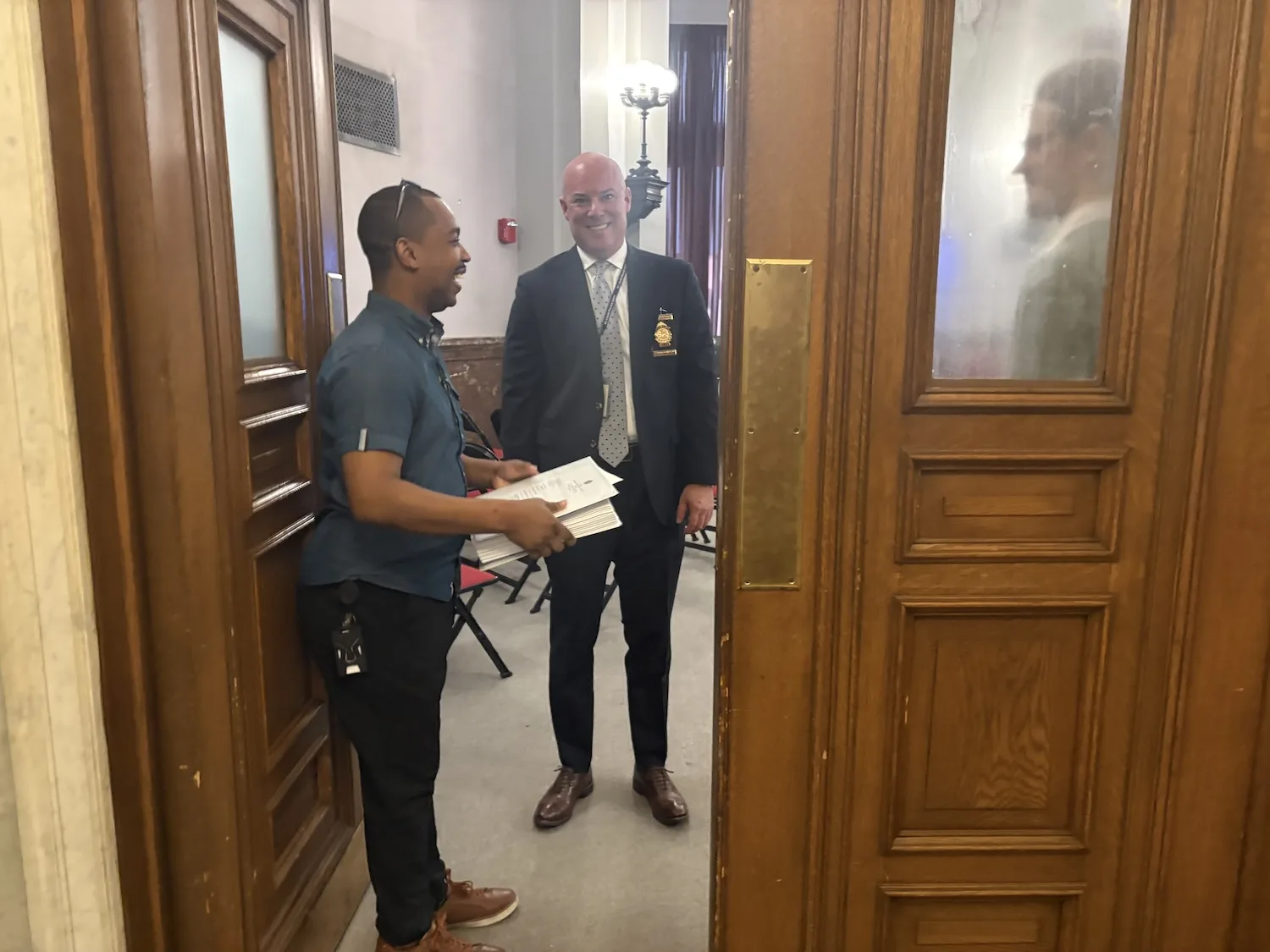
On Wednesday, the Police Board members were widely expected to not show up at noon. There was however a surprise, when a pair of officers showed up at the Kennedy Hearing Room in City Hall a few minutes before noon to drop off a load of binders, each with 700 pages inside, containing the police’s budget.
“Seven hundred pages of fun,” was how Lt. Colin Tully, the Police Board’s secretary, described the documents as he handed them over to Jay Nelson, chief of staff to Aldermanic President Megan Green.
Committee chairman Rasheen Aldridge called the no-show disrespectful and that what they’d sent was “700 pages of nonsense.”
Alderman Michael Browning, who vice-chairs the budget committee, said that the hundred of pages being dropped off minutes before the hearing was “an absolute farce.”
“I think this is a common legal tactic to bury your opponent in paper,” he said. “They printed off everything they could think to print off.”
SLMPD spokesman Mitch McCoy said in a statement that the board “takes its responsibility to the people of St. Louis seriously and remains committed to open communication regarding public safety funding.”
McCoy’s statement said that the board will continue to work through the budget process “as we await legal clarity” but reiterated that the ongoing litigation prevented members from appearing before the committee. (The Police Board is currently on one side or the other of five lawsuits.)
The 700 pages of documents included a letter from board attorney Chris Graville saying that the subpoenas to the commissioners were “invalid and of no effect” because the commissioners were not personally served and because the subpoenas themselves sought information the commissioners didn’t even have.
Graville also added that if the commissioners did show up at the hearing, it would represent a quorum of the board, and thus violate state transparency laws dictating that meetings of public entities be noticed 24 hours before they occur.
According to the city’s code, it is a misdemeanor to ignore a subpoena issued by the Board of Aldermen. However, the Budget committee would have to ask a municipal judge that the charge be filed, and it’s not clear aldermen are willing to take that step.
“I won’t say yay or nay. I’m digesting everything that just transpired. I wouldn’t be opposed to it,” said Aldridge after the meeting, asked if he supported going to a municipal judge seeking an arrest warrant.
Asked the same question, Alderwoman Alisha Sonnier said, “I think we’re exploring all the options to get the answers the public deserves.”
Alderman Matt Devoti, who both sits on the Budget Committee and is an attorney, said that his reading of city ordinance holds that the committee itself is able to issue what is called “writ of attachment.”
“The writ of attachment being the command that directs, in this case, the city marshal to find the person and bring them back before the committee,” he says.
Asked whether he thought issuing such a writ was a good idea, Devoti notes that he was the lone “present” vote when the committee otherwise voted unanimously to subpoena the Police Board. His concern then was whether the committee had the stomach to follow through if the commissioners no-showed.
Devoti says there is a “very good argument” that the commissioners failed to comply with the subpoena,” he said. But, he added, “Do we want to escalate what is already a mess? This is a circus, and do the members of the committee have the stomach to escalate the circus?”
That would require city leaders to wade into matters of century-old arcane city ordinance where few have gone before. Right off the bat, there is the question of whether the Police Board’s dispatch of the binders amounts to ignoring the subpoena.
Setting even that question aside, any escalation on the part of the aldermen would get tricky in any number of other ways. When serving a subpoena and compelling appearance before the Board of Aldermen, city code authorizes the city marshal office to arrest and jail individuals to compel an appearance. But the city marshal office is under the St. Louis police, making it unclear if the city marshal office would comply. Legal observers add it is unclear whether a judge would uphold a subpoena issued by the city against a governmental entity impaneled by the state.
There is however precedent dating all the way back to 1916 bolstering aldermanic ability to issue subpoenas to compel testimony with the threat of arrest. That case involved the Board of Aldermen seeking what is called a “special writ” in circuit court rather than a municipal misdemeanor charge, but the Missouri Supreme Court ultimately ruled that individuals could be arrested for defying an aldermanic subpoena.
Back in 1916, the president of the Laclede Gas Light Company was asked to come before the Board of Aldermen to answer questions about a “gentleman’s agreement” his company had with the then-Mayor Henry Kiel. He refused to answer those questions and was “adjudged to be in contempt,” according to a contemporaneous article in The St. Louis Star and Times. He was “technically arrested” in November, the newspapers wrote. Holman filed a lawsuit to prevent himself from having to appear before the aldermen. The matter went to appeals court and then the Missouri Supreme Court, which ruled in May 1917 that the utility CEO had to answer the aldermen’s questions.
Back in 2026, on Wednesday, the one Police Board commissioner who did show up at the committee hearing was Mayor Cara Spencer.
“I am not here under duress. I do not represent the Board of Police Commissioners. I am very frustrated by this process,” she said. “I share the frustration of the failure of the Board of Police Commissioners or the department to come before the committee.”
Spencer went on to air myriad frustrations with the Police Board, including that the police headquarters where they hold their meetings have at times been locked and difficult for her staff to access. She said that, to her knowledge, there had only been one meeting of the board where the public was able to speak. She said that she felt it was “ridiculous” that board attorney Graville receives a significantly higher per-hour rate when working for the board as part of litigation.
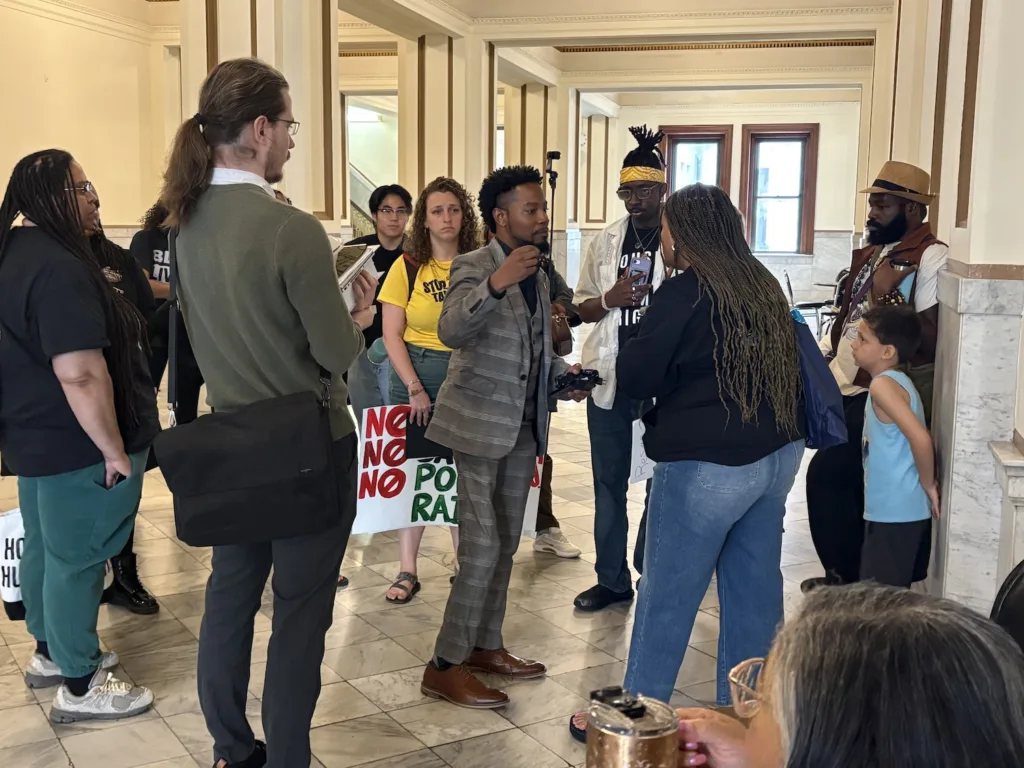
A couple dozen protestors were in attendance at the meeting, heckling Spencer throughout. They’d been there for hours.
The protestors showed up at 9:30 a.m. when the Budget Committee hearing began, not realizing that the subpoena requested the Police Board to show up at noon. Aldridge, the budget committee chair, purchased pizza for anyone who stuck around. Almost everyone did.
But without their foils present, the protesters heckled Spencer, Browning, and eventually even Aldridge.
The protestors were upset about the more than $250 million budget the Police Board is seeking for next fiscal year, as well as the $67 million it’s demanding for the current fiscal year. Spencer has adamantly opposed both those efforts. However, because Spencer was the one in the room, she was the one who got yelled at. Chants of “one term mayor” bubbled up from the crowd a couple times. Someone else held a sign in which the C in Spencer’s name was replaced with three K’s.
After the hearing adjourned, protesters gathered around Aldridge as he was leaving and yelled at him for not doing more to reduce the money allocated for the police department. “I want my BOA to have a spine,” yelled one protestor.
“It’s what you sign up for,” said one City Hall insider, explaining why Spencer (and by extension, Aldridge) had drawn the protestors’ intense ire over an issue on which the two of them are the closest thing the protesters have to an ally on the Police Board and the Board of Aldermen, respectively. “You’re the punching bag for everyone.”
The tumult on display at the Kennedy Hearing Room was perhaps why the Police Board had its meeting that morning on Zoom.
At that meeting, the board approved the department procuring six drones using money from the nonprofit St. Louis Police Foundation to launch a “Drone as First Responder” program. The drones will respond to 911 calls and likely be able to arrive at the scene faster than an officer. One Police Board staffer said that the drones, which will fly at around 400 feet, will not be used for surveillance, nor will they be recording nor livestreaming as they travel. Board members indicated that they’re writing policies to safeguard civil liberties.
Spencer criticized her fellow board members for announcing the program with only 24-hour notice. She said that a city attorney hadn’t been able to review the contract with Seattle-based drone provider BRINC. ”I would never as mayor sign a contract for which I’ve had 12 hours to review,” she said. Graville said that attorneys with the department had been able to review it.
Board members in favor of the program said that the board needed to sign the contract within the next 24 hours in order to lock in the agreed upon price as well as to have to have the program up and running by the time that Olympic soccer comes to St. Louis in 2028.
Spencer questioned why they needed to act so quickly to have a program stood up two years from now. She described the Police Board as being “under the gun” and the timeline tantamount to a “flash sale.” She also said that she hadn’t received any information about what the program would cost other than what she’d read in St. Louis Magazine the day prior.
The mayor dialed into the Zoom call on the sidelines of a meeting of the East West Gateway Council of Governments. She was not active on the call when the drone matter came to vote. It ultimately passed 4-0.


