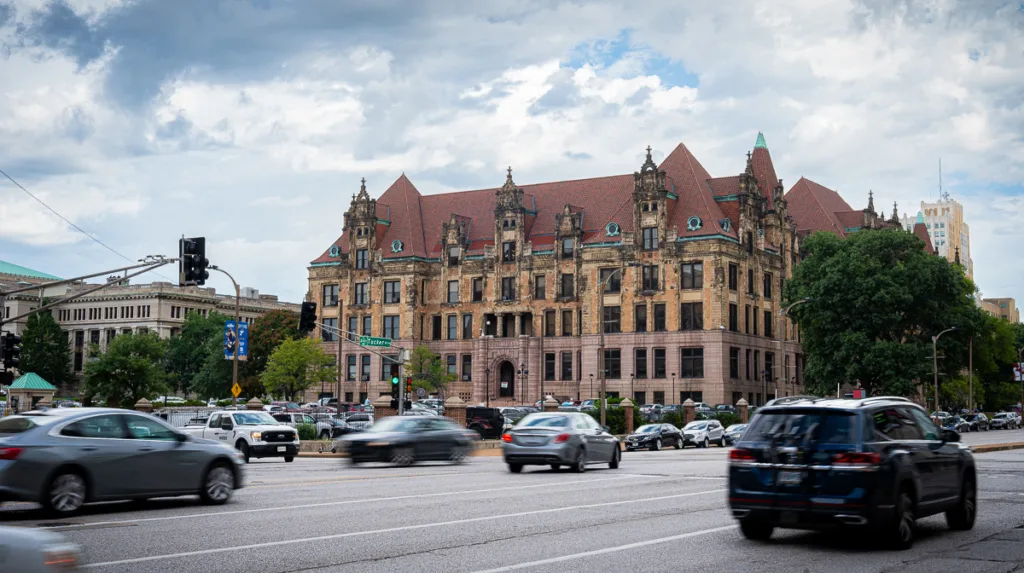
There’s no sugarcoating the facts: 2024 was the deadliest year on record for pedestrians in both St. Louis city and county. Both jurisdictions saw a big increase in fatalities caused by motorists last year, with 23 people killed in St. Louis city and 36 in St. Louis County.
Reported crashes involving cyclists and pedestrians dropped by 9.5 percent from 2023 to 2024. But pedestrian deaths surged, with an increase of 24 percent in St. Louis County and 187 percent in the city of St. Louis.
Get a fresh take on the day’s top news
Subscribe to the St. Louis Daily newsletter for a smart, succinct guide to local news from award-winning journalists Sarah Fenske and Ryan Krull.
That’s all according to Trailnet, the local nonprofit that advocates for better biking and walking. This is Trailnet’s fifth annual crash report, although it looks at data going back to 2010.
“From 2010-2024, we’ve seen fewer traffic crashes and injuries reported overall, whether you’re walking, biking, or driving,” the report notes. “But beneath these numbers lies a deeply troubling reality: traffic deaths are rising across the region. Despite fewer crashes, more people are being killed. This isn’t just a setback—it’s a warning sign that our streets are becoming more dangerous, not less.”
Trailnet CEO Cindy Mense says good work is taking place across the region to address traffic violence. Missouri finally has a distracted driving law that makes it illegal to text while driving (one of the last states in the union to enact one). The city recently passed a Complete Streets ordinance, which requires street design to take into account all users, not just motorists. MoDOT and the East-West Gateway Council of Governments took the same principles into account with new guidance for improving arterials, with design standards that are mindful of cyclists, pedestrians, and public transit users.
But the immediate toll of the region’s deadly streets can’t help but seize attention, Mense says.
“We’re making progress with putting the foundation of things that you need, like policies on distracted driving and making changes to the streets, but the way people drive, and the speeds that they drive, it just seems to be snowballing and continuing to make things worse for people outside of cars,” she says.
Mense blames several factors for this year’s increase in deaths, even as the total number of crashes has declined. Vehicles have grown increasingly bigger, making them more deadly when accidents occur. The year also saw several crashes with multiple victims. And, it comes after a year when deaths had finally declined—making bad numbers look even worse.
Trailnet is focused on state legislation that would enshrine driver’s education within secondary schools. They’re also advocating for better street design. As the report points out, a disproportionate number of pedestrian deaths last year took place in communities of color—something that has also been historically true across the U.S. As researchers have shown (including Angie Schmitt in her groundbreaking book Right of Way: Race, Class and the Silent Crisis of Pedestrian Deaths in America), that’s a combination of both bad design and the fact that more people in those communities tend to be reliant on public transit. If you put a bus stop in an area where there are few accessible crosswalks, the potential for a deadly crash goes way up. That’s something born out in Trailnet’s report, which shows a high percentage of fatalities taking place on arterials and places other than crosswalks.
Says Mense, “People in these communities have very few choices. What we’re trying to do is to give them safer and more options to get to where they need to go without being at risk.”
Trailnet also hopes the report will provide much-needed incentives to slow down. It lists the most dangerous streets in both the city and the county.
“I personally know the top 10 most dangerous corridors,” Mense notes, “and any time I have to drive them, or my kids have to drive them, they know them. I’m like, ‘Be careful when you’re driving on South Grand or Kingshighway’—just being aware that these are dangerous streets where there are a lot of crashes. People can slow down and pay better attention while they’re going through these corridors.”