As the mammoth Railway Exchange building and AT&T tower continue to sit vacant downtown, a bipartisan trio of St. Louis-area state legislators is winning cross-sector support in Jefferson City for a plan they say would make redeveloping those structures easier.
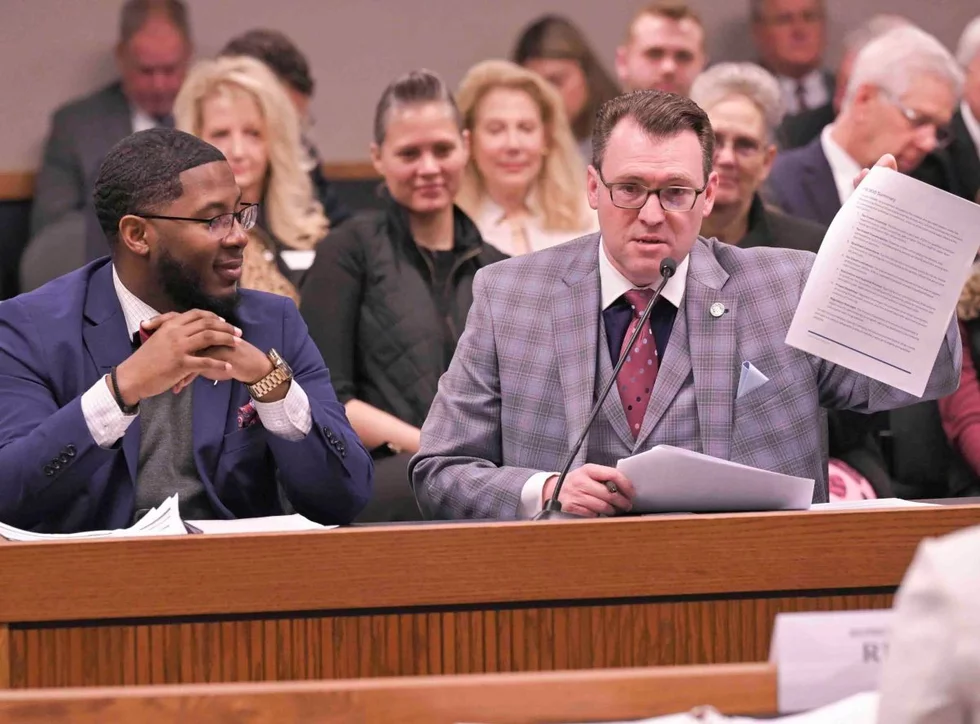
At a Missouri House of Representatives hearing on Tuesday, supporters came out in force to back the effort by Rep. Travis Wilson (R-St. Charles) and Rep. Marty Joe Murray (D-St. Louis) to pass “office conversion” legislation. (The two filed similar bills, seen here and here.) The idea is to create a 25 percent tax credit for converting office space to residential, retail, or other commercial uses.
Get a fresh take on the day’s top news
Subscribe to the St. Louis Daily newsletter for a smart, succinct guide to local news from award-winning journalists Sarah Fenske and Ryan Krull.
The bill would allow for up to $50 million in state tax credits for converting buildings over 750,000 square feet. (Only a handful of such buildings exist in the state.) To be eligible, buildings must have served as office space for at least 25 years. They need not be certified as historic, but if they are, the new credits may be “stacked” atop state historic preservation tax credits, which were reformed last year.
Present at Tuesday’s hearing were representatives from the development and construction sectors, the business group Greater St. Louis Inc., the Missouri Chamber of Commerce, the Missouri Municipal League, and Gayla Roten, director of the Missouri Main Streets Connection. Roten’s enthusiasm centers on the rural-area component of the bill, which provides that at least 25 percent of the total allowable tax credits go toward “mainstreet districts,” which have been designated in cities and towns all around Missouri.
Jim Farrell, president of Historic Revitalization for Missouri, submitted written testimony on behalf of Charles Goldman, who is trying to redevelop AT&T tower. In his statement, Goldman wrote that currently, “downtown’s market conditions are not strong enough to support the immense cost” of projects such as his $350 million vision for that building, which would include 600 market-rate apartments; 80,000 square feet of retail, dining, and event space; and nearly 1,000 automated parking spaces. The proposed legislation, he wrote, “is the key to bringing this vision to life.”
At Tuesday’s House hearing, both Wilson and Murray beamed as various committee members praised them for working together. One called them “bipartisan rockstars.” A few weeks ago, an office-conversion bill by Sen. Steve Roberts (D-St. Louis) got a committee hearing and enjoyed a similar level of support. (You can see who testified here.)
Why It Matters: Less than a year ago, the Wall Street Journal described St. Louis’ central business district as being stuck in a “doom loop” and “real estate nightmare.” The office vacancy rate in downtown St. Louis, now several years out from the pandemic, sits at 22.7 percent, compared to Clayton’s 15.4 percent. Credits could help move empty office buildings into more productive use.
What’s Next: While the House’s economic development committee has yet to vote on Wilson and Murray’s bills, Roberts’ bill was passed out of the Senate committee and has been put on the calendar for a floor debate, which may take place as early as next week. Plans would need to pass both House and Senate before the session ends in May—and meet muster with Gov. Mike Kehoe—to become law.