
There was a dark cloud hanging over St. Louis on April 27, 2026. Weather forecasts the week before had predicted a belt of severe weather stretching from Minnesota into northeast Texas, cutting across western Missouri and parts of five bordering states.
As the weekend passed—and weather crept eastward—the highest risk of tornado activity was placed, again, squarely on St. Louis, triggering several tornado warnings and sounding sirens.
Get a fresh take on the day’s top news
Subscribe to the St. Louis Daily newsletter for a smart, succinct guide to local news from award-winning journalists Sarah Fenske and Ryan Krull.
Many St. Louisans had believed, for a long time, that something special about our city, and maybe cities in general, insulated us from the potential for a tornado to cut through the urban core. May 16, 2025, changed that. It made the threat of catastrophe much more real for the people of St. Louis, and dramatically changed the social fabric—and built environment—of North City in particular.
By now it’s been well-documented that tornado sirens didn’t sound in many parts of the city last year, though the systemic breakdown that led to that failure has reportedly been fixed. But last month’s tornado warning awoke a new anxiety that comes when sirens do sound: What if it all happens again?
“As we’re seeing these waves of storms go through, it takes the overarching anxiety levels of our city and raises them,” says Ben Perrin, director of disaster services for the Catholic Charities of St. Louis. He was already responding to several disasters in Missouri when the tornado hit St. Louis on May 16, 2025, and last month found himself with serious deja vu. “I’m watching on my phone … the dark clouds forming over Forest Park. I’ve just got a pit in my stomach thinking, ‘Well, now they’re talking about this potentially taking … the same path as the May 16 tornado.’ My whole life over the last year has been wrapped up in this stuff. It’s taken a major toll emotionally, physically … all of that.”
Michael McLemore II recalls that people used to gather on their porches in his Greater Ville neighborhood to watch storms go by. He says, “You don’t really go out to watch the storms happen anymore, like you used to.”
Ultimately, there were no local fatalities or even injuries on April 27, though there were reports of damage. But that Monday in April, nearly a year after the May 2025 tornado, pulled into focus how traumatized many St. Louisans are.
“Ever since then, there’s a real PTSD,” Delesha George, an Academy neighborhood resident, says of May 16, 2025. “[That] Monday I was really, just on edge.”
Cami Thomas, a videographer and North City resident who mobilized her arts business into an active on-the-ground response team in the wake of the May tornado, felt torn that spring day 11 months later.
“Monday was bad, like having a day almost a year later where there’s threats of tornadoes, or the sky turns green again, or the wind is howling, the trees are scraping against the windows,” she says. “There are things that I didn’t realize we’re traumatizing until a new storm comes and my mind can say, ‘It’s not May 16, 2025, it’s not May 16, 2025,’ but my body and my nervous system and everything that makes us function day to day are in overdrive.
“It may as well have been May 16.”
‘The old St. Louis’
It’s been a year since May 16, 2025, and the worst circumstances you could find yourself in and the most fortunate still exist in tandem, even as they did at the moment of impact. There are still many people living in damaged, exposed structures and living out of their cars. Peter and Paul Community Services CEO Anthony D’Agostino says the number of unsheltered people in St. Louis doubled from 2025 to 2026, to more than 700, and says the tornado played a part in that increase.
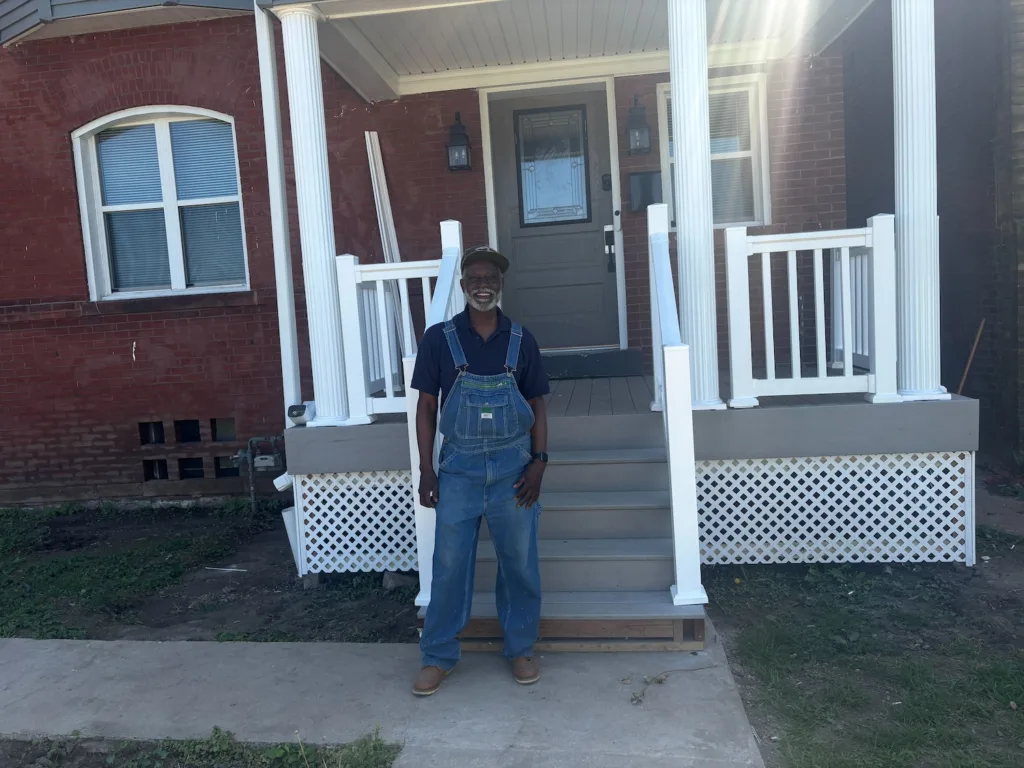
Some people have been able to patch up their homes, including Dennis and Terrance Morgan. The brothers live in an immaculate, recently repaired home across from Fountain Park, a few houses down from the now-demolished Centennial Christian Church, where Patricia Penelton died during the tornado. The brothers called her “the rock of the Church,” and spoke of her as “Ms. Pat.”
The Morgan brothers’ house is the one they and their nine siblings (among them a staggering three pairs of twins) were raised in. The pair’s good cheer is especially striking considering Dennis’ home just a few blocks west was damaged to the point of needing demolition, forcing him to relocate into the family home.
But even the most hopeful—and apparently whole—are adjacent to destruction. A house between the Morgans’ and the former Centennial Church sits ripped open, with a makeshift tarp no longer secure on the exposed upper floor.
Not only do the full scope of circumstances on that day persist, but time has complicated what recovery looks like. Every day that it rains, homes open to the elements in North City get a bit worse. Damage may compound. Mold enters structures that look like they might just need a new tarp job or a patch in their leaky roof. The Monday after the tornado brought steady rain, almost immediately soaking damaged buildings that people rushed to patch up with tarping.
The tornado tore through St. Louis in a particularly destructive way, exacerbating woeful inequities. First touching down in Clayton, it sped up as it crossed into St. Louis city limits, reaching peak velocity in Black neighborhoods often referred to simply as “historically disinvested.” It caused $1.6 billion in “damaged property loss,” the St. Louis Recovery Office noted in a presentation from April, adding that it hit more than 20 city neighborhoods, impacted a stretch of the city with more than 48,000 residents, and damaged more than 5,000 structures.
The disaster is canonized into the St. Louis lexicon as simply: May 16, burned into public memory with other era-defining moments in local history like the police shooting of Michael Brown in 2014 or the demolition of Pruitt-Igoe in the 1970s.
“The tornado is as much of a historical—and never-to-return-again event—as something like the World’s Fair or Mill Creek Valley being demolished and urban renewal,” says Dallas Adams, a disaster case manager at St. Louis nonprofit LifeWise who takes an active role in navigating the complicated constellation of recovery services for her clients, all aged 60 or older.
“There is not a return back to old St. Louis. St. Louis is forever changed by the tornado, and there is no definitive end.”

Organizing to do what the city can’t
When disaster struck St. Louis last year, it was one month and one day after the city got a new mayor and a few months into a new federal administration that looked to gut the Federal Emergency Management Agency. Local leaders had to learn how to respond to a disaster as they went. Nearly a year later, Mayor Cara Spencer repeated the adage that the city “had to be essentially building the airplane in flight,” when asked about how she’d deploy resources faster.
Resources still haven’t come fast enough, as she and the city’s chief recovery officer Julian Nicks have freely admitted over the past year. Spencer has blamed, in part, the Trump administration for forcing the city to learn what FEMA will and won’t cover, and standing in those gaps. The city’s Recovery Office says there’s been a total $364 million allocated from all levels of government for the recovery effort (per a presentation with numbers dated in March). Of that total, 45 percent ($164 million) has led to signed agreements and 43 percent ($155 million) is going to work that’s now underway. That’s out of an estimated $1.6 billion of damage.
As the city was learning as it went, another group stood up and deployed to help North City residents the evening of the storm, and for six weeks thereafter: The People’s Response. A joint venture between Action St. Louis and ForTheCultureSTL, the resource hub saw more than 10,000 volunteers, and helped more than 7,000 households, according to an impact report it commissioned.
Action St. Louis hasn’t forgotten an early message from Spencer not to “self-deploy,” says McLemore. His home was damaged by the tornado, and he’s the electoral justice organizer for Action St. Louis, previously known chiefly as a political organization backing progressive candidates, including the incumbent mayor that Spencer ousted in April 2025. Action now has the phrase on T-shirts. McLemore acknowledges that some disaster experts say deploying in the initial chaos can lead to a “second disaster,” but for the activist group, it felt like a necessity.
“Because of the history of disinvestment in North St. Louis, and just the lack of immediate response the day of, we knew that we’d ultimately be on our own,” he says. “Like, in the immediate aftermath of the storm, we didn’t see search and rescue until day three. Even then, when they pulled up, it was four guys on one of those quads. They stopped at where I was, and I gave them a rundown of the situation. They drove off. That was it.”
In the weeks that followed, as volunteers handed out supplies during the day at the O’Fallon Park Recreation Complex and served hot meals in the evening, The People’s Response forged a “machine” that residents praised for filling the gap left by the government. They, too, were learning as they went, McLemore notes: “None of us are, technically, trained disaster responders or anything like that.”
Action St. Louis then established the People’s Response fellowship program, “a six-month paid leadership and organizing program” for North City residents impacted by the tornado that trained them in advocacy, organizing, and leadership. Among the fellows was Cami Thomas, whose work eventually culminated in a resource hub at the art gallery The Luminary and delivered truckloads of goods to the impact area.
Thomas herself saw the tornado from two disparate sides of the city. Working out of her studio at Gravois and Jefferson avenues as the tornado hit, she recalled people in South City thinking the tornado had largely passed by the city. “They were like, ‘It’s kind of a crazy storm out there, right?’” she recalled. “I’m like, ‘Guys, no, this is bad; this is bad.’ … These are two different realities.”
Thomas has since been consumed by tornado response. “I threw a bunch of supplies in my basket at Home Depot, like axes and tarps, just stuff that I thought would be helpful,” she says of her birthday on May 17. “I went with a couple friends towards … where I heard The People’s Response had their hub. We couldn’t even get to that because the line was so long. So then we just started going street by street, seeing who needed what.
“If someone said they needed food, we’d give them food. … If they needed help moving a tree, we did that, and just like, asking people what they needed.”
This past April, Thomas helped bring to St. Louis the Carnegie Endowment for International Peace, a think tank that studies the flow of money for disasters. Touring St. Louis with Thomas’ organization, the outside observers found St. Louis at a crucial inflection point, calling for serious advocacy and central planning to steer the city on a sustainable path to recovery. (Since their visit, Nicks told SLM the city has also been in talks with the Carnegie Endowment.)
Thomas herself has been mulling plans for the future. “This last year has shown that it will be up to us and that we’re gonna have to take the will of the people into our hands,” she says.
Action St. Louis is now pushing for a $150 million spend from the city’s Rams settlement fund—$40 million more than what’s in the bill introduced by Spencer and Aldermanic President Megan Green. One of the organization’s main arguments is that there is lopsided funding for demolition and debris removal, way more than what would be designated for repairs. An April presentation from the city’s Recovery Office detailing the entire funding structure for tornado response showed a combined $236 million in various debris removal pots, and just $19 million for stabilizing and repairing damaged homes.
The week of the tornado’s one-year anniversary, St. Louis began demolishing some of the 120 properties in its “demolition pipeline,” using a fraction of the $100 million it got from the state. So far, the city has only seen $10 million from that fund, in what Nicks has called a “pilot” program. (Nicks stresses that he is confident more funds are coming from that bucket, at the state’s discretion. The Missouri Department of Public Safety did not respond to questions from SLM.)
When the legislature approved that money, Missouri officials signalled that the state’s priority was for debris removal over home repair. A slide from the Recovery Office listing all of the funds available as of April lists $28 million in “public debris removal,” $206 million in demolition and debris work for unsafe structures and private property debris, and $2 million for emergency demolitions. That same document lists just $19 million for stabilizing and repairing homes, listing tarps, boards, and roofing as examples.
“That’s why we care so much about allocating the Rams money specifically for the rebuild and reconstruction of the areas, because there are hundreds of millions of dollars directly earmarked that won’t be used for anything else but demolition and debris removal,” says McLemore.
Efforts both big and small
As residents fear what comes next, like gentrification or another year of slow rebuilding, neighborhood groups, nonprofits, and other organizations have emerged with their own, sometimes competing plans for the present and future.
Ali Rand, a mother of five living just south of Delmar in the Central West End, has famously become a force organizing people to help her neighbors north of Delmar—brick by brick, Venmo donation by Venmo donation. Many formally organized charities stepped up too, like Catholic Charities of St. Louis, which responds to—and sometimes helps coordinate—disaster responses at all levels in the state. “We like to view ourselves as being first to the table and the last to leave,” its director of disaster services, Perrin, says.
Along with many other aid efforts, big and small, disaster case managers have popped up to help residents, many funded through the interest on the city’s Rams settlement funds and hired through the United Way. Adams, a disaster case manager with LifeWise, tells SLM a lot of their work is connecting residents with the many, scattered services on offer: from legal help with Legal Services of Eastern Missouri to reapplications for people negotiating with FEMA.
LOVEtheLOU also stepped up after the tornado. Operating out of a church and community center near the intersection of Taylor Avenue and Dr. Martin Luther King Jr. Drive long before the tornado hit, the faith-based organization has become a hub for community organization.
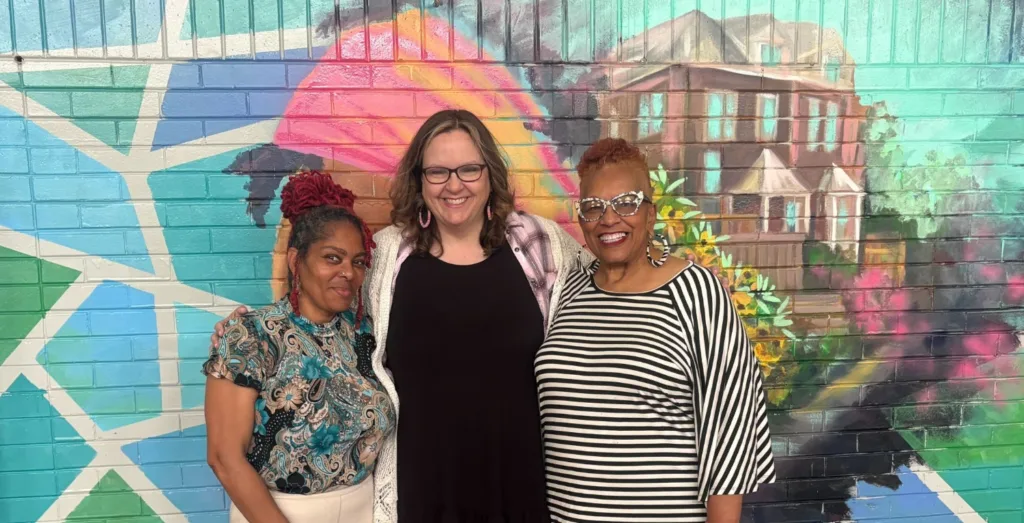
It’s worked to elevate matriarchs in the community it sees as key pillars of community support to “Persons of Peace.” When the tornado hit, those people became a natural distribution channel to get resources out to residents, says founder and executive director Lucas Rouggly. “They could take care of their block and take care of everybody that was close to them,” he says. That includes Richetta Price and Pat Miller.
LOVEtheLOU facilitated direct aid for both Price and Miller, securing each a check from the Compton Hill Reservoir Square Residents Association. That association on the city’s Southside to fix Miller’s back wall, which came down in the tornado, rendering her home unlivable. She plans to move back in August. “They did more for me than the city of St. Louis,” Miller says.
Price says that, as she was looking for contractors to repair the extensive damage to her roof, interior, siding, and garage, the Compton Hill residents’ association also “adopted” her to ensure she wouldn’t get scammed.
Miller’s hoping to build momentum in her neighborhood. “You get one house that looks good and other people say, ‘Well, I want my house to look good,’” Miller says. “This has been a battle, but I don’t intend to be defeated.”
Miller says she has a reputation for being the one to make her voice known at neighborhood meetings. In a spirited back-and-forth with Miller, Price emphasizes the need to hold fellow community members accountable, mentioning she’s distressed about reports she’d heard that workers attempting to repair the city’s electrical grid were shot at. Miller asks if she’s ever been to a government meeting, to tell them how she feels. Price dismisses that as oblique to the larger problem. “I’m talking about us,” she says.
Rouggly, a native of small-town Missouri who moved to North City nearly two decades ago as an expression of his faith, takes a more diplomatic view. “We went from crisis mode to recovery mode, and now we’re looking at … what is restoration? Ms. Pat keeps using the word ‘rebirth,’” he says.
A new organization founded by Kimberly Turner, an attorney and Realtor, also stepped up in the wake of the tornado to guide people through the complex systems of recovery. The Coalition, made up of individuals and organizations with expertise in law, insurance, and real estate, ran a community hub for people in need of support. They trained volunteers, canvassed, and handed out more than 15,000 “Know Your Rights” flyers. Turner says they also offered free legal assistance and helped file insurance claims. That advisory hub meets still, monthly, to advise residents.
Turner is concerned about a host of issues in North City, including rising insurance premiums and the high rate of uninsured people (the city says as many as 75 percent of people in the impact area were uninsured). Systematically raising prices for, or not insuring certain ZIP codes, is another form of redlining, she says.
She’s seen another form of redlining too: Even people with insurance find that contractors on their insurers’ lists refuse to work in certain ZIP codes. Turner wants the state’s Department of Commerce and Insurance to keep a log of insurers who have discriminatory practices. She sees a need for reform of the insurance industry.
“This is a time that allows for us to step up, as a community, and correct some previous wrongs—previous redlining and previous denials of resources to a community. And now is the opportunity to help us rebuild it, and rebuild it better than what it was before,” Turner says.
Another organization outside of the traditional halls of power is the Northside Independent Neighborhood Association, the neighborhood organization wing of the left-wing Uhuru movement. That organization has been working to develop a block of buildings along West Florissant Avenue, including a bakery and cafe set to open on Aug. 17, the birthday of early 20th century Black activist Marcus Garvey. That organization often does activism and development work under the Black Power Blueprint umbrella.
“The Black Power Blueprint has really been the one to do what the city refuses to do, which is to revitalize the Northside,” Sealli Moyenda, the president of the Northside Independent Neighborhood Association, says. “We have other properties that are going to get built up into retail spaces… because we want to bring back economic life in the community.”
Dr. LJ Punch—a trauma surgeon already known locally for his work in advocacy around gun violence—entered a new era after the tornado when he launched 314 Oasis, an aid group with hubs in the O’Fallon and Fountain Park neighborhoods. The group sprung into action to help residents with the material, physical, and psychological impacts of disaster.
“We, right here, are just living by a different set of rules… when we do that and we put in people the hope of their own healing, then the people themselves tap into that power and can insist on something different,” says Punch.
“This is quite a time,” he muses. “What did somebody say? ‘We are in the chapter that’s the material for someone’s most difficult history test one day.’”

An uphill battle even for basic repairs
In some swaths of the Northside, the damage can be imperceptible from the curb. Lined with stoic brick homes, Donna Bailey’s block of Farlin Avenue in the city’s Penrose neighborhood has relatives living in multiple houses on the block, and family friends around, too.
“Here, Kossuth and Lee was like an oasis,” Bailey’s son Andrew “Pancho” Rucker says, drawing a contrast between their sleepy corner and other nearby areas that can feel more dangerous. “You had to go to trouble. Over here it wasn’t like that.”
At a glance, nearly a year later, Bailey’s home looks like it withstood the tornado mostly damage-free, as do some others nearby. But the insides, yards, and sides of homes tell a different story. Bailey’s home has, among other issues, missing shingles on her roof, a chimney with missing bricks, missing soffit from her roof overhang, and a pile of debris in her yard from when a tree fell over into her backyard, her yard saw some tree damage from the severe weather in April. Some badly damaged houses, Rucker says, have only recently gotten major fixes, singling out one on the block that got a roof installed after sitting open for months.
“It doesn’t look like a lot of damage happened here, but a lot of damage happened,” Rucker says. “A lot of people pretty much fixed up what they could. This … cosmetically didn’t look as bad, but from a structural, foundational standpoint, it destroyed things really bad.”
Bailey was uninsured. “Over here, the insurance is so expensive I can’t afford it,” she says of her ZIP code. The people she knew that did have insurance were dropped a few months after their payout, she says.
Bailey got $10,000 from FEMA to fix the back room of her house, she says, which is prone to persistent leaking. She says the money was based only on a visual assessment of her home. “They just basically did it from the street, like, just took one look,” she says. It wasn’t nearly enough—and then a contractor took half of the sum and never did the work. She says she’s now gone back to FEMA, which asked her to submit another bid for the job. But finding contractors isn’t easy. “They don’t want to come in the 63115 area,” she says.
Summarizing the frustration of the past year, she says, “It’s sad that we’re still driving through and being tormented by the look of our neighborhood from the storm.”
Rucker sees the struggle to fix North City after the tornado as a fiercely political one. He wants to see major turnover in city government.
At least some Farlin neighbors agree, including his mom. “If we was on the Southside, with the mayor, we would get way much,” says Ericka Green, who lives a few houses down from Bailey. (Despite other damage to her home, she says, FEMA mostly just paid to repair her chimney.) “The Northside don’t get anything. … We get the shrimps, we get the leftovers. … If you go four or five blocks back, there’s so many houses on one block [with damage], it just looks like a ghost town.”
As Green, Rucker, and a neighbor discuss the impact of the storm, someone circles their street, apparently training a driverless Waymo vehicle, to their dismay. “He’s been around here four times,” Green says.
“Lord, have mercy,” her neighbor chimes in.
Getting back to the tornado, Green says, “When you write the article, make sure you put in here, the storm victims on the Northside got the bare minimum help.”
She adds, “We need more people to speak up for us, because … these houses been here for 100 plus years,” emphasizing how the houses on their block have been owned by families for generations. Rucker retorts that’s the work he’s been doing, encouraging people to act on their frustration.
Rucker gives the example of Festus, where half of its council was ousted this spring after approving a data center that residents heavily opposed. That needs to happen in the city, too, he says.
“This is still one of the few all-the-way family streets over here,” Rucker adds.
“We all work together,” Green replies. “We all work together.”
A neighborhood that feels emptier
On Thursday, May 15, 2025, Delesha George and her daughter, Brooklyn Morris, decided they’d go see Sinners, the breakout hit movie of that season, since Morris was back in town from Chicago for summer break. George recalls a long, shrill siren test that day.
What she can’t remember, for certain, is whether sirens went off on May 16, 2025, though she swears she heard something faintly from her Academy home. The next thing she knew, she and her daughter were rushing to safety after what sounded like a “train.” They emerged to find the tornado had ripped off the roof, and tore a hole into the kitchen, also damaging Morris’ room and destroying multiple windows.
George’s grandparents bought the home in 1963, and it was where she—and her mother—were raised. (Her paternal grandparents lived nearby too.) These days, her roof and gutters are finally fixed, but there’s still internal damage, like mold, a hard thing to track in a house built in 1908.
George has spent her career trying to help others, with stints at Missouri Foundation for Health, United Way of Greater St. Louis, the Deaconess Foundation, and elsewhere. “I’m so full when I’m able to help,” she says. Yet the tornado has cemented something she’s been considering for a while: She’s going to leave town.
Many residents of Academy moved there after the Mill Creek Valley neighborhood was leveled in the 1950s, displacing a vibrant Black community. That’s history that Sherri Bailey, a teacher at Soldan International Studies High School and an Academy-Sherman Park Neighborhood Association leader, knows well.
She says she’s overall “very optimistic,” as sounds of construction workers, roofers, and other people rebuilding their neighborhood become more frequent. She stressed their attitude was “Family over FEMA,” emphasizing that the community has pooled resources to help each other and cleanup debris-filled areas. The people in Academy are “holding it down,” she says. Even so, she says, the neighborhood feels emptier since the tornado.
And Dr. LJ Punch says Academy and Fountain Park, both directly north of Delmar Boulevard, are the frontline of potential gentrification. Before the tornado, those areas were seeing development and investment for people desiring proximity to the Delmar Loop and Central West End, at prices much lower than those south of Delmar. Now he worries the tornado’s destruction could exacerbate the problem.
On Kensington Avenue, many homes were torn up beyond recognition and Bill Atkins, a retired firefighter, had his leg severed. Ples Warren, a neighbor who knew Atkins and his family, sprung into action to carry him from his home towards Union Boulevard through ambulance-blocking debris and towards help. “Somebody had to get him through it,” Warren says.
James Williams has lived in the same home in Academy since 1951. His was the first Black family in the area, he says. He recalls a rush on May 16, 2025, to get to safety after an alert on his phone, but the tornado’s power dissipated just as quickly as it came. “All my rooms looked like a trash dump,” he says. Friends came running to his home to help him board windows; his entire roof was torn off. “I roughed it downstairs,” he says of his then-battered home. “[I’ve been] living down here for most of this past year.”
Williams got an initial insurance payout around $29,000, which only covered about half the cost of fixing his windows and roof, he says. That prompted him to hire an insurance adjuster, who got him an additional $52,000—though the adjuster pocketed 10 percent.
Williams says he and his neighbors are “just putting things together one thing at a time,” as he puts it, but they feel a latent anger that the City of St. Louis was not sufficiently responsive to the disaster. “[The] most disappointing thing: the city didn’t help us; they still haven’t helped us,” he says. “The city has done absolutely nothing.”
He said the city should’ve been out in the community first. “No white knight has come to help us,” he says, even while acknowledging that expectation is a “pipe dream.” He says he can tell that many families have left, at least anecdotally, as houses have remained unrepaired and there are few clear avenues for remedy. “I would like to see it restored to what it was,” he says.
Savion James was at MADE Makerspace on Delmar Boulevard when the tornado hit, and had to carry his bike home since debris and rubble turned the short ride back to Kensington into a gauntlet. Arriving back to see his block destroyed, he says, is “burned into my memory.”
James’ house, while still damaged, wasn’t nearly as bad as some nearby, and perhaps there’s a good reason. Along Union Boulevard are massive brick structures: Soldan, the Clark School Lofts (formerly the William Clark School designed by famed architect William Itner), and the Pilgrim Congregational Church. Were it not for these massive turn-of-the-century structures, vestigial from the height of St. Louis’ architectural power, some Academy residents believe the storm could’ve hit their homes a lot worse.
Reverend Kevin Anthony sees his church, Pilgrim, as a hub for justice organizing going forward, and acknowledges the idea that it stood strong to protect some homes in the community. “Pilgrim has come out of a long history of affluent people in St. Louis,” he says. “They were able to build just a dynamic facility and thank God if this building, or Soldan, helped to save lives and homes.”
He adds, looking out of an eastward window over Academy and towards downtown, “Every time I look out this window, here, I’m reminded of how the trees were chopped off. It used to be, you couldn’t see past these [telephone] poles here, and now you can see all the way to downtown. … [Before], you couldn’t see the Gateway Arch.”
As for George, she doesn’t take the same way home anymore. Certain blocks are too devastated, too depressing to go down, she says. In places where there’s progress, there’s fear that homes being rebuilt are coming at the expense of displaced locals, and could be the work of investors or flippers instead.
Mayor Spencer said not long after the tornado that she wants to be judged on how many tornado-displaced people stay in St. Louis, staking her reputation on keeping the population in North City here. The city says it does not currently have numbers on how many people affected by the tornado have left—or are staying.
“We know there’s massive loss, but we don’t have a good quantification,” Nicks says, adding that the Recovery Office has people working to get a handle on the scale of the exodus.
There are many people less fortunate than George, people with homes still in limbo or totally destroyed. Their minds may have been made for them while they waged a war of attrition: Time spent negotiating with insurers (if you had one), waiting for a federal disaster declaration before they could reach out to FEMA, then a longer wait for whatever help it might bring (FEMA’s spend on individuals impacted by the tornado averaged just over $6,000), and then months after that for the city to stand up its programs.
Residents gripe about the response at all levels, including the federal government and the state, but anger often seems to be aimed squarely at the city. Some want direct financial support. Some want to see people helping, or more demolitions of dangerous properties. Others want clearer messaging, or to see a major impact from the funds the city earmarked for the tornado zone months ago, but only now seems to be starting to spend.
Nicks acknowledges the validity of many residents’ concerns, himself making the comparison to Mill Creek Valley. “At the end of the day residents’ feelings are always fair,” he said on The 314 Podcast. “We’re talking about a group of people whose neighborhoods have been massively disinvested for decades, and those aspects of the protests, the active aspects of people’s concerns come from a long history of neglect from the city, and the fear that that neglect is continuing and will continue.”
Some are organizing. For Cami Thomas, the five arrests at the mayor’s State of the City address last month were a crucial inflection point. She likens the current moment to the opening lines to Langston Hughes’ poem “Harlem”: “What happens to a dream deferred? Does it dry up like a raisin in the sun?”
She says, “I think what City Hall and people getting arrested showed me, personally, is that we are primed to have, I’ll say, one of those types of St. Louis summers. Very explosive protests in the ways that we’ve done year after year: 2014, 2017, 2020. After a while, that stops getting like, ‘Let’s go to the meetings.’ And it starts getting, ‘We’re gonna show up at your meetings. We’re going to disrupt these things, risk getting dragged out in cuffs, because it’s actually that serious.’”
But others feel like they need to instead prioritize their own future. You won’t see them at City Hall. You may not even see them in St. Louis.
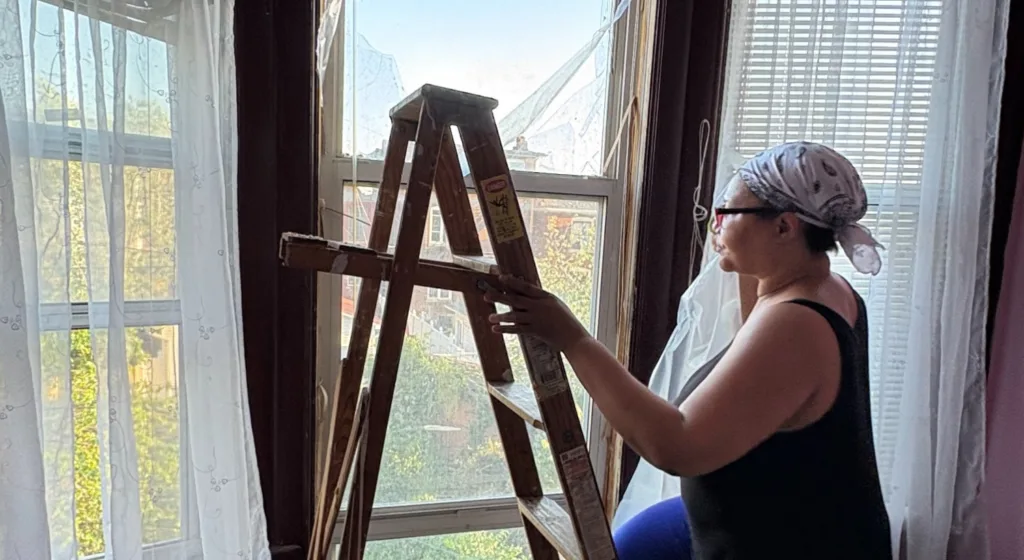
George had already planned to move to Chicago before the tornado, but it helped make up her mind. “After the tornado, I was like, ‘I can’t leave,’” she says. “But then the last year, I’ve come back to where I was before the tornado.”
It’s been a source of inner turmoil. “Why do I feel like I’m turning my back on the community?” she asks. Even though she’s moving, she plans on holding onto her generational family home for as long as she can, she adds that she’ll maintain a deep connection to the city. “I have to probably just go, because I keep moving the date,” she says.
She jokes that, in Chicago, she’s “determined to get a corner unit high rise.”
“When I go to Chicago … my nervous system is at peace,” she says, adding, “I started listening to that.”


