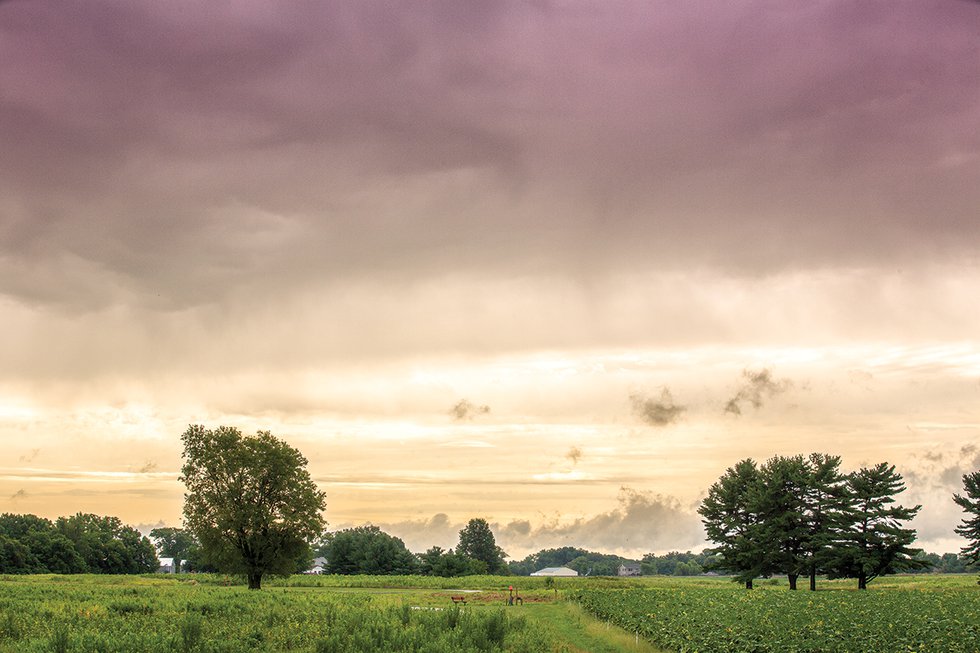
Seconds after the tires of my Chevy crunch the gravel of NILO Farms’ parking lot in Brighton, Illinois, I hear gunshots. That’s normal. NILO (nilofarms.com), a Winchester facility, is a 650-acre hunting preserve and shooting range just outside of Alton. From October through March, NILO offers guests the opportunity to hunt game birds or shoot clay targets. Three hundred bucks buys you the Design Your Hunt experience, an excursion to shoot duck, pheasant, or a gray-and-black-striped specimen called a chukar. I’m at NILO on a drizzly June morning along with 200 other people for the fourth annual NILO Open, a sporting clays competition. It’s sort of like golf but with firearms. What that means is that various platforms are scattered throughout the forest like golf holes, and when a group arrives at one, they stand there trying to shoot at orange clay saucers and blow them to smithereens. I watch an older man wearing gym shorts pick off two discs like it’s nothing.
NILO, which celebrates its 70th anniversary this year, was founded in 1952 by John Olin, inventor, scientist, and chairman of the Olin Corporation. He manufactured brass, chemicals, and sporting goods. Washington University’s Olin School of Business is named after him. The Olin family owned Winchester Repeating Arms, and Winchester now owns NILO (Olin spelled backward) and sells its ammunition for the shooting events and hunts. For years, NILO was Olin’s exclusive retreat, but it has been gradually opening up to the public.
Get a fresh take on the day’s top news
Subscribe to the St. Louis Daily newsletter for a smart, succinct guide to local news from award-winning journalists Sarah Fenske and Ryan Krull.
But there’s more to NILO than just guns (though there are a lot of guns). Because if business and manufacturing were Olin’s work, conservation was a passion. His motto was “There’s a better way to do anything if you will put your mind to work,” and decades ago, Olin was faced with a changing natural world and decided to do something about it. Visiting NILO today is like stepping back in time, when American conservation was in its nascent stage.
In the late 19th century, people began to view land, plants, and animals as precious resources that had to be conserved. But they weren’t acting fast enough, because in the 1920s, the game supply dwindled.
Olin, then chairman of a committee to promote restoration, hired an ecologist named Aldo Leopold—now recognized as the father of wildlife ecology—to conduct a game study of much of the Midwest. It was perhaps a little self-serving. “The survey is financed by the sporting arms and ammunition industry. The motive hardly requires explanation,” Leopold wrote in the preface of his report. “Success in game restoration means continuance of the industry.” But the committee jump-started similar programs, which, as Edward L. Kozicky writes in his brief biography of Olin, were “milestones in wildlife conservation.”
Olin had two theories on how to conserve the land and its animal inhabitants. The first was to artificially stock wildlife in natural areas, creating preserves, which was a novel idea for the time. NILO, essentially an overgrazed pasture when Olin purchased it, was his experiment. He staffed the farm with a team of conservationists. They planted alfalfa, wheat, soybeans, and other crops for ground cover and to create a more balanced ecosystem. They tested different principles—What feed worked best with waterfowl? Which habitats helped them survive the winter?—and published manuals for early conservation groups. Olin invited hunters, some of whom were kind of snooty about the idea of hunting on a preserve, to come and learn about the practice. On business trips, according to Sports Illustrated, Olin “would suddenly disappear to address a conservation or sportsmen’s club on the role of preserve shooting in modern conservation.”
As we walk around NILO, Winchester’s Jason Gilbertson asks me if I’ve ever fired a gun. I haven’t. Perhaps he senses my hesitancy. Perhaps he decides that letting the woman who showed up to a farm in pristine white Keds play a quick game of Five Stand would be a waste of primo Winchester ammo. Whatever the case, he asks, “Do you want to see the dogs?”
Oh boy, do I. The dogs, tucked away in a kennel on the property, are mostly Labrador retrievers. To put it mildly, Olin got into dogs. Big time. Because the second idea that he had in regard to wildlife conservation was to use hunting dogs to locate waterfowl that hunters had shot but couldn’t find in the field or pluck from the pond water themselves. Otherwise, they’d go to waste. But he also entered dogs to compete in field trials, hiring the best trainers to cultivate his champions.
One of the world’s greatest resided at NILO. He wasn’t a big guy, but he was smart. His name was King Buck, and he was a black Lab. Hand-selected by Olin, King Buck went on to win two consecutive National Field Trial Championships. He’s buried on the property, and a life-size statue of the doggo is placed outside of NILO Kennels. He’s also memorialized on a federal duck stamp, the only dog to ever appear on the postage.
NILO still holds field trials, but they’re not as popular as they were in the old days. Now, the dogs who live on the farm are mostly used for hunting. As Gilbertson enters the kennel, a yellow Lab lets out a howl, and soon the room is filled with barks. The kennel is lined with good boys and girls—and, yes, they mostly have gun-themed names. Shooter, a yellow Lab, lives next door to Shot…also a yellow Lab. Each member of the kennel staff trains a group of the dogs either on the farm or at home. As the dogs get too old to carry on with a long hunting season, trainers find families to adopt them.
Gilbertson leads me to a wood-paneled room in the back of the kennel and flips the light switch. It’s a small living room that looks perfectly preserved from the 1950s, and above the fireplace is a portrait of King Buck. Built-in shelves holding Olin’s silver dog competition trophies line the room, as do championship certificates from the American Kennel Club and photos of Olin with the dogs. It’s a fraction of the awards that the dogs have won, Gilbertson says. There’s no room to display all of them—boxes and boxes remain in storage. A framed cover of a 1958 issue of Sports Illustrated depicts John and Evelyn Olin on the cover stalking pheasants under the headline “Happy Hunters.” Judging from the surroundings, he was more than happy—this was paradise.