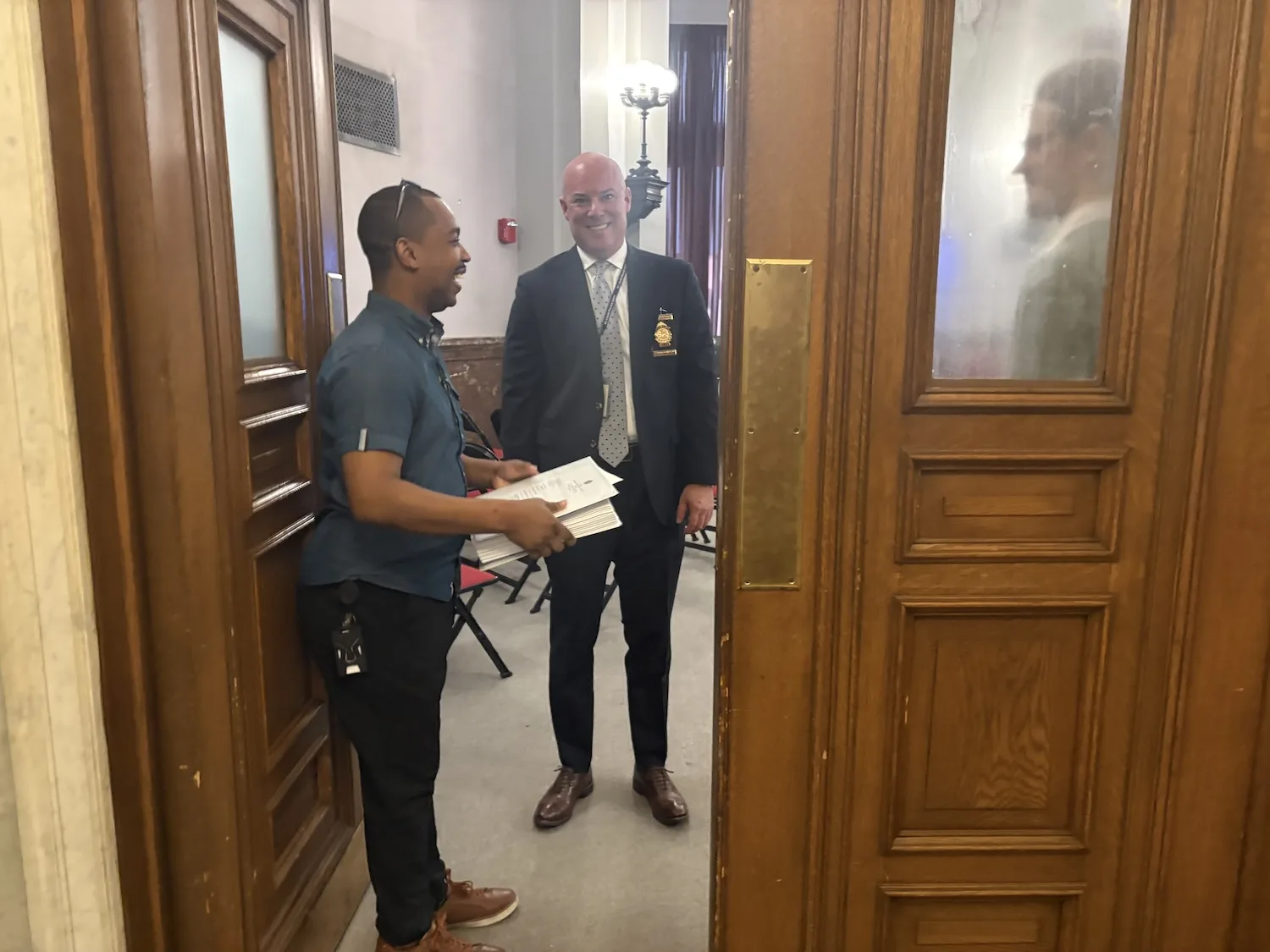
Several dozen friends and family of former Post-Dispatch reporter Nick Pistor came together last week at City Hall, which was Pistor’s beat from 2011 to 2016. The purpose was the renaming of the space he once worked out of, which is now the Nicholas J.C. Pistor Memorial Office.
Prior to the unveiling of the memorial plaque next to the Post-Dispatch‘s office at City Hall, Christine Byers told the assembled crowd that Pistor, who died suddenly earlier this year at age 43, “loved this building and everything it stood for.”
Get a fresh take on the day’s top news
Subscribe to the St. Louis Daily newsletter for a smart, succinct guide to local news from award-winning journalists Sarah Fenske and Ryan Krull.
“I find myself reading the text messages he and I exchange quite regularly, and treasuring them,” she said.
Alderwoman Anne Schweitzer, also a friend, said in her own remarks that Pistor, “Whether he wrote good things or bad things about us, at least he was truthful about what was going on.”
Byers noted that when Pistor passed away, he was engaged in an epistolary campaign, waged on Crown Mill cotton cream-laid stationary, to try to make the office he previously worked out of at City Hall open to all journalists, not just those working for his former employer. “I am looking for equal opportunity for journalism for all,” Pistor wrote in one of his many letters to the city’s then-executive director of operations Nancy Cross. He drew particular attention to the Post not paying any rent. Byers, herself a former reporter for the daily, used the term “monopoly.”
But the newly christened Nicholas J.C. Pistor Office on the first floor of City Hall remains the exclusive domain of the daily. It’s by no means spacious—big enough for a desk, chair, printer, love seat and not a whole lot else. A sign across one wall reads St. Louis Post-Dispatch. It’s currently being used by the paper’s City Hall correspondent, Austin Huguelet.
Richard Callow, a city politico and friend of Pistor, says the space remaining the sole domain of the Post runs “exactly counter” to the spirit of Pistor’s final pursuit.
But it’s tricky business pinning down why exactly that is.
One City Hall staffer said that there could be some sort of memorandum of understanding between the paper and the city declaring that office the Post’s, but it was probably signed in the Joseph Pulitzer era of the Post-Dispatch (1878–1907), which would make its specifics hard to know.
The office’s new designation came by way of an aldermanic proclamation. SLM asked Yusuf Daneshyar, spokesman for aldermanic president Megan Green, about the seeming inconsistency between the office’s new name and the Post’s continued monopoly of it. He said he wasn’t sure why the Post had retained sole use of the space. “My understanding is that the previous mayoral administration was looking into that question,” he said.
Conner Kerrigan, the spokesman for the previous administration, said that from what he recalls from his research, the Post, the Globe-Democrat, and the Suburban Journals all once had free office space in City Hall. Former Globe-Democrat reporter David Nathan recalls working out of the office adjacent to the Post-Dispatch for two years beginning in 1970. “There was a paper-thin wall between my Globe office and the adjoining competing Post- Dispatch office, and you could normally hear every phone or in-person conversation,” he recalls. “On top of that, two of the Post reporters I competed against at City Hall were hard of hearing and yelled much of the time.”
The Globe folded in the late 1980s, and the Post-Dispatch parent company shut down the Suburban Journals in 2010. Now the Globe’s old office is stuffed with Nutcrackers, Santa Claus figures and other holiday ornaments, as well as countless empty Dole banana boxes. It’s that space that Pistor originally began angling for, saying he wanted to write a book along the lines of Buzz Bissinger’s A Prayer for the City, but as no one seemed interested in taking his rent—or explaining why the Post didn’t pay it—he grew increasingly animated by the idea of opening it up to all journalists.
While the spirit of Pistor’s quest remains unfinished, the new commemorative plaque at least conveys his ideas about who gets to use the office. It includes a photo of Pistor, below which is inscribed: “May this space be forever used by someone who really wants to know what’s going on at City Hall and honor the man who always did.”
At Wednesday’s ceremony, Schweitzer said they had a choice to install the plaque on the wall’s plaster or its marble. She said they went with the marble because it would last longer.