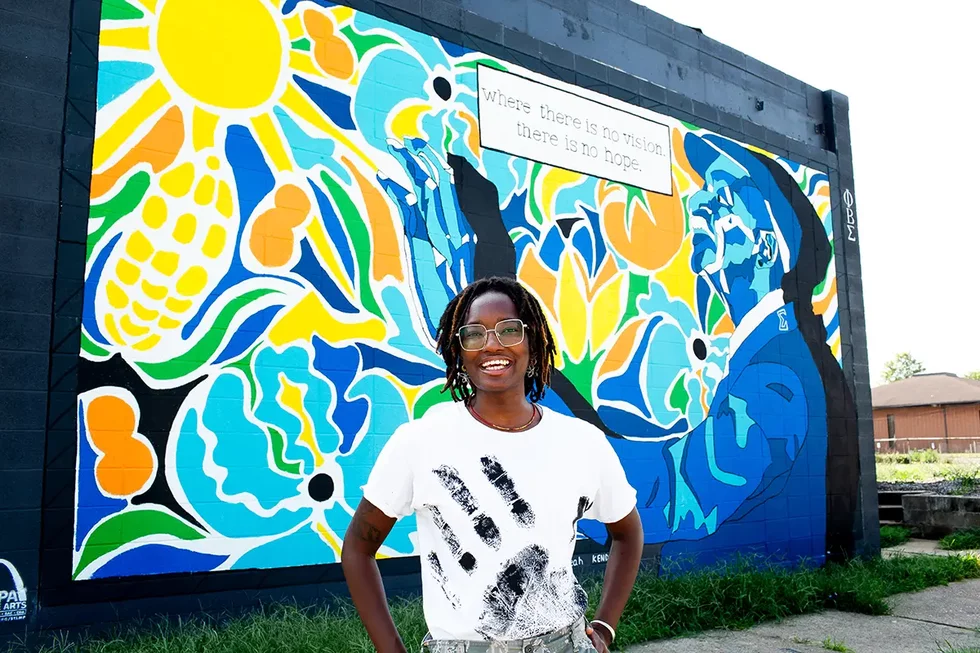
This is not a story about one mural turning a neighborhood around. That’s unrealistic in Jeff-Vander-Lou, on the city’s near North Side, and specifically at the corner of Compton and Bell, where you can stand and just feel empty space: in the nearby vacant lots, in the brick two-family with its rear blasted out, in the shuttered community center at the northeast corner. But on a roasting August morning, 23-year-old artist Fatou Kane stood looking up at that center and felt something different: “I hope more art goes up in this area.”
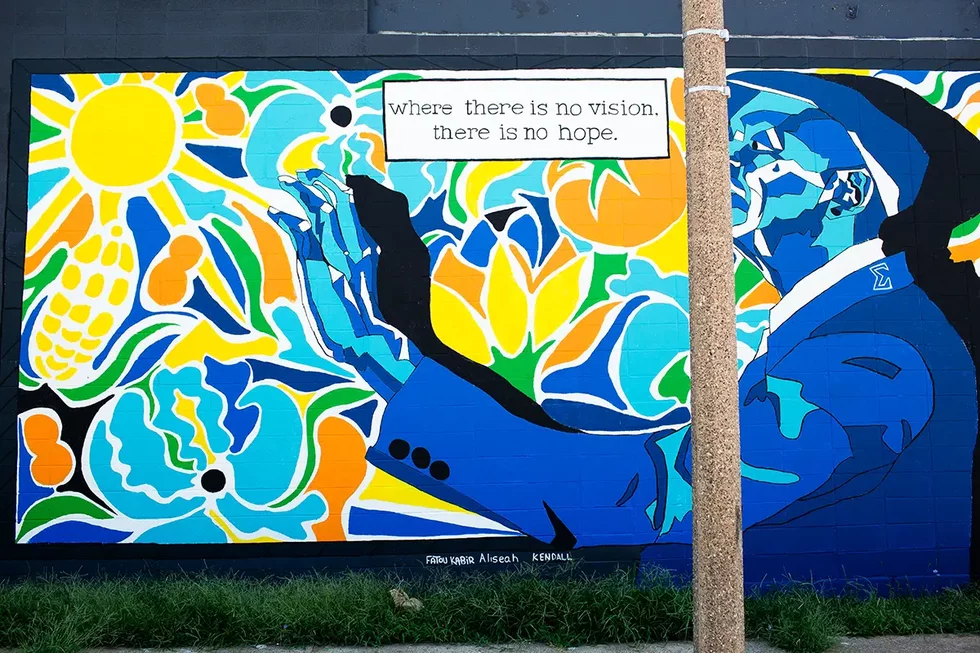
Kane had recently finished a swirling, two-story mural there depicting the renowned Black scientist George Washington Carver. It was one of 28 that the city commissioned using nearly $1 million from the federal American Rescue Plan Act. Each ward will get two murals. On the North Side, though, they foreshadow an infusion of funds. Most of the $498 million in ARPA money will be spent in high-poverty census tracts, which blanket city territory north of Delmar—the area that about 56 percent of Black city residents called home in the 2020 Census.
Get a fresh take on the day’s top news
Subscribe to the St. Louis Daily newsletter for a smart, succinct guide to local news from award-winning journalists Sarah Fenske and Ryan Krull.
The investments are multifarious, says Nahuel Fefer, executive director of the Community Development Administration. Within blocks of the new Carver mural, 147 units of affordable housing are being rehabbed; Grand is getting repaved; a park will get free Wi-Fi, and its rec center, a new roof. “The goal and the hope,” says Fefer, “is that it all adds up to more than the sum of its parts.”
But such projects can take years. Murals are fast. The 28 artists and locations were chosen through a competitive process involving both the Regional Arts Commission and city officials. The awardees proposed to either directly engage the community or showcase ward history. Kane’s project did both.
As for history: At midcentury, Black families—no longer restricted by racial covenants—had poured into Jeff-Vander-Lou, so the center, named the Carver House, arose to serve them. But over decades, many families left. The building languished; a vehicle smashed into it. Only recently was it stabilized by the Sigma Legacy Foundation, an alumni group of the Black fraternity Carver co-founded. Kane saw the spruce-up and suggested a mural. They agreed, urging that Carver be depicted looking north. “That’s where development needs to happen,” says Jerryl Christmas, a member of the foundation, which has received a tentative $100,000 ARPA grant for Carver House.
In July, as Kane and several helpers painted, folks walked by, honked from cars, took photos. Some said they’d spent time at Carver House as kids. All the murals have had a second salutary effect, says Tracey Morgan of RAC: They’ve pierced neglect. “I’ve already seen alderpersons come in and be like, ‘Oh, we need to clean this up.’ I can see progress being made.”
More is needed, says Rev. Dr. Timothy D. Price III, pastor of First Baptist Church, which has stood across Compton for 80 years. In June, his congregation pitched in on a neighborhood clean-up. He’s excited by the mural but has no illusions about its impact. “If the politicians don’t do something in that neighborhood,” he says, “the mural will be just another painting on the wall.”
Standing in the sun in front of Carver House, Kane was asked about the scientist’s quote on the mural: Where there is no vision, there is no hope. “It means knowing what you’re going to do before you step,” said the artist. Like the church and the fraternity foundation, Kane has taken a step here. The next one is the city’s.
Color by Numbers
Some datapoints on the St. Louis Mural Project
- 28 murals, 2 in each ward
- $34K average allocation for each mural
- 0.2% of $498 million in ARPA funds is being used for murals