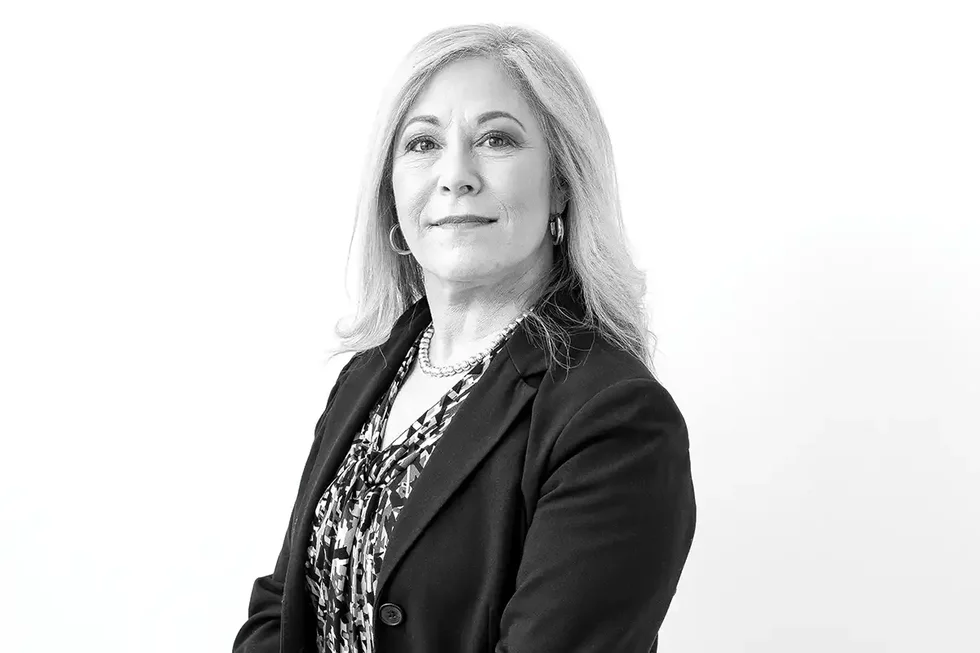
Every election cycle, the furor over voting rights seems to center only on key swing states, but protecting Missourians’ right to cast their ballots is a 365-day-a-year job for Denise Lieberman. Lieberman was part of the first Election Protection team, a national, nonpartisan organization that works year-round to ensure that all voters have an equal opportunity to vote—and to have that vote count. And since 2006, Lieberman has headed up the Missouri Voter Protection Coalition, which provides voters with comprehensive information and assistance at all stages of voting. Lieberman’s interest in voting rights isn’t just her job—it’s a passion that comes from her family history and her childhood, when she saw the effects of redlining. “We are a racial justice organization because you can’t talk about voting in America without talking about race and ethnicity,” she says.
What prompted the launch of the Missouri Voter Protection Coalition? We came together around voting in 2006, because that was the year the Missouri legislature first attempted to pass a strict photo ID law to vote. We came together as a nonpartisan table to coordinate opposition to the photo ID requirements. After it passed, we contributed to a lawsuit that ultimately went to the Missouri Supreme Court, which found those requirements to be unconstitutional.
Get a fresh take on the day’s top news
Subscribe to the St. Louis Daily newsletter for a smart, succinct guide to local news from award-winning journalists Sarah Fenske and Ryan Krull.
Once the Missouri Supreme Court struck down those rules, we thought maybe that was going to be the end of it. But the next year, the Missouri legislature again attempted to enshrine the very same requirements that the Missouri Supreme Court had found to be unconstitutional, as well as a number of other ones. So we kept getting together.
We began to realize that this coalition had some staying power. We started to develop a proactive agenda, including advocating for things like no-excuse absentee voting.
Last year, the state legislature passed House Bill 1878, requiring Missourians to present a photo ID to vote. What are you doing to challenge this? I’m counsel on the lawsuit challenging it in court, and we brought suit right before the law went into effect in August on behalf of the Missouri NAACP and the Missouri League of Women Voters. This is not just a photo ID bill. It has about three dozen provisions in it that harm Missouri voters. This is a bill that went from being 5 pages focusing just on photo ID to being a 56-page bill that has dozens of provisions.
There are some people who say it’s easy enough to get the proper form of ID to vote. First, DMV offices may not be accessible to people with disabilities. I took my 91-year-old mother to get an ID, and she is in a wheelchair, and there was a step to get into the DMV office. We had to basically lift her and take her in there. One of our plaintiffs in the case is someone with a mobility impairment. She has a variety of medical complications and walks with a walker, has a brace on her leg, and has epilepsy. It’s a dangerous situation. She really cannot get there.
Many DMV offices are not open evenings or weekends. They often close at 4–4:30. So hourly wage workers, shift workers, and essential workers really don’t have much availability to get to the DMV. For people who lack access to transportation, most DMV offices are not on public transportation routes.
Once you are at the DMV, in order to get a Missouri ID, you have to present four different types of underlying documents. First, you must show proof of identity, which is a certified birth certificate from the United States or naturalization papers. If you came to the U.S. 25 years ago and you don’t have those naturalization papers, replacing them can be something like a $200 cost depending on what you need to get.
If you were not born in the state of Missouri and you need to get a certified birth certificate from another state, 17 states require you to have a photo ID in order to get a copy of your birth certificate, which you need to have in Missouri before you can get a photo ID.
You’re very passionate about voting rights. Where does that stem from? Both of my parents were local elected officials and nonpartisan elected officials. I grew up in a household that really walked the walk when it came to taking ownership for being involved in your community.
I grew up in a community that was block busted shortly before I was born. These were communities where voters of color were getting redlined and had terrible opportunities to get housing. It convinced my father to run for office, and he passed the first fair-housing law in the state of Missouri.
So I grew up in a Black community. I went to a Black school. My older siblings married people of color. My extended family are all people of color. And so those experiences really allowed me to see how people can be marginalized. And I was able to kind of understand that from a pretty young age.
What do you attribute the Missouri Voter Protection Coalition’s success to? I think this coalition is successful because it works to elevate everybody’s voices by uplifting the leadership of the communities that are impacted rather than parachuting in to make determinations for them. You see that too often, especially in some national organizations.
Our coalition meets every Monday morning over Zoom. We had almost 150 people on the call today. People in St. Louis are meeting the people that are doing the same thing they’re doing in Kansas City, and they’re meeting the people that are doing that work down in the boot heel. It offers, I think, some really powerful ways to build leadership.
other states, such as Arizona, Texas, and Georgia, have a strong grassroots movement happening around voter rights. Do you see that happening here? I see it growing. I don’t think it’s as pronounced as it is in some of those other states, but that’s the kind of work that is developing. I think that’s the work that was born of the broader civil rights movement that came out of the Ferguson uprising after Mike Brown was killed.
I think young people are beginning to appreciate that if you care about criminal justice reform or jail reform or immigration reform or environmental justice, because communities of color are the places where lead poisoning is high, then you have to connect it to that ability to build power through voting.
I think there are still a lot of people who are disillusioned and feel that voting doesn’t work for them, but I also think that people are witnessing the degradation of the democratic process through disinformation. They realize that they must take their democracy back, and that the way to do that is not by staying home on Election Day.