The St. Louis Development Corp. only moved to seize land from developer Paul McKee after he sought to demand $116 million for the acreage, according to a letter released by the agency Friday.
The leader of SLDC, Otis Williams, said in a letter dated Thursday that the asking price of more than $116 million for NorthSide Regeneration’s land was “so extreme that no amount of negotiation would be realistic.” Instead, the city last began to pursue eminent domain proceedings against NorthSide Regeneration, led by McKee.
Get a fresh take on the day’s top news
Subscribe to the St. Louis Daily newsletter for a smart, succinct guide to local news from award-winning journalists Sarah Fenske and Ryan Krull.
SLDC announced this week that it’s looking to file a condemnation petition for 89 parcels in the Jeff-Vander-Lou neighborhood, near the recently-opened National Geospatial-Intelligence Agency (NGA) West headquarters.
St. Louis Public Radio reported that SLDC and the firm were in negotiations for a sale price for all of NorthSide’s holdings last year, but talks fell through over disagreements about the price. Williams’ letter—which the agency circulated to the press on Friday—suggests that the disagreement was over the $116 million price tag. In some cases, Williams wrote in the letter, the developer’s demands exceeded the value of properties in Clayton and Frontenac.
Paul Puricelli, the lawyer for NorthSide and its lender, the Bank of Washington, cast doubt on that figure in an email to SLM Friday. He said SLDC’s appraisal of the company’s land portfolio was a far smaller $20 million.
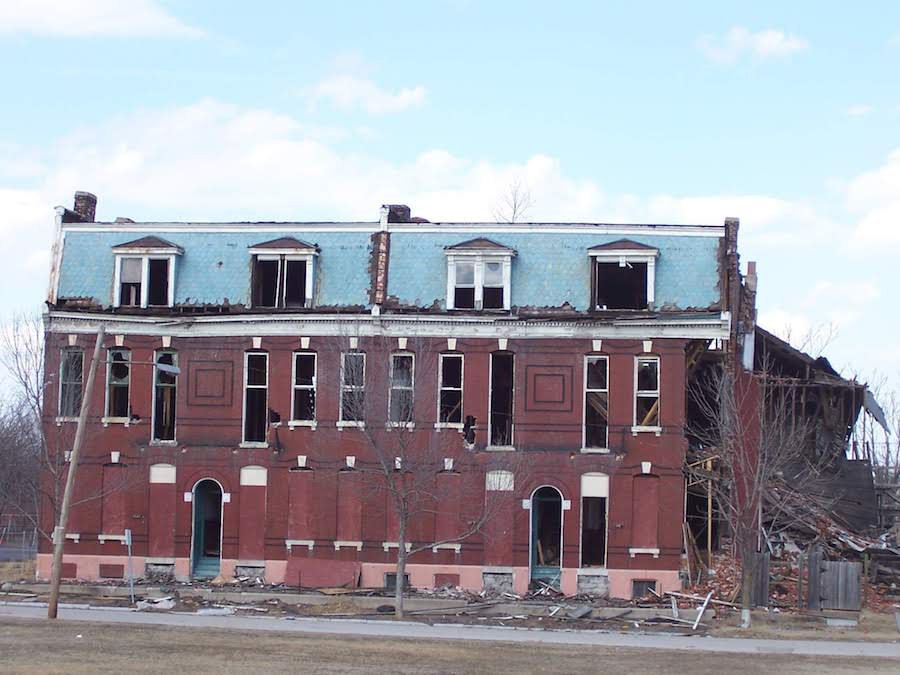
McKee and his firm are frequently cited as barriers to growth in North City. They’re accused of sitting on empty or deteriorating properties and not delivering on promises to redevelop the area after cutting a deal with the city to obtain around 1,500 acres of North St. Louis land 17 years ago, per Williams’ letter.
Many of those properties have gone undeveloped, and some of McKee’s attempts at developments, including a grocery store and a three-bed health facility, have since shuttered. Williams’ letter noted that NorthSide amassed nearly 1,700 parcels.
Puricelli told SLM Friday that his clients were “disappointed by the City’s announcement that it intended to proceed with eminent domain proceedings,” saying the move would further add to the city’s inventory of distressed properties. He also said the proceedings were a distraction from the stated aim of redeveloping North St. Louis.
Williams’ letter—sent in response to a Jan. 6 correspondence from Bank of Washington CEO and board chair L.B. Eckelkamp—has a laundry list of complaints about the negotiations with the firm and the bank, a long-time lender to NorthSide. Among them: that the city gave NorthSide $360 million in Tax Increment Financing (or TIF) funds, along with another $43 million in state tax credits, to redevelop North St. Louis, yet the firm has little to show for it.
“The only projects [NorthSide Regeneration] ever completed were a gas station, a grocery store and a three-bed hospital—two of which have since closed,” Williams writes. He goes on to say that the tax credits were used to “inflate” the price of NorthSide’s properties and used to pay off its long-standing debts with the Bank of Washington instead of its intended purpose.
Puricelli told SLM that the allegations were a “glaring misstatement” and that “there is absolutely no basis for the allegation that [Northside] misused tax credit proceeds.”
But the Jan. 6 correspondence from Eckelkamp alleges that Williams was biased against NorthSide, saying Williams cast doubt on its appraisal of their entire land portfolio before a December meeting to discuss a deal. There also appears to be disagreement about who initiated the sale of NorthSide’s acreage, with Williams saying McKee’s son, Chris McKee, wanted to divest the NorthSide portfolio, and Eckelkamp saying the city came to discuss acquiring all of the firm’s land.
In a lengthy response to Williams’ letter, Puricelli harshly criticized SLDC’s strategy, saying, “The City has apparently decided that paying its outside lawyers a small fortune to litigate hundreds of eminent domain cases is a better use of public funds than first seeing whether an agreement might be reached.” He also said Williams did not give enough credit to McKee and NorthSide for initially attracting the NGA’s interest to North City
Why It Matters: McKee and NorthSide have long been seen as a barrier to growth in North St. Louis, and more scrutiny is being paid to the firm—which has had holdings there since the early-to-mid 2000s—since the NGA West headquarters opened in September and the May 16 tornado, which have both triggered questions about the city’s strategy for North City. Williams and others see getting the land out of NorthSide’s hands as a crucial step towards change in historically disinvested North City.
What’s Next: SLDC said that its subsidiary tasked with blighting, the Land Clearance for Redevelopment Authority, would file a “condemnation petition” for the initial 89 parcels near the NGA, 81 of which are NorthSide or “McKee-tied,” an SLDC spokesperson says. That will take the fight to St. Louis Circuit Court. The agency has also sent notices to owners of 170 other nearby properties, notifying them of the intent for the city to acquire their land, the first step in eminent domain proceedings. It will look to acquire more parcels as money becomes available, per a news release.
Editor’s note: This post has been updated with more information from Paul Puricelli.