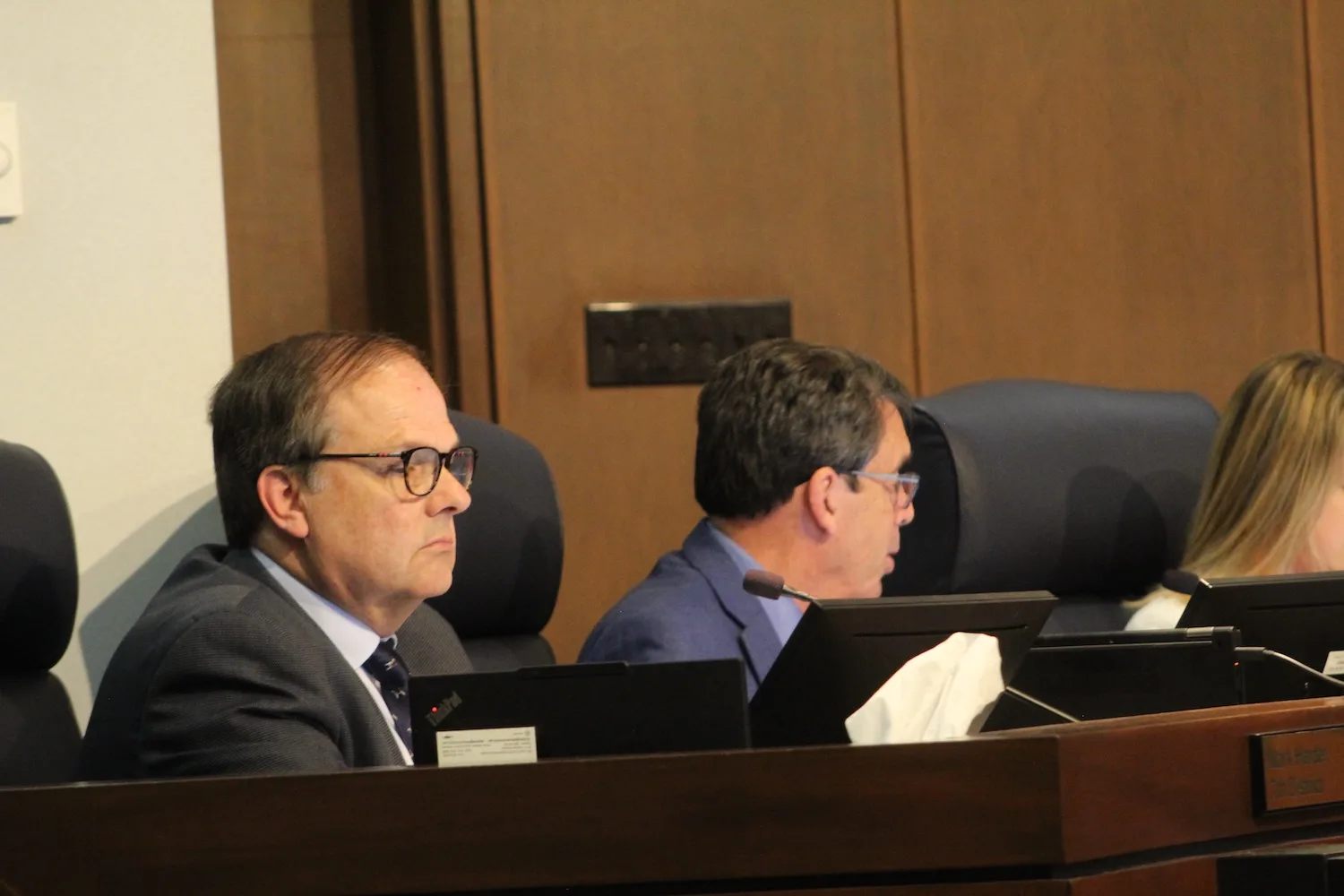
St. Louis County Councilman Mark Harder sent off a flurry of discontent among county staffers last week when he came into a non-public portion of their offices seeking records in order to get a federal payout—and leaving workers with the distinct impression that they needed to prioritize his request.
One employee later wrote in an email to a supervisor that, “I felt his expectation was for him to receive special treatment and that I needed to complete it as soon as possible. I stopped what I was doing to get it done.”
Get a fresh take on the day’s top news
Subscribe to the St. Louis Daily newsletter for a smart, succinct guide to local news from award-winning journalists Sarah Fenske and Ryan Krull.
Harder, who represents a wide swath of far West County, including Wildwood, is far from the only county resident to apply for funds through the Federal Radiation Exposure Compensation Act, commonly known as RECA, to access compensation for those made sick by exposure to World War II era nuclear waste. The county has gotten 500 requests for documentation since the program was expanded to include parts of St. Louis County in July; 270 are pending.
But the way in which he made the request for a certified copy of a marriage certificate made county workers push it to the front of the queue, email records show. The Department of Revenue employee he made the request to on Oct. 27 later wrote in an email to a supervisor, “Since he had access to the office and due to the manner in which he entered the office, I suspected that he was someone who worked for the county, however, he did not introduce himself. I felt as if he believed that I should know who he was.”
Two employees wrote emails about the breach of normal protocol in handling the request. One said in an email she felt like staff had to “stop whatever you are doing or else….” The request for the marriage certificate was completed that day.
Harder did not respond to a text message, phone call or email. It is not clear what health ailments (or past ailments) made him or a family member eligible for the federal funds.
Harder’s district, like all odd-numbered ones in the county, will be up for grabs next year, and one can’t help but wonder if the staffers memorialized their gripes via email with politics in mind. Next year’s county elections will play out against a backdrop that is contentious even by St. Louis County government standards. County Executive Sam Page is expected to seek re-election, and the council is chock-full of Page antagonists, Harder among them. The council drafted legislation specifically tailored to bar Page from moonlighting as an anesthesiologist, his profession outside of politics. The council also put on last April’s ballot a measure that would have empowered it to remove department heads, who are Page appointees. Page vociferously fought back against that effort, which ultimately failed at the ballot box, though Page himself wound up getting criminally indicted by the attorney general for a mailer related to that issue. An effort to remove the Page-appointed public health director, Kanika Cunningham, appears to be the latest proxy fight—along with, perhaps, Harder’s RECA line-cutting.
The RECA program provides a one time tax-free reimbursement of $50,000 or reimbursement for medical expenses for anyone who lived, worked or went to school for two years or more in an area around Coldwater Creek in North County and later contracted certain types of cancers and other diseases caused by radiation exposure. The program is facilitated by the federal government; the county’s role is providing birth, death, voter registration, marriage license, deeds to property, and other records that show the applicant lived in the impacted area for more than two years at some point after 1949.
Some of the documentation is easy for county staffers to access. Others are more complicated, stored on microfiche. County spokesman Doug Moore says that on average the requests for documents currently take around a week.
The director of the Department of Revenue has asked for around $380,000 for temporary staff and other resources to handle the increased number of people asking for RECA-related documents. That request is pending before the County Council.