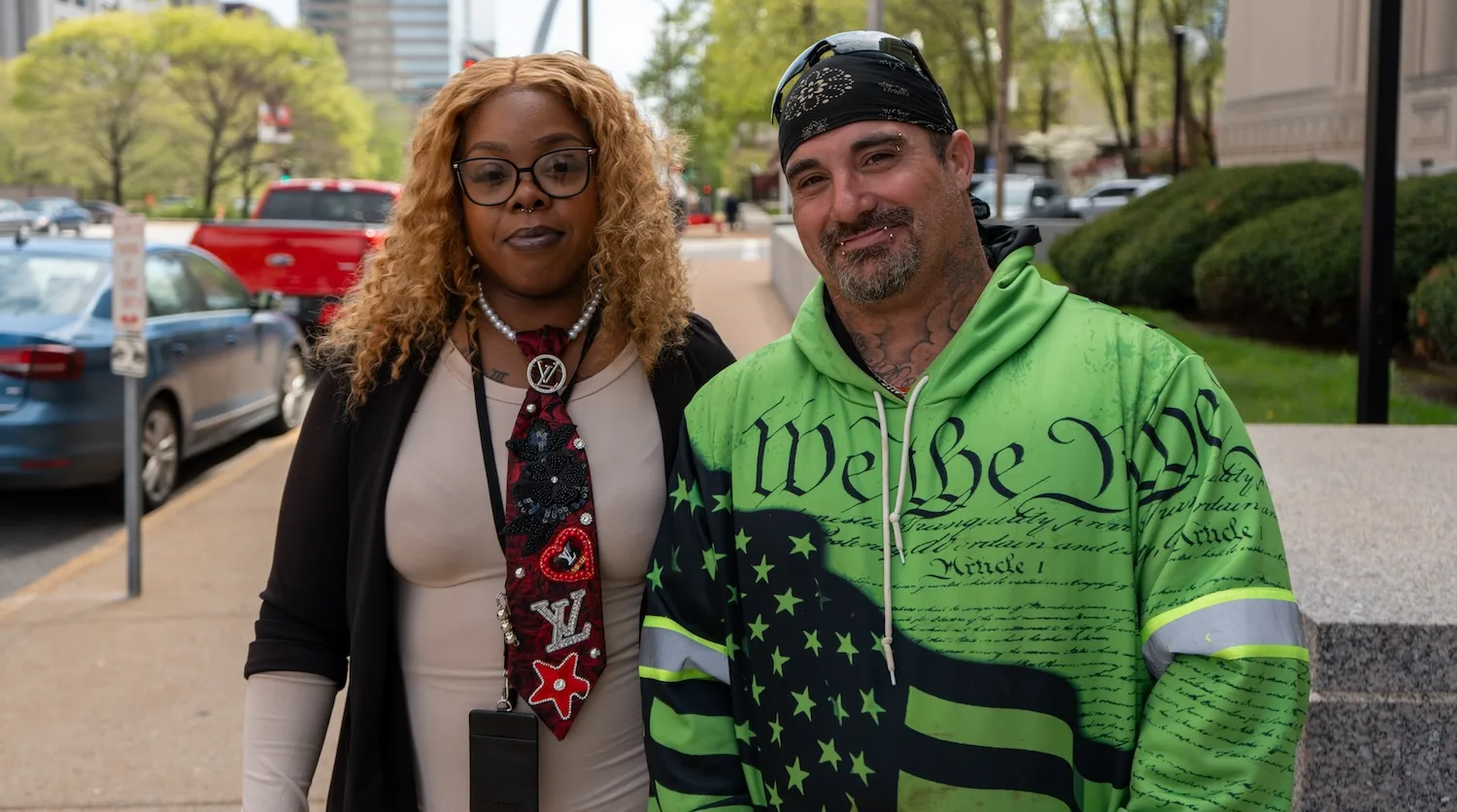
Sandra Morales of South City refers to the mechanism by which she built up her credit and bought a car as a tanda. That’s what they call it back in Mexico, her place of birth. American English has no single-word translation, although many other languages do: In Japan, it’s known as tanomoshiko; in Somalia, ayuuto; in the Caribbean, susu; in the Philippines, paluwagan. The U.S. seems to be settling on “lending circle.” The idea is that folks band together and, at regular intervals—say, each week or each month—everyone puts money into a figurative (or literal) pot. At each interval, one participant takes the whole pot. This process repeats until all participants have had a turn receiving the money. If your turn comes early on, the pot feels like a loan that you pay back with zero interest; if your turn comes late in the circle, the pot feels like savings you’ve accrued. The whole thing runs on trust.
Trust is what induced Morales to try the very first lending circle organized in 2017 by LifeWise, a nonprofit headquartered just south of downtown. She heard from a friend about LifeWise, whose mission is promoting economic well-being. Morales wanted to get better at saving the money she earned working in a restaurant, and when she met the LifeWise staff in-person, they spoke Spanish and seemed honest. So she joined their inaugural circle, which involved six people placing $100 each into the pot every month for six months. When the pot of $600 finally came around to her, she recalls, she sent it south across the border so that her daughter there could have a more festive 17th birthday party. Birthdays are a big deal in her family. “It was nice,” she says, “because when the time came, I didn’t have to fight or need to get some different kind of loan.”
Get a fresh take on the day’s top news
Subscribe to the St. Louis Daily newsletter for a smart, succinct guide to local news from award-winning journalists Sarah Fenske and Ryan Krull.
Since then, Morales has taken part in many more lending circles at LifeWise, which charges no fees to participants and reports their activity to credit bureaus as payments on an installment loan. The program has helped Morales go from “credit invisible” to a 710 credit score. It also helped her purchase a 2018 Nissan Rogue, which she says is “indispensable” for getting to work and taking her son to school. “It was something I never thought I’d be able to buy,” she says.
LifeWise says that despite minimal outreach, the number of participants in its lending circles has swelled to more than 300 annually, and the sum of inbound and outbound flows now exceeds $46,000 per month on average. From 2017 through 2025, 77 percent of participants have increased their credit scores. For those with established credit, the average bump has been 33 points. As for the 320 participants who started with insufficient credit, they ended up with an average score of 643. “That’s very good,” says Natalie Gemberling Webb, LifeWise’s director of economic wellness. “That’s what mortgage lenders are looking for.”
Hence the utility of the lending circles for upward economic mobility: Credit is what allows people to purchase big-ticket items such as homes and business assets.
LifeWise appears to be one of only two nonprofits in the U.S. that organize no-cost lending circles for philanthropic purposes and report the financial activity to credit bureaus. The first to get in the game was Mission Asset Fund in San Francisco. It began its circles in 2008. It then built a management platform it could license and has since served as administrative support for the lending circles of about 100 partners in 21 states, says Efrain Segundo Orozco, Mission Asset Fund’s director of partnerships. When asked why more nonprofits don’t run lending circles, he points to costs such as intake, underwriting, credit reporting, loan servicing, and the signing of promissory notes. “It’s expensive to build a system to be able to manage this,” he says. “I’m very happy to hear that LifeWise is doing something similar in St. Louis.”
While the benefits seem to be greatest for people such as immigrants who have no established credit, plenty of lifelong American citizens apply to LifeWise’s circles, Webb says—and perhaps because informal lending circles are so rare here, they’re the demographic that shows the most wariness at first. “I would say some of the most skepticism we receive is from the U.S.-born participants,” Webb says. “They’re like, ‘What? No, we’re an individualistic society. We don’t pull our money together to do this!’”
LifeWise now has year-long circles of varying monthly deposits: $50, $100, $200, or $300. (If someone misses a payment, LifeWise fills the gap while working with them to get caught up; defaults, which do get reported to the credit bureaus, are rare, Webb says.) Each circle has a dozen people, so the pot comes around to the participants as sums of $600, $1,200, $2,400 or $3,600. According to a survey conducted a few years ago by a WashU graduate student, a plurality of 31 percent of participants used the money to pay down debt; 15 percent used it to save in a bank account; and another 15 percent used it to purchase an asset.
About two-thirds of participants said they were able to make their role in the lending circle work by cutting monthly expenses or making a budget. And that’s another thing: While participants aren’t required to take financial coaching classes at LifeWise, the great majority do. Those classes are what create the interpersonal trust that makes lending circles work. Unlike informal lending circles in other parts of the world, the LifeWise circles are composed of participants who may or may not know one another but who do know Gemberling or Mayda Paredes, a Peru native who serves as the nonprofit’s assistant director of economic wellness. “Sometimes, someone is coming in to talk about the lending circle,” says Paredes, “but then they see you and they need a hug because something is going on in their life. So this relationship is very strong.”
As for Morales, she’s planning to put her savings from future lending circles toward finishing the build-out of a house back in Mexico for her daughter. “Not all the money goes toward getting something material,” she says. “But I guess it always ends up going toward something for the family.”