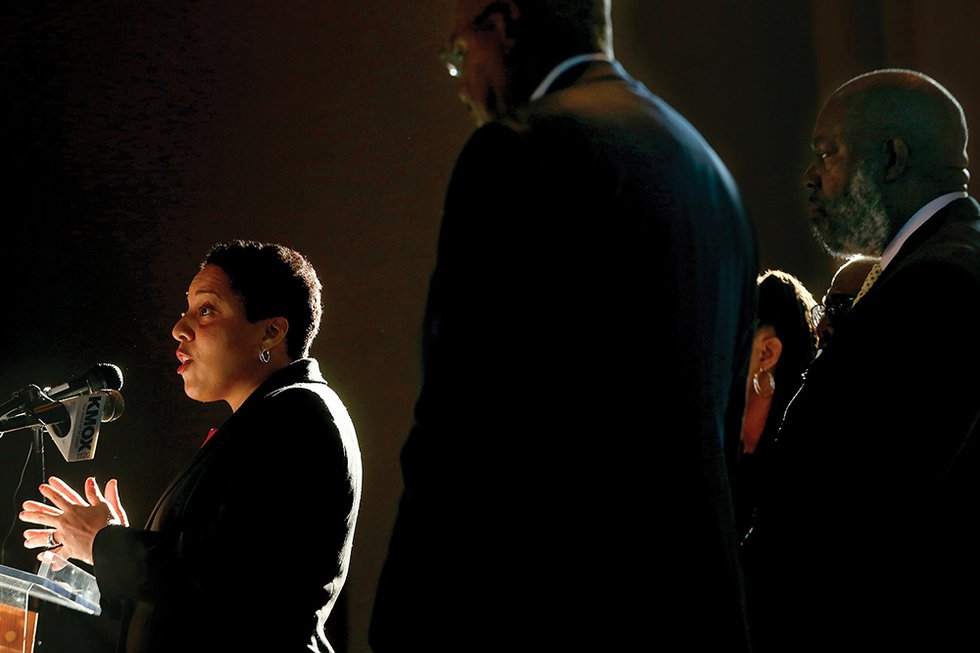
When former Circuit Attorney Kim Gardner entered a federal diversion program to avoid prosecution last month, she was the beneficiary of the exact type of program she let fall to pieces in her own office.
Diversion programs are designed to attack the root causes of crime and allow people facing charges to avoid the harsh realities of the criminal justice system if they agree to counseling and other treatment. If they complete the various tasks ordered by prosecutors, the charges disappear, letting them get their lives back on track without a criminal conviction. Gardner was given diversion after admitting to illegally using office funds to pay the $5,004 she was assessed after being reprimanded for ethics issues by the Missouri Supreme Court in 2022.
Get a fresh take on the day’s top news
Subscribe to the St. Louis Daily newsletter for a smart, succinct guide to local news from award-winning journalists Sarah Fenske and Ryan Krull.
Both in campaign mode and in office, Gardner was a great supporter of diversion—but only in rhetoric. In reality, when she left office last year, fewer than 35 people were in diversion programs, says Christy Bertelson, a spokeswoman for the Circuit Attorney’s Office.
That is a pretty paltry number, especially since Gardner received a three-year, $1.15 million grant in 2019 to boost diversion efforts. Even as the office was featured in a slick 5-minute video about diversion, the program itself “was a concept, that’s all it was,” says attorney Terry Niehoff, who represents many criminal defendants in the city. By way of comparison, under current Circuit Attorney Gabe Gore, more than 90 people are enrolled in diversion programs, with plans to scale enrollment up to around 250. (For further comparison, St. Louis County had no prosecutor-led diversion program when Wesley Bell took over the prosecutor’s office, a spokesman for Bell’s office says 130 are enrolled right now.)
The 2019 video claimed 276 people had completed diversion programs through the Circuit Attorney’s Office in the past two years, begging the question of how enrollment dropped so low in Gardner’s second term. “Kim had really good ideas that she didn’t know how to execute properly,” says Natalia Ogurkiewicz, an assistant circuit attorney under Gardner who fired off a blistering, public resignation letter amid the office’s collapse and is now with the McDermott Law Group. “I don’t remember it being a fruitful endeavor to get people in there.”
She adds, “The problem was that she got more and more paranoid about [bad] headlines. She was refusing to screen people”—leaving line prosecutors who recommended diversion twisting in the wind. Another assistant circuit attorney who worked under Gardner said that paperwork related to diversion had a way of getting lost and it felt arbitrary as to who was considered a good candidate for diversion or treatment.
Niehoff says that sort of haphazard micromanaging was his experience, too. “She interviewed everybody who was up for diversion. She decided who got in. It was like, ‘Does Kim Gardner want you to have diversion?’” Niehoff stresses that diversion is most often used for people charged with lower-level crimes, meaning that, to his mind, Gardner speaking with people facing something like a property damage charge was perhaps not the best use of time for the city’s top cop—in particular given that it was later revealed Gardner was balancing that full-time job with an advanced nursing program. “When you’re not studying for your nursing license, then you’re interviewing people who have a first offense and deciding whether or not they get diversion?” Niehoff says.
Why It Matters: One of the few things that Republicans and Democrats have agreed on in recent years is that there are too many Americans behind bars, a problem that diversion programs can go a long way to improving. Another irony of Gardner’s tenure is that even as enrollment in her own reform programs dwindled, in places like Lincoln County, under Republican prosecuting attorney Mike Wood, similar programs flourished. “Every case that comes through that could possibly be screened for some type of diversion and would be eligible for it, we would exercise that,” Wood says. “Diversion programs are the new rage.”
What’s Next: Under Gardner’s diversion agreement, federal prosecutors are deferring the case against her for 18 months. If, during that time, Gardner avoids breaking the law, reports to and follows the instructions of a pretrial services officer, as well as repays the $5,004.33 in misappropriated funds, she’ll be off the hook—no felony conviction, and both her law license and nursing credentials intact.