The controversial Republican megabill that President Donald Trump signed into law on July 4 has been criticized for deep cuts in Medicaid and adding trillions of dollars to the national debt.
But the measure contains at least some great news for the St. Louis region: up to $3.5 billion to provide financial compensation and health screenings for thousands of people exposed to harmful radiation resulting from the federal government’s secret disposal of radioactive waste in North St. Louis County and St. Charles County.
Get a fresh take on the day’s top news
Subscribe to the St. Louis Daily newsletter for a smart, succinct guide to local news from award-winning journalists Sarah Fenske and Ryan Krull.
Spearheaded by U.S. Sen. Josh Hawley (R-Missouri), the newly authorized Radiation Exposure Compensation Act will provide as much $7.7 billion to victims of radiation exposure from atomic weapons testing, uranium mining and unsafe storage in the St. Louis area as well as Arizona, New Mexico, Utah, and Kentucky.
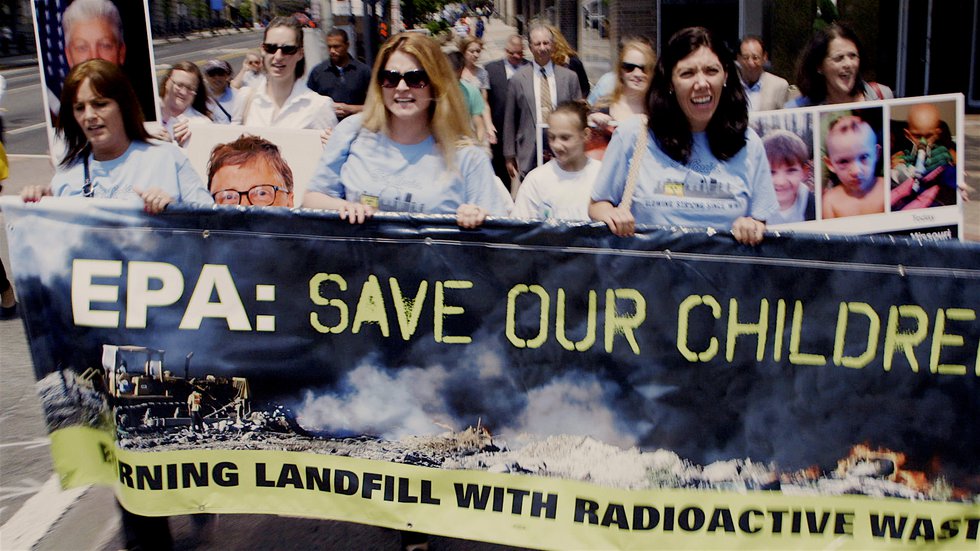
For Dawn Chapman, co-founder of the group Just Moms STL, RECA’s passage—just six months after it appeared dead in the water—represents the culmination of 13 years of tireless advocacy. Chapman and her co-founders fought on behalf of countless people exposed to radioactive waste related to America’s nuclear weapons program, which contaminated Coldwater Creek in North St. Louis County, the West Lake Landfill in Bridgeton, and the Weldon Spring Chemical Plant in St. Charles County.
“We’re proud of all the hard work,” Chapman says. “We’ve been fighting 13 years. This is the fruition of it. But also it’s so scary to us to have this program [and] also to have the responsibility to make sure it’s accessible.”
For Karen Nickel, the group’s other co-founder, the passage of the RECA amounts to an “acceptance of guilt” by the federal government for the harm it caused dating from the 1940s.
That’s when thousands of metal barrels full of radioactive waste from the Manhattan Project were secretly dumped at a site near St. Louis Lambert International Airport. Over the ensuing decades, the barrels corroded, leaching the waste into the nearby waters of Coldwater Creek, a 14-mile waterway that crosses through densely packed neighborhoods in Florissant and Hazelwood and empties into the Mississippi River. Generations of children played in the creek, which also snaked in and around parks, ballfields and schools in the region, exposing unsuspecting residents—a number potentially in the tens of thousands.
The federal government’s acceptance of guilt transcends the financial compensation that radiation victims will receive, Nickel says.
“Because for so long nobody wanted to believe us,” she says. “‘And no, this didn’t make anybody sick.’ Now it’s the federal government acknowledging those things. Because they’re the ones that made this waste. They’re the ones that handled it irresponsibly and recklessly…”
Applicants for financial compensation must be able to prove they lived in 21 ZIP codes in St. Louis and St. Charles counties for at least two years, and that they suffer from a specific list of cancers, including cancers of the brain, colon, pancreas, stomach, and appendix, among others.
If they qualify, residents in St. Louis and St. Charles counties sickened by the radiation can apply for compensation of a lump sum payment of $50,000, or, in lieu of that, compensation for medical bills going back many years that could far exceed the $50,000 amount, according to Chapman.
Relatives of those who died from radiation exposure can qualify for payments of $25,000. Chapman says children of the deceased will be first in line.
The U.S. Department of Justice will administer the compensation program. Its plans for financial awards and health screenings are still being worked out, she says.
Since the late 1990s, the U.S. Army Corps of Engineers has been overseeing the cleanup of contaminated soil around schools, houses and parks in North St. Louis County—a project with an estimated price tag of $400 million, though that figure is likely to climb as new properties are added to the cleanup list.
Now that RECA has passed, the next big step is helping claimants find the documentation they need to prove they have lived in the required ZIP codes and suffer from the list of eligible cancers and other diseases.
“The hardest part of this is going to be the documentation,” Chapman says. “It’ll be real estate records, right? It’ll be job records, school records.”
The DOJ, however, will have discretion to approve documentation on a case-by-case basis, she says.
“So if you have a photo from a yearbook,” she says. “Or you’re on a sports team two years in a row, and there’s a photograph, that might be something.”
Chapman and Nickel made many trips over the years to Washington, D.C., to advocate for RECA’s reauthorization to include the St. Louis region. The pair got help from activists and advisors including Lois Gibbs, the organizer of the Love Canal Homeowners Association, which brought attention to the dangerous chemicals dumped into the Love Canal in western New York in the early 1980s.
They also benefited from the help of noted environmental activist Kay Drey, who spearheaded a dogged seven-year battle using the federal Freedom of Information Act to obtain documents from the Atomic Energy Commission, the Nuclear Regulatory Administration, and the Environmental Protection Administration, among other agencies.
In 2021, Drey passed a trove of more than 15,000 government documents to Chapman and Nickel. The documents proved beyond a doubt that the federal government and its government contractors knew about the dangers of the radioactive waste but failed to warn the public.
“We were both really nervous to get the documents,” Nickel says. “But really for us, we got to learn the whole story from the beginning to the present of what really did happen and how it did happen. I think we thought, ‘Wow, we really uncovered something here.’”
Chapman and Nickel, after a year spent organizing the documents, passed them on to the Missouri Independent and the Associated Press. Reporter Allison Kite’s resulting bombshell of a story, published in 2023 by those two outlets, along with MuckRock and the Riverfront Times, caught the attention of Hawley, who became a top advocate for re-authorizing RECA to include Missouri victims of radiation exposure.
A key player in RECA’s final passage last week was House Speaker Mike Johnson (R-Louisiana).
As of late last year, Johnson opposed the reauthorization of RECA. But then, by last week, Johnson dropped his opposition after Hawley agreed to support the mega-bill’s deep cuts in Medicaid, a proposal that could result in 17 million low-income Americans losing access to the federally funded healthcare program, according to some estimates.
Nickel says she thinks Johnson agreed to the RECA expansion after Sen. Mike Lee (R-Utah) signaled his support for the measure.
“I think at that point, the speaker was like, ‘I want you all to agree on something,’” she says. “I think a lot of it must have been pressure, too. I think he was tired of hearing about it.”