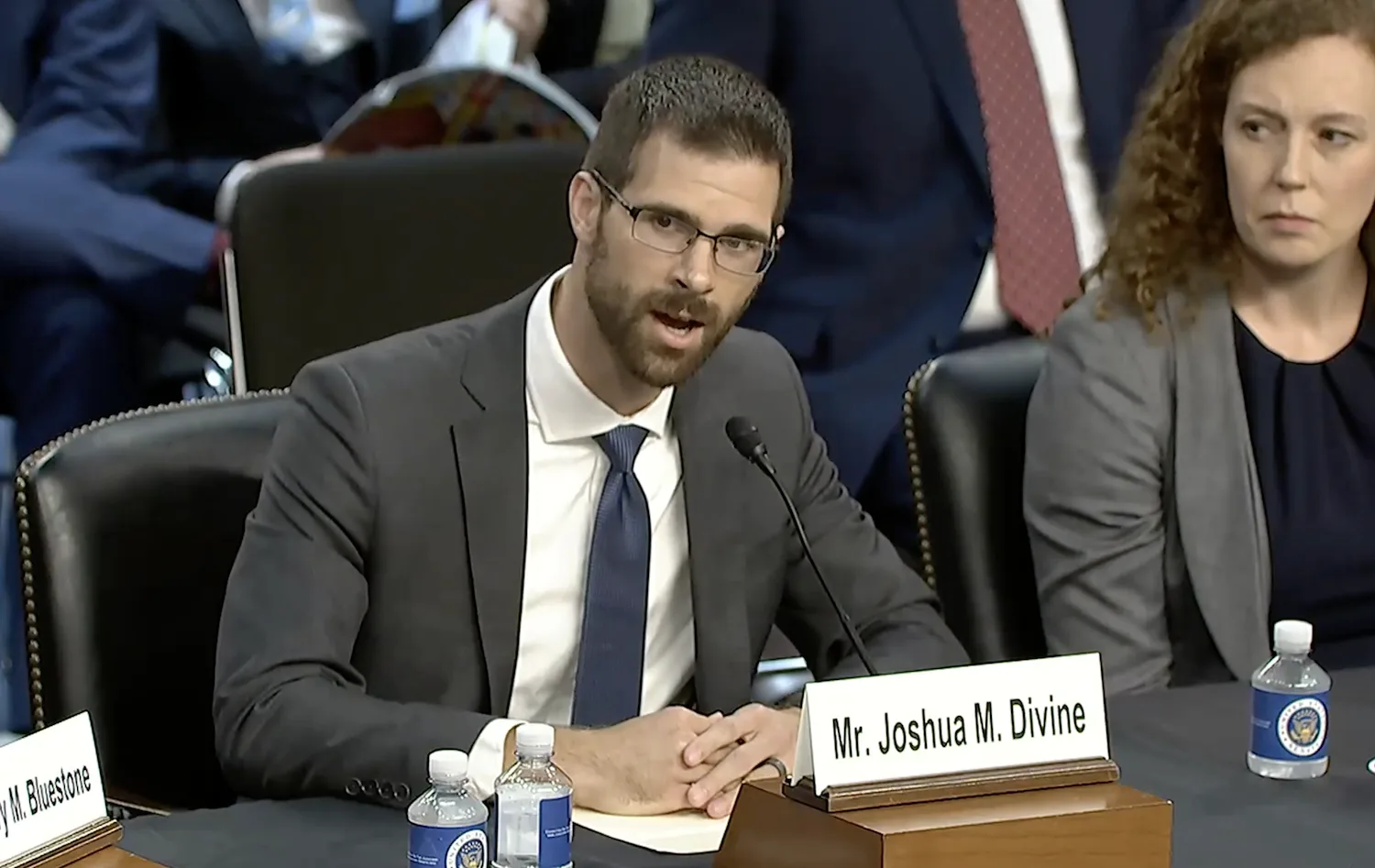
A federal judge in St. Louis who was previously reprimanded for injecting politics into his handling of a criminal case is apparently at it again.
U.S. District Judge Joshua Divine, a 2025 Trump appointee, recently issued what lawyers say is an extremely unusual sentencing order suggesting that people found guilty of possessing child pornography could be given the death penalty.
Get a fresh take on the day’s top news
Subscribe to the St. Louis Daily newsletter for a smart, succinct guide to local news from award-winning journalists Sarah Fenske and Ryan Krull.
The order was unusual not just for its breadth and depth—it’s 23 densely footnoted pages—but also its seemingly tenuous connection to the case before him. Divine wrote the sentencing order in the case of Anthony Moore, a Jefferson County man facing charges in federal court. Divine’s order is focused, however, on arguing that judges in state court should be able to hand down such sentences.
Michael Wolff, dean emeritus of the Saint Louis University School of Law and former chief justice of the Missouri Supreme Court, says the order has “almost nothing” to do with Moore’s case.
“The opinion does not resolve any legal or factual issues that Moore’s case presents and sounds like a MAGA warrior auditioning for a different job, either a higher court or some other role in MAGA World,” he writes in an email. “At its best, the judge’s opinion is a press release made erudite by the inclusion of some legal citations and analysis.”
Moore, 46, pleaded guilty to knowingly receiving and distributing child pornography from a 13-year-old girl that he also allegedly molested, by soliciting nudes from her and then keeping them on his phone. (According to court records, the girl’s father “discovered this relationship when he went through her cellular telephone and discovered communications of a sexual nature between the Defendant and his juvenile daughter.”) That offense carries a sentence of five to 20 years in prison. Divine—who had to stay within those parameters under federal law—sentenced him to 20 years.
His sentencing order suggested he’d go much further if he could, providing a lengthy analysis of why the 2008 precedent widely seen as barring courts from handing down the death penalty in rape or child porn cases should, in fact, be no deterrent to doing so. “The Supreme Court in 2008 found a national consensus against capital punishment for child rape and concluded that the most decent thing was to take capital punishment off the table,” Divine wrote. “But in the face of extraordinary increases in crimes against children, plus paradigm changes in the legal and technological landscape, policymakers and prosecutors may determine that the most decent thing is to impose the most serious penalty on those who harm the most innocent.”
He added, “Society can ‘evolve’ in ways that take crime more seriously and give children greater protection. A court need not reflexively conclude today that the Constitution prohibits historically authorized penalties like capital punishment against those who commit sexual offenses against children.”
Moore’s lawyer, Jeff Goldfarb, declined to comment on the order or the case.
Divine is widely considered a protege of U.S. Senator Josh Hawley, under whom he served as chief counsel before being named Missouri’s solicitor general. Hawley also helped clear the way for his appointment to a federal judgeship, albeit indirectly: Hawley reportedly refused to cooperate with President Joe Biden on any judicial nominees for Missouri in hopes of getting more conservative judges through under a subsequent Republican president—intransigence that led to four open judgeships in the state, swelling dockets and leading the federal courts to declare a “judicial emergency” for Missouri in 2024. In a statement last summer, Hawley said, “My state has waited four long years for these judges, and I look forward to them serving Missouri with the highest distinction.”
Divine’s nomination for a federal judgeship subsequently drew fierce pushback from Sen. Dick Durbin (D-Illinois), not just because of his relative youth (he was 34) but his views, which included refusing to answer whether he opposes in vitro fertilization and previously calling for literacy tests as a prerequisite for voting. Said Durbin at that time, “No one who believes that a racist Jim Crow law should be revived belongs on the federal bench.” The Missourian, however, was confirmed by a 51–46 vote.
While Divine has been in office just one year, the Moore case isn’t the first time he’s inserted his opinions on the issues of the day into his caseload. As Tony Messenger of the St. Louis Post-Dispatch previously reported, Divine wrote a “bizarrely political screed” last fall in the case of Lesman Rivera-Vasquez, an undocumented immigrant from Honduras who ran a stop sign. Charged with being in the country illegally and illegal possession of ammunition, Rivera-Vasquez took a plea deal. His attorneys agreed with prosecutors he should be deported.
Divine then wrote a pre-sentencing order suggesting that he needed to sentence Rivera-Vasquez to a tougher than usual sentence thanks to, yes, former President Joe Biden’s immigration policies.
“The Trump administration is vigorously enforcing immigration laws, deterring unlawful immigration conduct, but the previous administration did not,” Divine wrote. “When the Federal Government fails to enforce the law or pursues policies that increase lawbreaking—as the Biden administration did with illegal immigration—courts may be required to impose higher sentences to offset the negative effect the Executive Branch’s past decisions had on deterrence.” He sentenced Rivera-Vasquez to a year in prison and levied a fine as well.
A three-judge appellate panel—all Republicans, two of them appointed by Trump—told Divine to cut out the politics and resentence Rivera-Vasquez. They wrote, “A criminal defendant should not be punished for a prior administration’s immigration policy.”
Wolff, for one, agrees. “Judges take the bench as a result of politics but it is their duty to set aside their partisan policy beliefs and apply the law,” he writes. “The U.S. Constitution gives federal judges lifetime tenure to help them carry out this duty without needing to run for election or seek political reappointment. If a judge wants to continue waging MAGA wars from the bench, perhaps MAGA World should help him find another line of work.”