This story was commissioned by the River City Journalism Fund
Economic development boosters mourned when backers canceled plans for a $574 million electric vehicle battery materials plant in North St. Louis. ICL Group LTD (formerly known as Israel Chemicals Limited) canceled its plans last November due to the Trump administration pulling back on a pledged $197 million for the project.
Get a fresh take on the day’s top news
Subscribe to the St. Louis Daily newsletter for a smart, succinct guide to local news from award-winning journalists Sarah Fenske and Ryan Krull.
Activists, however, celebrated. And they are now questioning how the plant was ever approved for significant incentives from the City of St. Louis. They point to its potential environmental toll, as well as ICL’s role as a key player in the production of a deadly chemical compound that Amnesty International and Human Rights Watch allege has been used in attacks on civilians in Lebanon and Gaza.
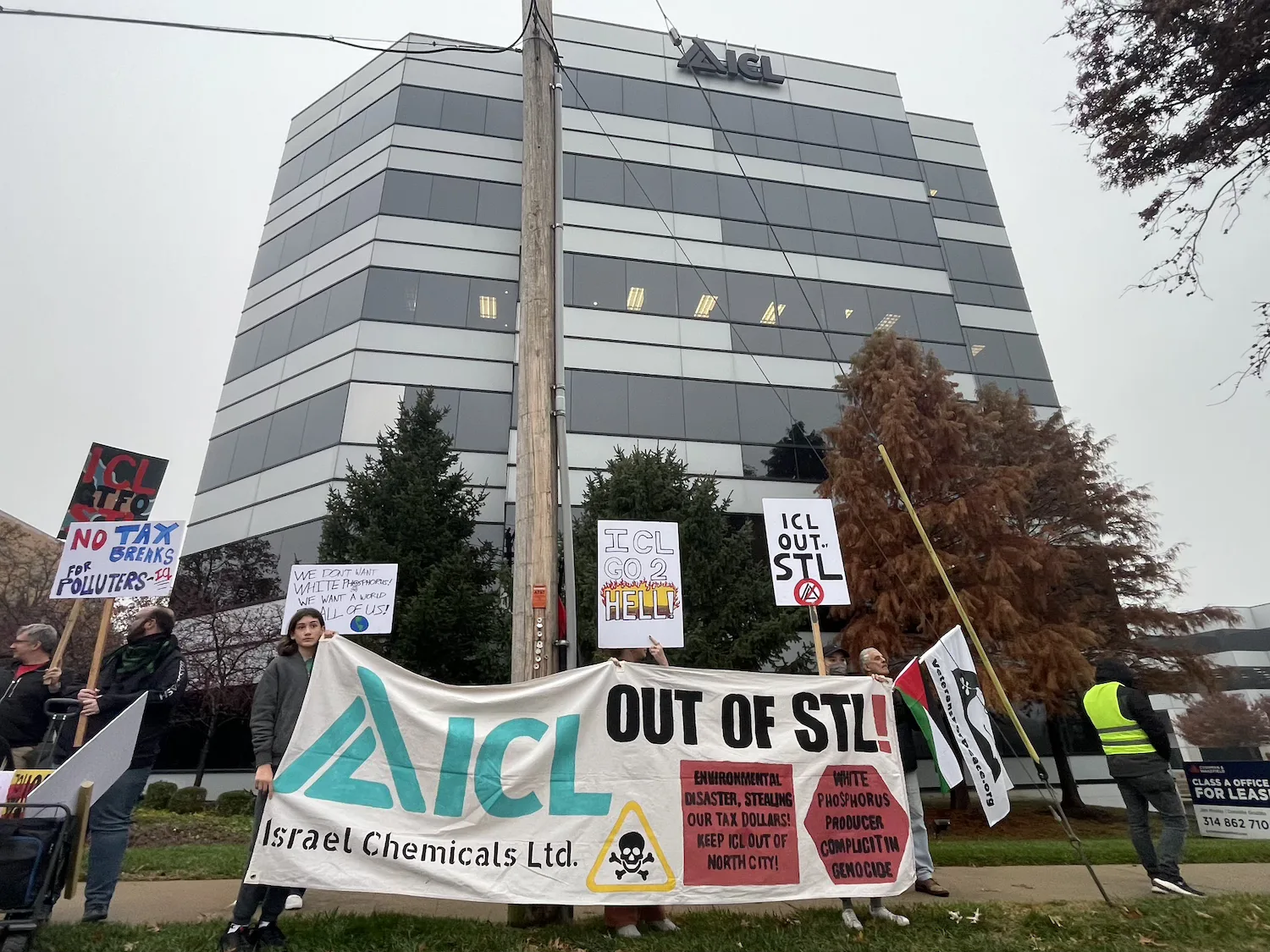
Activists and residents formed the group “ICL out of STL” to publish information about the company and the push to reform the process that allowed it to obtain tax incentives. And now their attention has turned to a second ICL facility in the City of St. Louis.
Defense Department contracts show the company’s South St. Louis plant serves as an integral part of the supply chain manufacturing white phosphorus for the military. That plant, too, is the source of potential environmental hazards, activists say.
White Phosphorus
Last year, the Board of Aldermen approved a non-binding resolution calling on the city’s Board of Trustees of the Employees Retirement System to divest its stock holdings, bond investments, and pension funds from companies “complicit in perpetuating violence against people within our city or abroad.” The effort was inspired by U.S. and Israeli military violence in Palestine.
The city’s approval of incentives for ICL seemingly contradicts this desire. Defense Department contracts show that for years, ICL’s facility in the Carondelet neighborhood has helped manufacture vast quantities of white phosphorus for the military.
White phosphorus is a chemical compound that burns when it is exposed to air, according to Brian Castner, a weapons investigator and head of crisis research with Amnesty International and a former military bomb disposal officer.
Records show that ICL and Monsanto (now Bayer) are two parts of a trifecta supplying the military with the compound. The third is Pine Bluff Arsenal, which houses the U.S. military supply of white phosphorus and, by extension, some of Israel’s supply.
While the details of how those three entities interact are not fully clear, government contracts show that ICL was awarded $1.6 million from 2020-2024 for “explosives manufacturing” to take place in St. Louis, “in support of Pine Bluff Arsenal.” The contract limited procurement to “authorized distributors of white phosphorus produced by Monsanto.” (The New York Times has reported that “Bayer, through its acquisition of Monsanto in 2018, operates the only facility in the United States that produces white phosphorus,” naming it as a place in Idaho.)
In a statement, Bayer says it uses most of that white phosphorus to make its weed killer Roundup. However, it adds, “A portion of the white phosphorus is sold to a limited number of third-party companies as elemental phosphorus which has many other important industrial uses (e.g. fire retardants, leavening agents, aviation fluids, beverages, etc.). We do not sell white phosphorus for military purposes. We cannot comment on agreements that other companies may have with third parties.” The company declined to comment on our follow-up questions.
ICL also did not respond to multiple requests for comment.
Artillery shells Israel dropped on civilians in Lebanon in October 2023 were linked to Pine Bluff Arsenal, according to the Arkansas Times, relying on an investigation by Amnesty International that examined the artillery shells’ identification codes. Another investigation, this one by Human Rights Watch, confirmed the use of the compound over the Gaza City Port in October 2023 as well. The organization noted that it has tracked the Israeli military’s use of white phosphorus in previous conflicts in Gaza, including in 2009.
In 2023, the Israel Defense Forces told the Washington Post that Israel uses white phosphorus shells to create smokescreens, not cause fires. “It said its use of the weapon ‘complies and goes beyond the requirements of international law,’” the paper reported.
The IDF did not respond to the River City Journalism Fund’s inquiry. The Post reported that the IDF possesses safer alternatives for producing smokescreens that do not contain white phosphorus. “It is unclear why the Israeli military fired the rounds into the evening, as smoke would have little practical use at night and there were no Israeli troops on the Lebanese side of the border to mask with smokescreens,” the Post wrote.
Instead of questioning or even acknowledging these connections, the St. Louis Development Corporation’s Planned Industrial Expansion Authority unanimously approved significant tax incentives for ICL in November 2024. These incentives provided a 90 percent real and personal property tax abatement for 10 years, with a 50 percent real property abatement after this until the development reached its 15th year.
The board’s attorney, Olivia Findley, said there would be no public comment at the meeting, but that the public could submit written statements. The vote happened immediately after this announcement and a review of the community benefits scorecard, making it unclear what impact public input would have on the decision.
“They did this behind closed doors. They rushed it through in as much secrecy as possible, as fast as possible,” says Lauren Filla, an organizer with ICL out of STL and co-chair of the Eco-Socialist Green Party of Eastern Missouri. “There’s not any actual community member that I’ve talked to that says I think we need this. The city’s talking points have been ‘Well, there will be jobs. There will be 150 jobs proposed.’ And we’ve asked, ‘Is there any evidence that those jobs will go to the members of the actual community where it’s being built?’ And we haven’t received back any kind of acknowledgement or answer to that.”
SLDC declined multiple interview requests and has not yet fulfilled a records request submitted in October 2025 asking for all emails to or from any member of SLDC’s Board of Directors discussing the project, as well as any documents in SLDC’s possession relating to the development of the new ICL plant. It did submit the following statement (printed in its entirety):
“In 2023, SLDC implemented transparent, standardized, and beneficial policies and procedures for the consideration of Development Proposals. We adhere to those rules and guidelines when deciding whether to give projects incentives. The Board of Aldermen previously approved the site on which the ICL plant was to be built as blighted. The Planned Industrial Expansion Authority subsequently approved incentives for the project during a public meeting. Then—as is now—SLDC invites the public to submit any concerns to the organization, which are taken into consideration.”
Daniel Pate, ICL Out of STL’s tax abatement and incentive expert, says the lack of community input was the point.
“SLDC is actually, I think, being really, really underhanded and intentionally going through a little-known board that rarely meets and doesn’t do very much to be able to authorize a project that would generate a lot of backlash and a lot of questions if it had to go through a normal process,” Pate says.
While the Planned Industrial Expansion Authority may appear to be an obscure board that meets infrequently, it’s made up of the same members as the Land Clearance for Redevelopment Authority, which meets monthly to review development proposals that seek public assistance, such as tax abatement or tax-exempt revenue bonds. Neither board tends to leave room for public comment at its regularly scheduled meetings.
Because the land for the factory is part of an earlier redevelopment area, officials were able to rely on a blighting study and plan approved in 2008 for the Carrie Avenue TIF. That allowed the Planned Industrial Expansion Authority to grant incentives without going before the Board of Aldermen, Pate says.
‘Zombie’ Abatements
Aldermanic president Megan Green agrees that reforms are needed.
“Obviously, when we look at ICL, for example, that was a tax abatement that was granted over 10 years ago for a different project, but then it kind of became this zombie abatement, where then it was able to be brought to life for a new project many years later,” Green says.
Green says the issue has to be fixed and that aldermen are working on legislation to address it. If there is a change to a proposed project, it should go back through a public process for approval, she adds.
“We now have a process for determining how much abatement a certain area of the city qualifies for based upon the trends in that area,” she says. “And so it doesn’t really make sense to allow these abatements to last in perpetuity.”
It’s much more reasonable to have a five-year sunset clause, Green says. Anything that requires an abatement or TIF or involves foregoing tax revenue should go through the board, she adds.
Green says she was not aware of ICL’s ties to white phosphorus until after the Planned Industrial Expansion Authority approved the new location.
“Whenever we look at business development in the city, we need to recognize that not all business is good business,” Green says. “If there is an entity that wants to be in our city that is actively causing harm to folks, whether it be in our local community or abroad, I think that there needs to be a greater threshold for approval for those types of projects. And, they certainly need to go through a public process and not just be approved without the public knowing that it’s even a possibility.”
Mayor Cara Spencer declined to comment on this story.
A chemical compound that burns through bone
White phosphorus is a waxy white/yellow solid that emits a garlic-like odor, is highly soluble in fat, and can burn to the bone. It is harmful to humans by all routes of exposure.
It is used in grenades and artillery shells “to produce illumination, to generate a smokescreen and as an incendiary,” according to the World Health Organization. It can also be used in fertilizer and detergents, to make fireworks, and to kill rats.
Because it burns when exposed to air, and water can’t put it out, it is incredibly difficult to treat civilians who have been exposed.
Israel’s attack on Lebanon at the border town of Dhayra in October 2023 “was an indiscriminate attack that injured at least nine civilians and damaged civilian objects,” according to Amnesty International, which called for the attack to be investigated as a war crime. The Biden administration said in 2023 it was “certainly concerned” about reports that Israel had illegally used U.S.-supplied white phosphorus in the attack and would investigate.
Though Castner says the shells recovered from Lebanon were estimated to be manufactured in the late 1980s, DOD contracts show the military is continuing to manufacture the compound and store it at the Pine Bluff Arsenal.
ICL’s contracts with the Army for white phosphorus date back to at least 2010, according to an older government site tracking the orders, which has since undergone maintenance, making some of these contracts unviewable. The older contracts list ICL’s Creve Coeur headquarters as the contract awardee.
As for Bayer, even as the German company says it does not sell white phosphorus for military use, it is named in contract solicitations (typically as Monsanto, the St. Louis company it acquired in 2018) as part of the distribution network producing the compound.
The New York Times reported in March that Bayer supplies white phosphorus “via intermediaries, to the United States military, which uses it to fill white phosphorus munitions at the Pine Bluff Arsenal in Arkansas.” The newspaper linked that supply work to President Donald Trump’s “abrupt” order one month earlier supporting the company’s production of its controversial weed killer Roundup, reporting that “concerns about the availability of phosphorus for defense played a significant role in Mr. Trump’s move to deem Bayer’s operations a national security priority,”
Environmental Concerns
Activists said they plan to shift their focus to ICL’s existing facilities in Carondelet, taking aim not only at its ties to war, but also environmental concerns. An ICL Out of STL protest also targeted the company’s North American headquarters in Creve Coeur last fall.
A key point advocates have made is that the North City plant would have polluted a historically Black neighborhood with high childhood asthma rates. They note that ICL still owns 401 Adelaide Ave., where the development would have been located, and could build something else on the site, activists say. A report from the Missouri Department of Natural Resources shows that the Carondelet facility received warning letters annually from 2022 to 2024 for violating the Clean Air Act.
Maxine Gill, the policy coordinator for the Missouri Coalition for the Environment, said the organization and its partner, the Washington University Interdisciplinary Environmental Law Clinic, submitted comments to the Department of Energy in response to a draft environmental assessment of the proposed site in North City.
“The DOE’s assessment dismissed any localized environmental harm, claiming it would be offset by the adoption of EVs elsewhere,” Gill said in a statement. “This argument attempts to justify a sacrifice zone—one community intentionally overburdened by pollution and facing disproportionate negative health outcomes in order to create benefits for others elsewhere.”
In Israel, ICL paid $33.7 million after a 2017 leak from its facility polluted the Nahal Ashalim riverbed in the Negev region. The Times of Israel called it “the largest amount ever paid in compensation for environmental damage in Israel.”
Local activists suggest St. Louis was lucky ICL will not be building the Northside facility heralded by the city.
“We are glad this disastrous project will no longer be moving forward and harming local residents with further degraded air quality,” Filla said in a statement after the rally. “But we still have to address the underlying conditions that allowed for this plant to be approved and receive significant local tax abatements without public input or approval from elected officials.”
This story was commissioned by the River City Journalism Fund, which seeks to advance local journalism in St. Louis. See rcjf.org for more information.