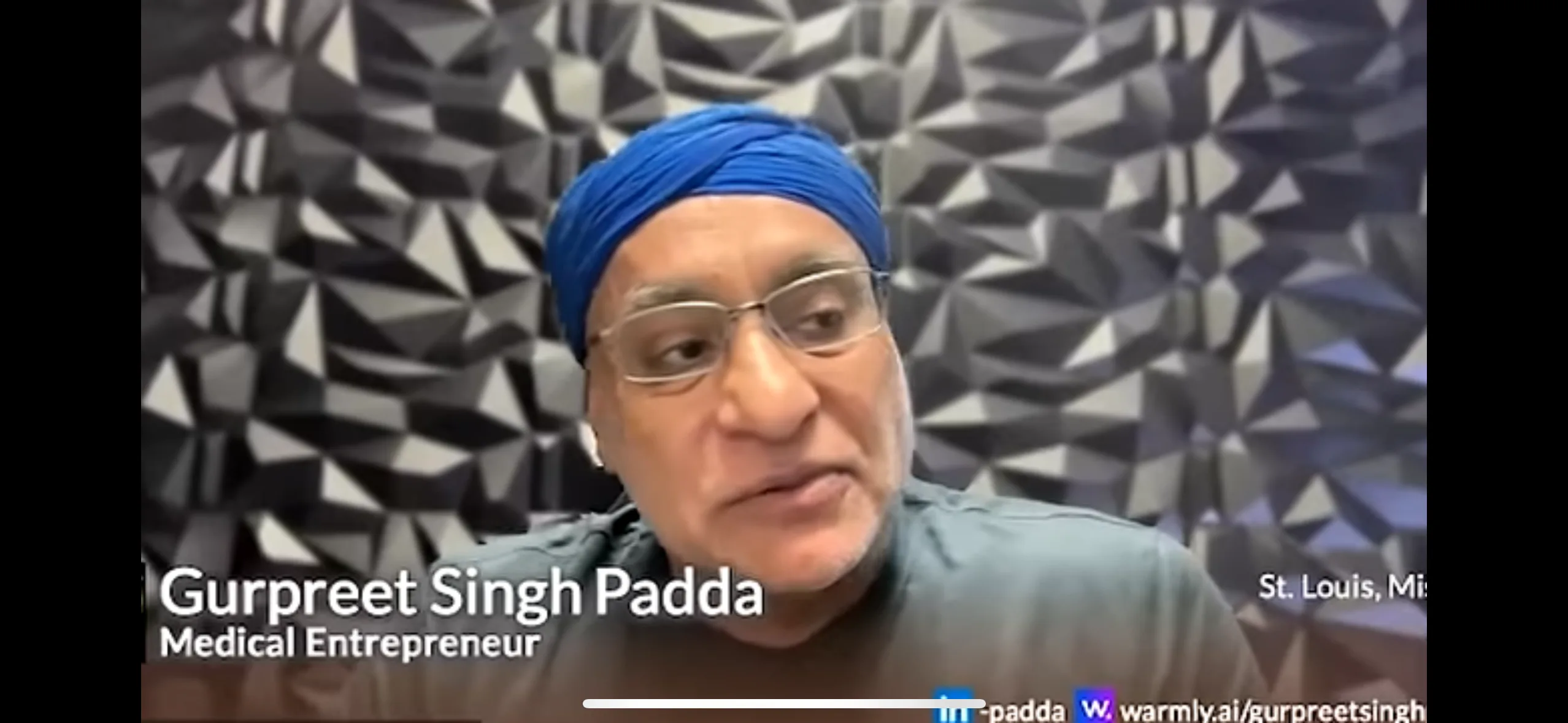
Dr. Gurpreet Padda was not that long ago one of the city’s more prolific restaurateurs and, by some accounts, the foremost practitioner of his area of medicine. He owned Cafe Ventana, Sanctuaria, Hendrick’s BBQ and Cathedral Square Brewing, among other enterprises. He had further ambitions.
Then came the crash.
Get a fresh take on the day’s top news
Subscribe to the St. Louis Daily newsletter for a smart, succinct guide to local news from award-winning journalists Sarah Fenske and Ryan Krull.
It’s impossible to say for certain why. Padda himself did not respond to text messages sent to numbers associated with him, a note left at his medical office’s front desk, or emails to him and his practice; the husband of his business partner, reached by phone, was not helpful.
But it seems likely that the crumbling of Padda’s real estate and restaurant empire has to do with the changing fortunes of Padda’s medical practice. The federal government has been focused on making it harder to prescribe—and overprescribe—pain medications. That collapse has also had repercussions for neighborhoods across the city, which are dealing with foreclosed properties and also at least two fires.
Padda was born in India, where he previously told SLM that a roadside restaurant had been in his family for the past 800 years. At age 9, he moved to the U.S. He went to high school in St. Louis, Kansas City for medical school, and then Saint Louis University for a business degree.
In 2000, he purchased a three-story, Art Deco tan-brick building at Chippewa and Brannon in the Northampton neighborhood. The structure had undergone a significant post-war remodel and was converted into a full-fledged medical center by businessman Frank J. Hardt—whose name is still embossed in the building—in tribute to his grandson, who died in World War II. A pharmacy called Keller’s operated from the 1930s until relatively recently.
Padda installed his Padda Institute pain management clinic atop the pharmacy on the building’s third floor. In a recent podcast interview he said that he takes a holistic approach to pain management, interviewing patients to get to the root cause of their ailments. It’s a philosophy he has said he developed after spending the early part of his career as an anesthesiologist, watching patients get procedures done only to have underlying problems return in short order. “There was no durability,” he said. “And I would use the pain medication, and I realized, hold on, we’re not really getting to the source of the problem. We’re creating addiction.”
In 2005, Padda purchased the former Playboy Club on Lindell, a nightlife destination that throughout the 1960s had so many members even Bobby Darin couldn’t get a table, as well as the building that would later house his Cafe Ventana. In 2010, he scooped up the first of his two churches: the 6,000-square-foot former St. Lucas Evangelical Church in Soulard, a stone’s throw from McGurk’s.
That year, Padda told SLM that he had plans to expand the New Orleans-themed Cafe Ventana as well as for an “incubator for micro-app companies” called iNeoCortex to go atop the coffee shop. He’d bought a 31-acre farm in Belleville to grow organic crops for his eateries. He wanted to install a bar and restaurant in a historic church in the Central West End (he later bought his second historic church, the 39,751-square-foot Second Baptist in 2018). The sky was the limit. He referred to himself and his business partner as “the patron saints of lost real estate causes.”
In the years since, Cafe Ventana and Cathedral Square have shuttered, as have Padda’s Tex-Mex and Italian endeavors. Hendricks is still going strong. Padda no longer owns Sanctuaria, though he remains its landlord. He’s lost the old Playboy Club, the Cafe Ventana building and the building where he still operates his pain clinic. (Unusually for a third-floor pain clinic, the elevator is inoperable.) A lawsuit accuses him of squatting there for two years after he lost ownership. His ecumenical holdings have gone up in flames.
The vagaries of the restaurant and land businesses are perhaps not entirely to blame.
In 2018, Padda was hit with lawsuits filed by 23 cities and counties in Missouri, part of a complicated legal case against multiple actors. The suit accused him of running a pill mill “under the guise of being a doctor” from the Padda Institute. About half of his patients were being prescribed oxycodone and nearly another quarter OxyContin, one filing alleged. According to one suit, the pharmacy housed within Padda’s Art Deco building acted as an opioid dispensary for his patients, ordering 6.9 million pills and other “opioid dosage units” between 2006 and 2014—more than any other pharmacy in St. Louis city. A lawsuit filed by Jefferson County alleges that residents would travel to Padda after being denied pills by doctors closer to home.
“The evidence was clear that he was loose with his writing of opioid prescriptions,” says Jack Garvey, who represents the multiple municipal governments still suing Express Scripts, Optum, Padda, and others for their dispensing of opioids. Padda has been dismissed from some of the suits, but remains an active defendant in ones filed by Jefferson and Franklin counties. The lawsuits essentially allege that the big pharmacy benefit managers and doctors such as Padda flooded Missouri with addictive pills, causing a public health nuisance. Padda wrote prescriptions for “thousands of pills” that wound up a long way away from his South City clinic—including places like Jefferson County, Garvey says.
Padda’s lawyer has not filed a response to the lawsuits (Garvey believes Padda could well face a default judgment, but for now Garvey is focused on pursuing the bigger defendants).
And in the meantime, in 2020, Medicare started looking into Padda’s operation. That year, officials told Padda his office had been overpaid by Medicare since 2016 to the tune of $5.9 million. They wanted that money paid back.
That’s according to a lawsuit Padda filed in 2021 arguing that figure was a miscalculation. He ultimately dropped the suit, and it’s unknown what he ended up having to pay. (The Centers for Medicare & Medicaid Services, the federal agency trying to collect, did not respond to questions from SLM.)
Whatever the result, Padda was facing a changed regulatory landscape. New federal guidelines—and prominent federal enforcement actions—have made it much harder for physicians to overprescribe medication for pain. Physicians who don’t toe the line have faced not only lawsuits, but federal prosecution. (Padda has not been among them, but his work is almost certainly under a microscope as state-level prescription drug monitoring programs now monitor the dispensation of pills.)
In 2023, Associated Bank began foreclosing on his South City pain clinic, the old Playboy Club and the Cafe Ventana property, as well as an adjoining parcel. Padda had previously taken out multimillion dollar loans, using the properties as collateral, but had gone into default.
Amid all this, his churches began catching fire—first, the Second Baptist Church on Kingshighway.
Jim Dwyer chairs the Central West End North Special Business District Commission. He calls Padda an “irresponsible property owner.” He and others on the SBD say they warned Padda over and over again that people were going into the church and sleeping there, and that it needed to be secured. When the warnings went unheeded, the SBD shouldered the cost of overnight security details. After several months, though, those costs proved untenable. In October 2021, flames erupted in the church, climbing up its belltower. “His failure to safe guard the property amounts to malfeasance,” says Dwyer. “He ignored this historic property.”
About Padda losing his other holdings, Dwyer says, “Irresponsible behavior reaps its own rewards.”
In a story about the city’s failure to investigate historic buildings catching fire last year, Padda told the Post-Dispatch that he’d taken the Central West End building’s insurer to court. They’d paid out $875,000; he felt he was owed $2.5 million.
A year and a half after the fire in the Central West End, Padda’s church in Soulard suffered its own blaze.
Maureen McMillan, a Soulard native who lives down the street from the charred church, says that she remembers when Padda first showed up in the neighborhood, hosting a community meeting to debut his plans to turn the church into a microbewery. He introduced himself as a doctor—“didn’t really say what kind of doctor,” she says. It immediately rubbed McMillan the wrong way that Padda both bragged about his wealth and at the same time implied he’d been a victim of racism in the neighborhood while scoping out the church in his Range Rover.
McMillan says she and other neighbors knew of Padda’s other businesses because he talked about them at that meet-and-greet. “Then slowly, those other businesses started to close, and we all kept watching up here to see what was going on with the church,” she says. Then it went up in flames.
Since the fire, much of the church’s roof remains missing. Large, unsightly white plywood covers what had been its stained glass. The church’s location means that it is something a lot of people pass when they enter the neighborhood.
“This seems to be kind of part of a pattern,” McMillan says, noting that the Soulard church wasn’t Padda’s first church fire. “He doesn’t seem to have a plan really moving forward.”
The May 16 tornado that devastated a swath of the city further damaged the old Second Baptist Church in the Central West End, with the tower that had suffered most of the fire damage collapsing further. Fencing that had surrounded the property had blown down or was left wide open.
At the court hearing last Tuesday, the attorney for Associated Bank, whose loan Padda defaulted on, said that in addition to taking possession of the properties Padda put up for collateral, the bank was also seeking attorneys’ fees and damages for the rent they could have been collecting between the time when the bank first began the foreclosure process in February 2023 and today. It pencilled out to around $1 million. A judge has yet to rule on that matter. This time, Padda had a lawyer in court to represent his interests: Spencer Desai, an attorney most well known for handling bankruptcies.
Editor’s note: A previous version of this story referred incorrectly to Dr. Padda’s response to the opioid-related lawsuits against him. A lawyer did file an appearance on his behalf in a few of those cases, although that lawyer did not file a response. We regret the error.