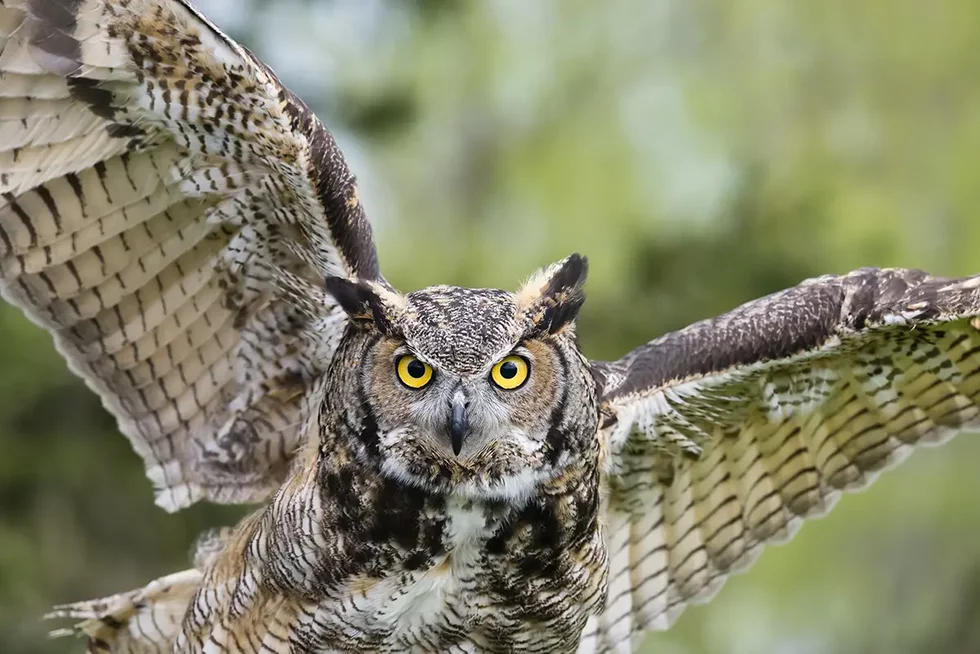
It’s a sunny but cold day as I forge up the hill north of Steinberg Skating Rink in Forest Park. Only the bravest purple crocuses have appeared in the brown winter grass. Together with a group of researchers, I’m hunting for Forest Park’s apex predator. Between the park’s canal waters and the MetroLink, a clutch of pines are known to be the roosting trees of Astrid, the great horned owl.
“We have definitely found a couple of rabbit vertebrae here,” says Jeff Meshach of the World Bird Sanctuary. He plucks a bone from a bed of brown pine needles. It’s a little larger and sharper than a fingernail. “So if she caught a rabbit,” Meshach says, looking up into the evergreens, “she would probably feed on that not too long after she caught it. She might want to take it off the ground and up onto a branch.”
Get a fresh take on the day’s top news
Subscribe to the St. Louis Daily newsletter for a smart, succinct guide to local news from award-winning journalists Sarah Fenske and Ryan Krull.
Stephen Blake, assistant professor of biology at Saint Louis University, chimes in: “People have this idea, from watching wildlife programs on the telly, that you have to go to Africa or the Grand Tetons to see amazing wildlife. But Astrid the great horned owl is probably staring at me right now… We’ve been tracking her movements for the last year in order to begin to build a scientific picture of how an apex predator can operate in an urban park, 150 meters from Kingshighway, 200 yards from the urban jungle of Barnes hospital and the rest of the city.”
Blake and Meshach are part of a team of researchers with the Forest Park Living Lab, a group that grew out of a study of the park’s box turtle population, and now unites six collaborative partners: The Saint Louis Zoo, Washington University, Saint Louis University, Forest Park Forever, The World Bird Sanctuary, and the National Great Rivers Research and Education Center. Of course, amateur naturalists and birdwatchers have done this work for decades, but the Living Lab’s goal is to figure out how park predators and prey are behaving around each other, and how that may affect the food web and the ecological health of the park—and therefore St. Louisans. So far, the Living Lab researchers have tagged Astrid, a number of raccoons, and some ducks. “Later this year, we’re hoping to tag another set of terrestrial apex predators: coyotes and foxes, and a variety of other species,” Blake says.
Astrid stays hidden, but for data collection purposes, that’s OK because the owl is wearing a GPS device. Stella Uiterwaal, a postdoctoral researcher at Washington University, bicycled to our hunt with a whip antenna sticking up out of her backpack like a metal sail. Beneath the pines, Uiterwaal consults a Ghostbusters-like handheld device—called a base station—used to download data from a UHF (ultra high frequency) signal. “We can turn this on and listen for the little signals the tag makes and play a game of hot and cold,” she explains. The tag Astrid is wearing sends out a signal that the researchers can locate and which allows them to get close to her. It also transmits data: Its bleeps and bloops measure not only latitude and longitude, but also temperature and acceleration. Flight behaviors look different than roosting in a tree.
“PEOPLE HAVE THIS IDEA THAT YOU HAVE TO GO TO AFRICA TO SEE AMAZING WILDLIFE.”
As urban expansion continues, parks are increasingly important conservation areas. One objective of the Living Lab project is to promote wonder and exploration, especially for the kids of St. Louis, who have free access to Forest Park’s wildlife on their doorstep.
And there’s plenty to learn from urban-adaptive raptors like Astrid. In case you were wondering, an owl pellet looks like an unwrapped Cadbury Creme Egg that’s been left under the couch for several decades—fuzzy. “We just found a keel bone over here in a pellet,” Meshach points out. It’s evidence of Astrid dining on a smaller bird, he says. “She won’t attack a white-tailed deer, but she’ll go for raccoons, she’ll go for herons, she’ll eat rodents, she’ll eat voles, and she’ll eat squirrels. She fulfills that same function in the ecology of the community as, say, a leopard on the Serengeti.”
If Astrid were to underestimate the danger on the ground, foxes or coyotes might take a chance on stealing her dinner, but it better be in the daylight. At night, she’s an airborne Terminator with sharp talons. “They’ve got incredible hearing and eyesight,” Meshach explains. “They probably see in black and white, but their ability to hunt in low light is incredible.”
There’s no owl in the world that makes its own nest, I also learn. They take over the home of other birds of prey or natural cavities, such as in trees or cliffside rocks. In Forest Park, Astrid’s house was probably the former home of a red-tailed hawk. She likely evicted them, “but that’s OK,” Meshach says. “They’re good nest builders.” Charles and Sophia, another great horned owl couple in a cottonwood tree on the other side of the park, have a clutch that will be hatching soon. We don’t know if Astrid has owlings. “If she’s not on a nest now, she’s probably not going to have eggs this year,” Meshach says.
One thing the team has learned as part of the Living Lab is that Forest Park’s animals don’t stay within the park’s boundaries—they make plenty of excursions into the human realm. Astrid is known to treat the stone-and-glass edge of Barnes-Jewish Hospital as a cliffside perch, and she hunts as far as Maplewood. “One of our raccoons, practically every night, legs it out of Kennedy Forest into a culvert, scuttles under I-64, and hangs out in a dumpster in Downtown,” Blake says. “I’ve found him in there, kipped up in the dumpster, and he’ll come back to the park for a few days and then do it again.”
Wildlife often serves as an indicator of how healthy a park system is, says Sharon Deem, director of the Saint Louis Zoo Institute for Conservation Medicine, who analyzes the soil, water, and air in Forest Park as part of the Living Lab. “We work in wildlife health and ecosystem health, and both of those are really important for human health as well,” she says. “As sentinels, wildlife are often the first indicators of a toxin exposure or may be the first exposed to an infectious agent, both of which may impact human and non-human animal health.”
And there’s good news, with a turtle-shaped caveat: The park is home to a pretty robust group of critters. “Our baseline data shows healthy animals moving around the park, and that’s very exciting,” Deem says. However, “from our turtle species, and that long-term work, we know that there are some ways that box turtles are dying because of the human imprint.” The project is keeping a close eye on the reptiles.
Our survey party left with plenty of data, but no visual of Astrid. I couldn’t help but feel let down, but Astrid has bigger fish to fry. It’s all the more reason to look for rabbit bones in the underbrush and look to the treetops. If you pass the pines at dusk, keep an ear out for Astrid’s hoot.