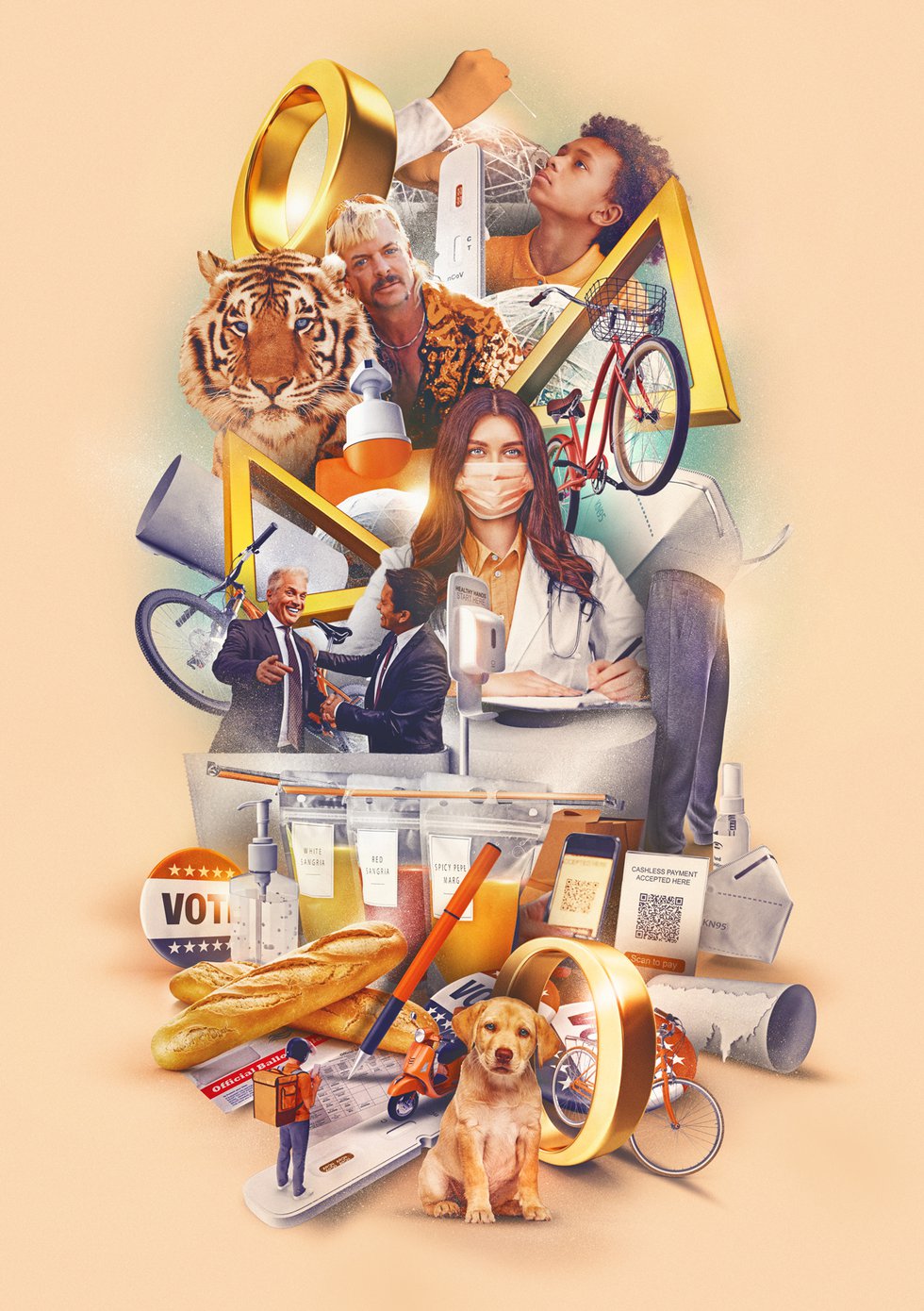
We never thought we’d be here—no, sorry, we never wanted to be here—but this month marks two full years of living with COVID-19. At the beginning of the pandemic, the Missouri Historical Society asked St. Louisans to share their pandemic experiences as part of its Stories of the Pandemic collecting initiative. That got us thinking: If we were to plan an exhibit to explain the innovations and cultural phenomena from the years 2020–20whatever to future generations, what would it include? So imagine with us that the year is 2220. (COVID-19 has got to be over by then, right?) Here’s how we’d describe the pandemic to our great-great-great-great-grandchildren.
THE GREEK ALPHABET
Get a fresh take on the day’s top news
Subscribe to the St. Louis Daily newsletter for a smart, succinct guide to local news from award-winning journalists Sarah Fenske and Ryan Krull.
This was likely useful in the 8th century or whatever, but we never want to hear the word “delta” again.
THE CENTERS FOR DISEASE CONTROL AND PREVENTION
A former government agency in charge of public health, it was disbanded in 2035 after issuing its final guideline: “The CDC now recommends the 5-second rule.”
HANDSHAKES
In the Before Times, humans used to grab one another’s hands and wag them up and down as a means of greeting. Some people squeezed your hand too hard. Some people’s hands were limp, and it was off-putting. Whatever the case, it was all incredibly unhygienic. Now we greet each other by doing the YMCA dance from 6 feet away.
OUTDOOR DINING IN IGLOOS
When dining indoors became too risky, a brilliant group of entrepreneurs got the idea to purchase a bunch of PVC bubbles so diners could still enjoy a meal out, but only with their posse. The inventor of the PVC bubble won the Nobel Prize in 2024.
TO-GO COCKTAILS
And the inventor of the to-go cocktail took home the award the following year.
AT-HOME RAPID TESTS
Part of the approach to combating COVID-19 was to test at home when you had symptoms or had been exposed to someone with the virus. This exhibit could not include a test because there were none to be found.
TELEHEALTH
People used to go to things called “offices” to see their doctors. Offices were outlawed in 2030.
VOTING BY MAIL
Yes, we used to make people go to a specific location—and that location was not immediately clear…you had to look it up—to vote. Of course, now we just vote using a QR code.
QR CODES
Speaking of: Is there a better comeback story than that of the humble QR code?
SWEATPANTS
This is now all anyone wears, but before the pandemic it was customary to wear pants without elastic waistbands.
HAND SANITIZER
Thanks to genome editing, our hands now sanitize themselves!
TIGER KING
A documentary that gained popularity at the beginning of the pandemic, when stay-at-home orders were in place. Lin-Manuel Miranda’s 2030 adaptation would go on to win the most Tonys of any Broadway musical in history.