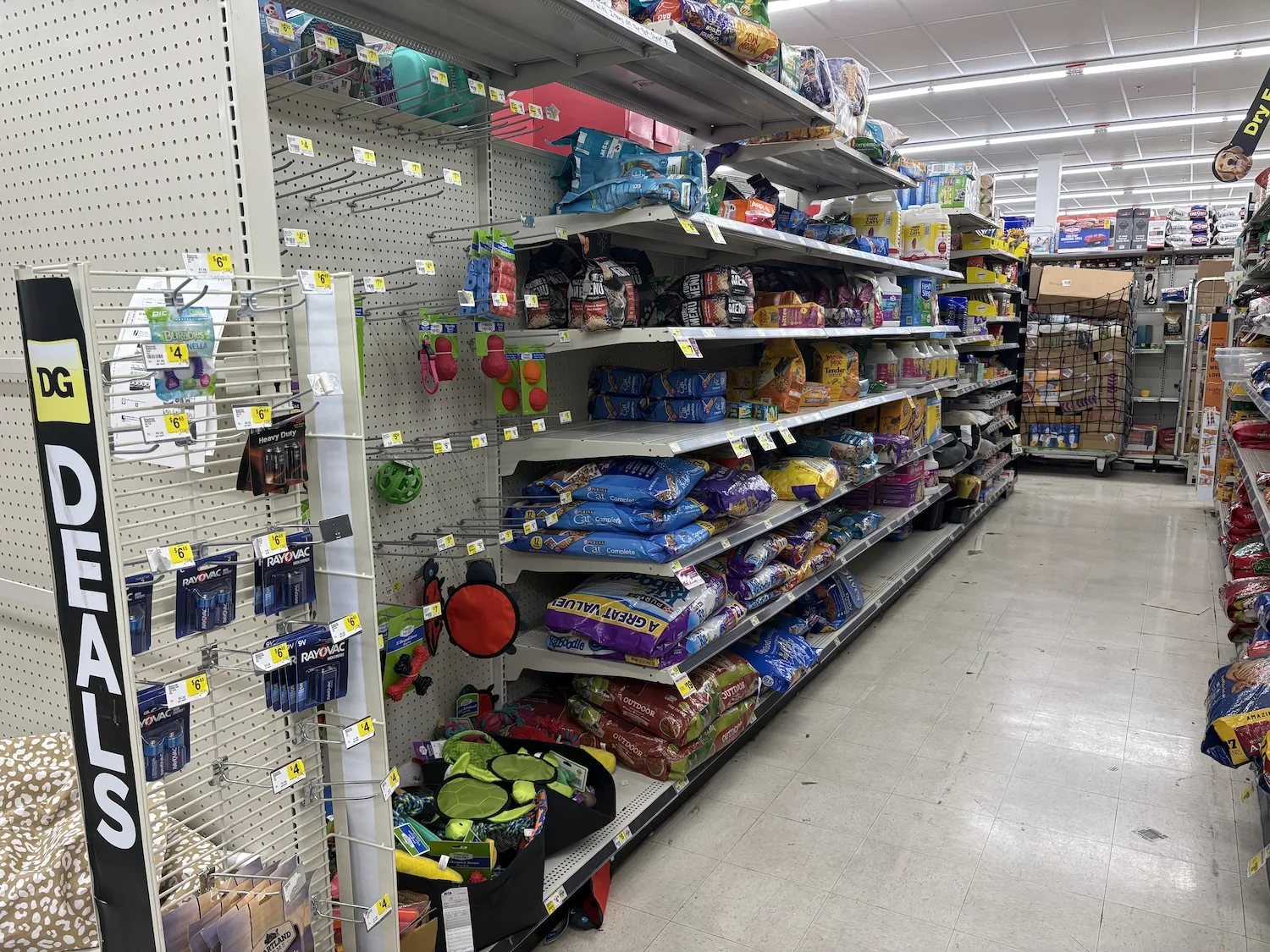
In 2022 and 2023, investigators working for the state of Missouri spent a lot of time at Dollar General. A lot of Dollar Generals. One hundred and forty-seven of the store’s locations, to be exact.
They were investigating the retailer, which operates around 650 locations in Missouri, for unfair and deceptive pricing practices—and, at least according to a lawsuit filed by the Attorney General’s office in September 2023, seemed to find ample evidence of such.
Get a fresh take on the day’s top news
Subscribe to the St. Louis Daily newsletter for a smart, succinct guide to local news from award-winning journalists Sarah Fenske and Ryan Krull.
Investigators with the Missouri Attorney General’s Office and the Department of Agriculture Weights, Measures (an agency whose purpose to ensure an equitable marketplace for both businesses and consumers) checked the prices of more than 5,000 products on Dollar General shelves across the state, searching for discrepancies between the price posted on the shelf and the price that was rung up at the register. In many cases, they found substantial differences. According to their suit, at one store in the Patch neighborhood of St. Louis, a 28 ounce bottle of Gatorade was marked as $1.45 but rang up for $1.70, while a plastic storage box whose listed sale price was $16.50 was $18 at checkout. At a location in Mehlville, Hanes socks, BodyArmor sports drink and Hershey’s Chocolate with Almonds had similar discrepancies. At a store in Kansas City, it was the Suddenly Pasta Salad, the cat food, the scented candles, and Chapstick.
The lawsuit against the Nashville-based Dollar General Corporation was filed when Andrew Bailey was the attorney general. Bailey was often criticized for lawsuits he filed against the Biden administration, as well as threatening to investigate Kansas City Mayor Quinton Lucas after a city-run social media account criticized Kansas City Chiefs kicker Harrison Butker—actions that were widely seen as more about political messaging than substance. (It paid off; in August, President Donald Trump appointed Bailey deputy director of the FBI.)
But the suit against Dollar General seems to be one where his office really did its homework. The investigators devised a plan wherein if three or more items selected from the shelves at random rang up with different prices than what was marked on the shelves, the store was considered to have failed the test. Ninety-two of the 147 stores failed.
“Price discrepancies ranged up to as much as $6.50 per item, with an average overcharge of $2.71 for the over 5,000 items price checked by investigators,” the AG’s Office wrote in its lawsuit.
When Catherine Hanaway took over as attorney general last month, she signaled that her office would focus on prosecuting Medicaid fraud, violent crimes, and consumer protection—the sort of things the state’s attorneys general used to send press releases about before the job became a fast-track to Washington. “This case reflects my office’s key priorities when it comes to protecting consumers,” Hanaway told SLM in a statement. “My office will always work to safeguard Missouri consumers and ensure that corporations are held accountable under the law.”
The lawsuit asks that Dollar General be ordered to stop the alleged price gouging, pay fines and restitution, and forfeit what the state says is their “ill-gotten gains.”
Dollar General has more than 20,000 locations around the U.S., including its 650 in Missouri. The company has had a banner year, with more customers flocking to the stores to find deals amid rising prices caused by tariffs and inflation. Its stock is up almost 30 percent year to date. Even if the sticker doesn’t always match what’s rung up at the register, the store’s prices tend to be lower than other retailers, but that is in part because the locations are often staffed by only a skeleton crew. That, in turn, has made the stores into soft targets for crime. A 2020 ProPublica investigation into crime at Dollar General as well as its chief rival, Family Dollar, was reported primarily from St. Louis. It described the stores as places that “tend to be thinly staffed and exist in a state of physical disarray” and accused them of “fostering violence.”
In court filings, Dollar General has denied deceiving customers. None of the three attorneys representing Dollar General responded to emails seeking comment. However, in a deposition, Dollar General’s pricing execution officer Brian Haug indicated that new prices are pushed out company-wide electronically from headquarters in Nashville to all the stores’ registers across the country. It stands to reason then, especially in a period of high inflation, that the state investigator’s findings could be explained by clerks not being diligent about changing the physical price tags on the shelves. It also stands to reason that the lack of updated pricing information on store shelves could have something to do with the stores’ low staffing levels. (It’s also worth noting that the Attorney General’s lawsuit describes a few instances of an item’s price actually being lower at the register compared to what was on the tag.)
The suit was set to go to trial last week, but was delayed over a disagreement as to who should ultimately decide that trial’s outcome.
The Attorney General’s Office wants a jury trial. Dollar General’s attorneys want a bench trial, leaving the verdict wholly in the hands of the judge. Generally speaking, attorneys who feel like the letter of the law is on their side often want a bench trial. Attorneys who feel their case is more in line with the passion of the populace want the jury.
On October 1, St. Louis City Circuit Judge Michael Noble denied the state’s request for a jury trial. The Attorney General’s Office appealed, but that appeal was denied. The office can appeal again to the Missouri Supreme Court.