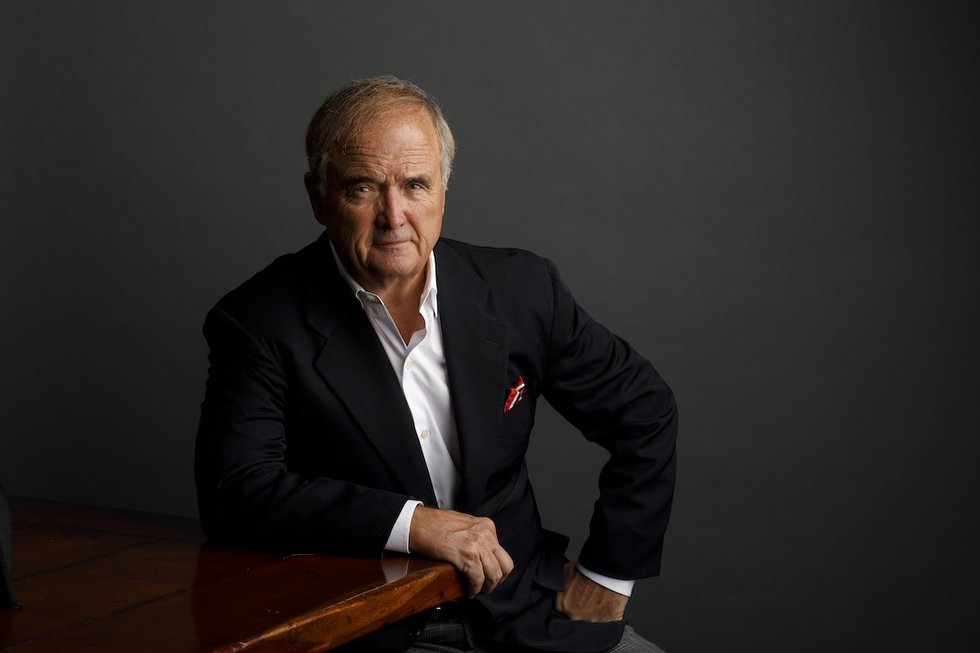
David Hoffmann—the billionaire Missouri native who dabbles in everything from real estate to newspapers to ferry services—is in full expansion mode.
His Hoffmann Family of Companies, for which David Hoffmann serves as chairman, has so far this year bought a San Francisco Bay Area herb company, a St. Louis area poinsettia grower, and a luxury yacht dock in Michigan. His wine and ice cream concerns have become the official vendors of Enterprise Center. Hoffmann himself also recently closed on an eight-bedroom, 10.5-bathroom megamansion in Naples, Florida, where he now resides.
Get a fresh take on the day’s top news
Subscribe to the St. Louis Daily newsletter for a smart, succinct guide to local news from award-winning journalists Sarah Fenske and Ryan Krull.
His most high-profile purchases, however, have been local newspapers in Florida, Michigan, and California, including the Mackinac Island Town Crier, Florida Weekly, and a trio of related publications in California’s Napa Valley region.
Riley Palmer was the City Hall and education reporter for the Napa Valley Register when Hoffmann Media Group purchased it in September.
“We all were kind of scratching our heads,” she says. “Like, wait, he owns newspapers and a ferry in Michigan?”
Hoffmann has more recently set his sights on Lee Enterprises, the parent company of the St. Louis Post-Dispatch, gradually buying up shares in the $53 million company until becoming its second biggest shareholder. In March, he pitched Lee’s board on buying the whole thing. “We’re moving forward. We’re in discussions and are hopeful they’re going to be successful,” Hoffmann told SLM yesterday as he flew to New York City, where he planned to purchase a hotel.
Close watchers of Lee say that buying the company, which Wall Street values at around $53 million, would likely cost about half a billion dollars, because whoever buys the company would have to also pay Warren Buffett’s Berkshire Hathaway the $450 million it’s owed by Lee.
Hoffmann acknowledges that is what “it looks like on the surface.” He says, “We’ve said from day one, we would like to buy the whole thing, but we don’t have to buy the whole thing.”
Hoffmann’s plans to become a newspaper baron have left St. Louisans scratching their heads as well.
One reason is that Hoffmann’s forway into Missouri wine country is generally seen as a blunder. He made big commitments to the region in 2021, saying he’d turn the Augusta area of Missouri, where he grew up, into the Napa of the Midwest. Hoffmann talked a big game about investing $100 million there and in nearby Defiance. He bought a vineyard, a general store, a bicycle shop, a gas station, and an airplane hangar. He announced construction of an amphitheater and luxury hotels.
The amphitheater and hotels never happened. He’s since sold many of his purchases. Residents say it’s no longer even possible to rent a bicycle since the bike shop run by HF Companies ceased operation—a big deal given the town’s prominence along the Katy Trail.
An employee of Defiance’s Chandler Hill Winery, who didn’t want her name used, describes a particular block in Augusta, on which Hoffmann had planned to operate three businesses. “On one end was the White House Cafe, and then in the middle was supposed to be a fancy jewelry store. And then on the other end of it was supposed to be like this art gallery. All three of these fronts are vacant.” Hoffman put the building housing the three businesses back on the market last year. Hoffmann himself describes the property as being in limbo.
Says Lisa Hobson, a former employee of Hoffmann’s in the region: “They bought it all. And then they started selling it all.”
On top of that, Hoffman Family of Companies and Hoffmann himself have also been taken to court by people saying that they haven’t been paid, sometimes relatively small sums, for the work they were hired to do. Early in Hoffmann’s bid to turn Augusta into the Midwestern Napa, winemaker Lucian Dressel sued Hoffmann in small claims court, saying that the billionaire agreed to pay him $6,000 a month to do preliminary work on a winery and sales facility. He put $2,000 down but upon changing his mind five weeks later, didn’t pay the remainder, Dressel claimed. More recently, a Washington-based door company took Hoffmann to small claims for a $1,700 unpaid bill. In St. Louis, Hoffmann Commercial Real Estate has faced liens from contractors seeking payment for work they did, only to have the bill go unpaid. In December last year, a contractor sued Hoffmann for $130,000 in unpaid work done at the Clayton building housing the headquarters of Hoffmann Commercial Real Estate. It was dismissed a month later. Then, about six weeks ago, another contractor filed a $329,000 lien for work done at the same Maryland Avenue property.
From Hoffmann’s point of view, things in Augusta look quite a bit different. “We haven’t given up on it,” he says, adding that the town was in rough shape when he began investing in it, and even though some ventures haven’t panned out, the area is still doing better than it was five years ago. “That town didn’t have a gas station,” he says, until he came along. “That’s still there,” he adds.
“It was never our intent to be operators of bike stores or these little small businesses,” he continues. The idea was to put some money into them and eventually turn them over to other operators so that HF Companies could focus on wine, which Hoffmann says is the most important part of the Augusta project. “And that’s going great.” In addition to being sold at Enterprise, the wine is in grocery stores in Missouri and Florida, with plans to expand distribution beyond. “Actually, our wine production is one of the few wineries in the country where our production is up, about twenty percent.”
He says that he gets a little bit bent about negative press coverage of his recent operations in Augusta, especially given that HF Companies have, by his count, invested nearly a quarter-billion dollars in the region. “We don’t know any private company investing as much as we are in St. Louis, to be honest,” he says. “We’ve been disappointed with some of the press coverage that’s negative. We don’t think it’s deserving. And if you add it up, is Augusta better off or worse off? When we came there, it was falling into the ground.”
But while Hoffmann’s actions in Augusta have angered some locals, it’s not clear whether journalists should be concerned. The newspaper business is hardly bucolic terrain. The size of the newspaper industry, in pure dollars, has shrunk about 80 percent since 2005—circulation by about 60 percent, and headcounts in newsrooms by about 26 percent in roughly the same time. Two U.S. newspapers close per week, according to Northwestern University. In a media landscape dotted by rapacious private equity funds and clueless cash-strapped owners, Hoffmann could be a mediocre steward and still prove better than the alternative.
Palmer, of the Napa Valley paper purchased by Hoffmann, certainly didn’t describe Hoffmann as any sort of villain, but she also didn’t paint him as a white knight. She describes the transition from Lee to Hoffmann as “stressful.”
“They are new to owning newspapers,” she says of Hoffmann. “It’s a new venture for Hoffmann. They were trying to figure things out as we were trying to figure things out. So that led to a little bit of confusion at times.”
When Hoffmann took over, no one was laid off, she says. And when she later left, the paper replaced her (never a given in the newspaper business). However, the Register—which had already dropped to three print issues a week—declined further to a weekly print schedule under Hoffmann.
Hoffmann says that not a single person has been laid off from any paper he owns. He also says that his company plans to announce in the coming weeks the acquisition of a “pretty big” non-Lee newspaper in Missouri.
Palmer says that it was evident that Hoffmann Media Group just wasn’t as practiced in the media business as Lee. (Lee owns 72 daily newspapers compared to Hoffmann’s relatively recently acquired 21 papers.) As one example, Lee’s graphics department had a streamlined process for generating graphics for the paper. “Even though their design team was in the Midwest, there was an easy process for getting these kinds of things made,” she says. “With Hoffmann, them being a bit newer, they were still figuring out those processes, and so it was a little confusing.” She added that requests to get reporting-related expenses covered, like for a transcription service, fell on deaf ears.
The Register’s current editor and publisher Daniel Evans, however, says that he is subject to much less top-down structure under HF Companies than Lee. Under Lee’s centralized system, the Register had to run full-page ads for Donald Trump memorabilia and random clocks that his readers were annoyed by and unlikely to buy, but had been purchased as part of a system-wide ad buy. “Additionally, we had no choice over our comics or puzzles selections, something our readers are particularly sensitive about,” Evans says. “It’s been nice to have local control back in Napa.”
In St. Louis, the Post-Dispatch’s rank and file is not particularly keen to see a Hoffmann purchase. David Carson, the vice president of United Media Guild, which represents the paper’s journalists and sales staffers, says, “Amongst the Lee papers that are represented by the guild, there are some people who are very anxious to see Hoffmann purchase the paper. I would say the St. Louis Post Dispatch guild is not one of those guilds.”
“We have reservations,” he adds.
That appears to be in part because of what the paper has seen–and reported on–in Augusta. Jeff Gordon, a sportswriter for the Post-Dispatch as well as president of the guild, points out that of all the publications comprising Lee Enterprises, the Post is the only one to have covered Hoffmann critically.
“Just look at it from a common sense perspective. Buffalo hasn’t really covered Hoffmann. Omaha hasn’t covered Hoffmann. Some of the other Lee papers really haven’t covered [him],” Gordon says. “We’re the one paper that has had some coverage of what’s been going on.”
Gordon stresses that to his mind the coverage has all been very fair. At first, it was quite positive.
Gordon and Carson say the biggest problem for anyone looking to buy Lee—David Hoffmann or otherwise—is the company’s $450 million in debt, which is owned by Warren Buffett’s Berkshire Hathaway. If Hoffmann, or anyone else, buys Lee, they’d have to immediately pay Buffett back that money, unless Buffet agreed to other terms, Carson says.
Despite the size of the debt, Carson notes, Lee enjoys relatively favorable terms. (In fact, Buffett’s outfit has allowed Lee to waive three recent payments on the debt, freeing up capital to recover from a cyber attack.)
“The idea that David Hoffman would be able to get better terms for this $450 million of debt—I don’t know how he would accomplish that,” says Carson.
Carson has a word of caution: “I would also say the quickest way for David Hoffmann to stop being a billionaire would be to purchase a newspaper chain. I love newspapers. We perform a valuable service in keeping our community informed, but we’re not exactly a growth industry.”