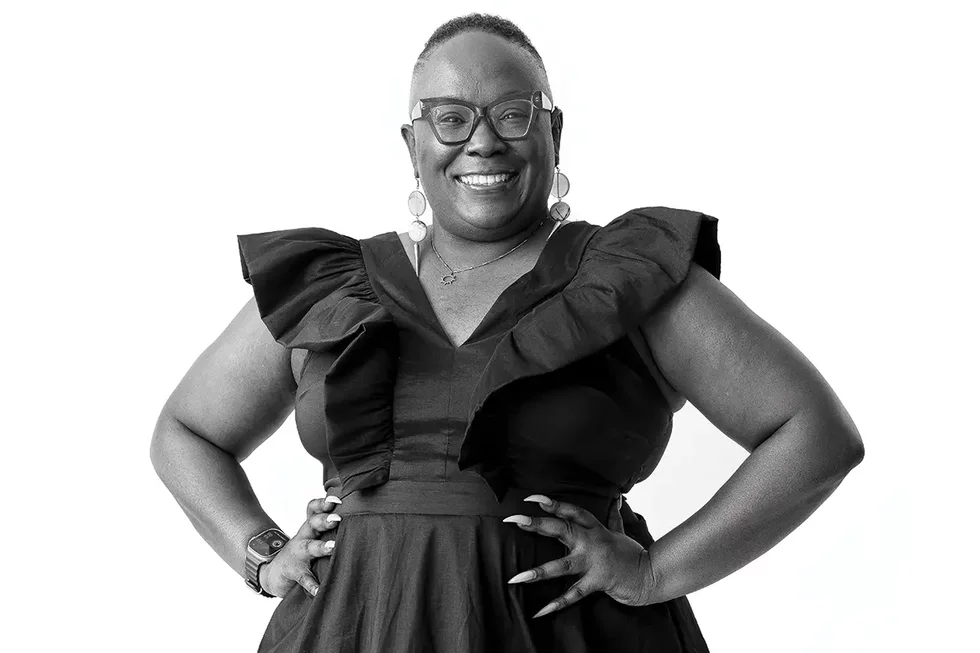
When a girl enrolls in The Sophia Project, one of the first things she learns is the chant: We are the girls who believe in ourselves, who never forget our potential. We are the girls who know our worth, value our bodies, and demand our voices be heard. We are the girls who set goals, believe in our dreams, and never forget the power of self-worth. We are the girls of The Sophia Project. In 2011, Dawn Price founded the St. Louis–based nonprofit and named it after the Greek word for “wisdom.” Price’s mission is to empower girls of color and provide support for those who are experiencing trauma, facing academic difficulties, and generally struggling with the transition from middle to high school. The Sophia Project’s four pillars—self-care, self-efficacy, scholarship, and social grace—are designed to give them a stable base when everything else around them is turbulent. “If you build a safe space for girls,” she says, “they will unpack.”
What made you want to pursue this mission? I’m from St. Louis, but I was working for the Regional Council of Churches of Atlanta. We received funding to do HIV prevention, and I created a curriculum called Temple Testimonies. One of my friends invited me to do a workshop with girls at a Sunday School convention, where we talked about having sex prematurely and adolescent issues. In that moment, it made me feel good to reach them. But I also realized they need more than just a presentation. There needs to be some kind of continuum of care. I had been working with my fair share of nonprofits, and my dad kept saying to me, “It’s time for you to start your own.” So I came back home, and I wrote a proposal.
Get a fresh take on the day’s top news
Subscribe to the St. Louis Daily newsletter for a smart, succinct guide to local news from award-winning journalists Sarah Fenske and Ryan Krull.
How do you identify the girls who could benefit most from the program? We have teachers, principals, and counselors that recommend who we should work with. We try to target children who are under a 2.5 grade point average or have a history of suspensions and poor attendance.
Many children could use this kind of help, even if they’re not struggling in school; others might qualify but be resistant. How do you make sure you can support as many girls as you can reach? We’ve been adamant about creating programming that doesn’t force them to be enrolled in The Sophia Project. Anyone can be involved in the International Day of the Girl, Self Care Saturday, or Girl Talk. These are all events that are designed to nurture all kids, not just those who are actively enrolled.
In addition to the program’s pillars, what are some practical skills that girls learn? Whether you’re in my in-school session, summer session, or Friday-night session, you learn how to introduce yourself, what you want out of life, and how to talk about your dreams. I tell them, “I want you to talk about your dreams repeatedly.” We go through that process regularly with them. We do conflict resolution, and we’re constantly talking about healthy relationships and how to form them. I really try to reiterate that conflict is healthy in relationships. It doesn’t mean a relationship is over. In the beginning, I used to play Superwoman. I was the social worker, the counselor, the program facilitator—all that stuff. Now, we partner with people who help us with things like yoga and mindfulness activities. We’ve also hired therapists to become part of The Sophia Project’s programming and do evaluations as well as group exercises.
You say the sophia project is all about wisdom. can you tell when a girl has been enlightened? This is the part I laugh about. Two things happen: One is the day after they graduate high school, I have an influx of girls who put my name down as a reference on a job application. They realize they’ve had a relationship with someone for a couple of years who can give them a reference.
What’s the other thing? Sometimes they’ll call me back after they graduate and ask, “Can I still come to Friday-night [programming]?” I’m like, “You’re an adult. I’m working with eighth-graders now. You have everything you need in your toolbox to achieve your dreams.” Everything they need, they already have inside of them. It’s just a matter of being mindful of this on a regular basis: You are your biggest advocate.
What’s a highlight of overseeing the program? We do a little debutante-type of ceremony at the end of every academic year. Every girl gets a little black dress and a string of pearls. One year, I had to chase down two girls. I went to their home, walked in, and saw their bedroom was in the living room. When I gave them their dresses and saw the happiness, it was worth every single dollar I had to beg for and every call I had to make to get to that moment. Stepping in that living room, it was like, I know I’m doing the right thing.