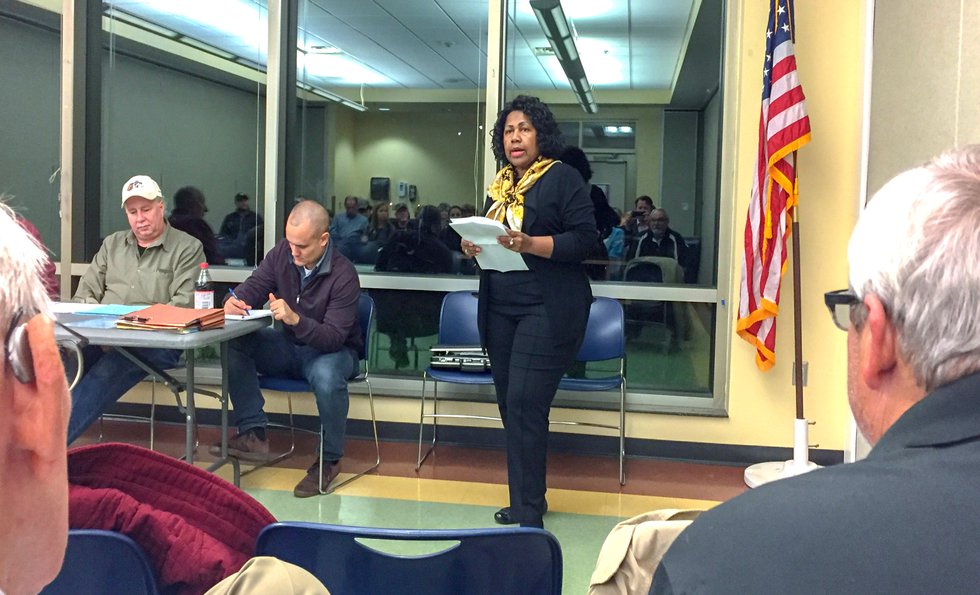
Hear more from Green on The 314 Podcast.
St. Louis’ longtime comptroller Darlene Green ruffled feathers earlier this month when she publicly called for Mayor Tishaura Jones to supplement the city’s fleet of plows and salt trucks with private contractors. Two weeks had passed since the Jan. 5 snowstorm; streets were perilous and residents were frustrated. So she suggested a state of emergency and urgent contracting with private companies to pick up the slack.
Get a fresh take on the day’s top news
Subscribe to the St. Louis Daily newsletter for a smart, succinct guide to local news from award-winning journalists Sarah Fenske and Ryan Krull.
Green says she thought she’d get a phone call from Jones; instead, she got a public letter, one that felt a bit chilly. In it, Jones noted that she didn’t have to call a state of emergency, said she had already been seeking out private contractors, and said she’d soon send contracts for the comptroller’s office to expedite.
Green didn’t sweat the tone. She was just glad to see those contracts.
”I really don’t have time to care about that,” she said of the mayor’s response. “I have to deal with the best interest of the people. You know, we’ve got an unusual situation with the ice and snow. I’m understanding that people are saying that we haven’t had it in 25 years. And to me, that’s kind of like an emergency.”
Green was the inaugural guest on St. Louis Magazine’s new The 314 podcast, in an interview that went live this morning. In it, she discussed her political career, why she doesn’t like the proposal for a city administrator introduced at the St. Louis Board of Aldermen, and why so many people are frustrated with the status of city services.
Just as she wanted to see more urgency around snow removal, Green wants to see the city get back to the basics—and do a better job with them.
“People get excited about the big things, yeah, but they get really, really angry when their basics aren’t taken care of,” she observed.
She believes the problems didn’t begin with Jones (she actually traces them back to the administration of Mayor Lyda Krewson). But she believes they’ve continued under Jones, and has sought to advise the mayor on addressing them.
“I can absolutely tell you that we can do better and we should,” she says. “I have dropped those messages to our mayor, our director of operations. And I am very hopeful that eventually it will catch fire so that those basic city services—filling the potholes, getting the trash picked up—all of those things can get done better, because after all, it’s the taxpayer’s dollars.”
Green was appointed comptroller after the resignation of Virvus Jones (coincidentally, the current mayor’s father) while he was under criminal indictment in 1995. She’d never run for office before (“the response from everybody,” the RFT reported, “was Darlene who?”) But she quickly became such a force that she’s rarely seen a significant campaign against her (or even an opponent) throughout five mayoral administrations. More than anything, she says, she’s proud of the work she’s done to raise the city’s credit rating from BBB when she took over (“junk credit,” she sniffs) to A+, AA, and A2 today (all much better). She was also a key voice in fighting off privatization of Lambert St. Louis International Airport.
Even so, she faces not one but two rivals this election cycle. She acknowledges that former state Representative Donna Baringer, also a former alderwoman, represents a formidable challenge—but says she’s convinced Baringer isn’t right for the job. As proof, she notes that Baringer says she voted for Prop B, the one recommendation of the city’s Charter Commission torpedoed by voters in November. The proposition would have allowed aldermen to add, or take away, items from the city’s budget. “The whole city voted no,” she says. “ And so you’ve gotta know that here’s a person that really doesn’t get it when it comes to the city’s finances.”
(Reached for comment, Baringer says, “Ultimately, the voters of the city were fairly divided on this charter change. The lowest support in any ward was 40 percent, while the highest was 58 percent—falling just short of the required 60 percent to pass. Given this close margin, I would never disregard the voices of nearly half the city’s voters.” She added, “This proposition aimed to streamline the budget process in line with how most levels of government operate. I want to be clear—I’m not afraid of change.”)
Green knows that part of what drew challengers this year is some of the coverage her office received a few years ago, when she was criticized by people in the St. Louis Post-Dispatch for not being in the office frequently enough and not paying bills quickly enough. She has ready explanations for both: She says she started staying home during COVID-19. “I have to also consider that I was in the 60 club,” she says. She says she’s fully back now. She also says her office switched to a digital system, and that included a learning curve for other city departments—but payments are now moving swiftly.
Interestingly, one of the Post-Dispatch stories about delayed payments features a contractor whose companies SLM would later tie to a supervisor in the Building Division, Adebanjo Popoola, a situation the FBI is now investigating. (Popoola has said the ties are a coincidence; he later resigned.) Green says that shows the importance of her office not moving too swiftly. They were able to halt payment on $387,525 in invoices from companies tied to Popoola, payments that remain frozen today.
”I have a big job and it is to not only pay the bills quickly, but also to pay attention, because this one bill, a payment could have gone out if I had been listening to the naysayers about not paying the bills,” she says.
Green says she intends for this to be her last campaign, but she has no intention of leaving the city of St. Louis in the lurch. She loves it too much to do that. ”This is a great city, it always has been a great city,” she says. “The charter written in—what is it, 1914?—was a great charter to protect it. I believe in it, and that’s why I fight hard to make sure our fiscal structure that was created all those years ago is maintained.”
Editor’s note: A previous version of this story contained inaccurate information about the city’s credit rating in 1995. It was BBB, not AAA. We regret the error.