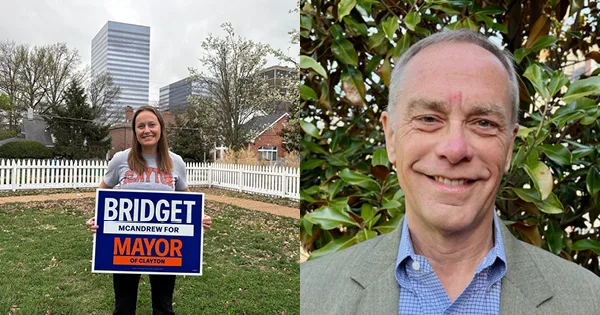
There has only been one contested mayor’s race in Clayton so far this century—until this year.
And this year’s race nearly wasn’t: Alderman Rick Hummell only decided to run after the filing deadline had passed. He’s hoping successful write-in candidacies in Clayton and Maplewood last year could provide a model for a victory of his own.
Get a fresh take on the day’s top news
Subscribe to the St. Louis Daily newsletter for a smart, succinct guide to local news from award-winning journalists Sarah Fenske and Ryan Krull.
As for the lone mayoral candidate on the ballot, Alderwoman Bridget McAndrew, she’s taking nothing for granted. Asked whether she takes Hummell’s candidacy seriously, she says, “Oh, definitely very serious.” She notes that high-information voters are most likely to turn out in municipal elections: “When people are voting in April, they know exactly what they’re there to do. So I don’t think it’s hard for people to understand: They’re either going to vote for me and check the box, or write a name.”
Hummell hopes they’ll write a name—his. Retired after 35 years in banking and finance, he’s based his campaign on the idea that his business acumen is what Clayton needs, and that contrary to the perception elsewhere in St. Louis County, the community of 17,000 people has serious issues it needs to address, including a downtown area that often feels dead and the rising costs of city services, even as revenue is not rising.
Some of Hummell’s most outspoken supporters have been opponents of Washington University’s proposal to build athletic facilities on the bucolic grounds of neighboring Concordia Seminary. The proposed zoning overlay, which many locals thought was far too open-ended, could have brought a fieldhouse, baseball fields, and more. While it’s been withdrawn, some locals fear what might come next.
Hummel represents that area on the Board of Aldermen and was the lone vote against the overlay before its withdrawal. He acknowledges the university’s plans are a big issue for some of his backers—but he insists that his support goes far beyond it. He adds, “I am not anti-WashU, and I’m not against WashU doing things that are for their betterment. I think I’ve got a good relationship with them. … I want to make sure that things work for all of our constituencies, including WashU.”
As for McAndrew, she says she understands that when change is contemplated in a neighborhood, it can have a galvanizing effect on locals. An attorney, she attributes her original interest in local politics to the school district putting her neighborhood school up for sale more than a decade ago. “There’s just something that kind of compels you to really sit up and take notice,” she says. “And the WashU/Concordia thing was certainly a big issue in our community.”
Even so, she notes that Clayton’s ability to control what happens to the Concordia site is limited. “Ultimately, we don’t own the property,” she says. “We can certainly put restrictions on it, and obviously, there are zoning regulations. Somebody can’t come in and build a 20-story building. But ultimately, we don’t control the property, so we can’t restrict or forbid development there that is under appropriate zoning regulations.”
She adds, “Concordia was very open with us that they had to monetize the property to be able to be financially solvent. So I think the vast majority of people absolutely understand that something will happen there.”
McAndrew stresses her on-the-job experience, with seven years on the Board of Aldermen compared to Hummell’s two. (Both candidates, interestingly, are natives of Wisconsin.) Like Hummell, she suggests the city can’t afford to be complacent. “I think we are doing great, and our surveys show that people are generally very happy in Clayton,” she says. “But I think we work hard to do that, and we have to continue to pay attention and continue to work hard to keep what we have.”
Reports filed earlier this week show McAndrew has raised $17,303. Hummell has raised $9,819, with $2,252 of that from himself. That would hardly be enough to make a ripple in neighboring St. Louis, where challenger Cara Spencer has raised $1 million, but in Clayton, that attracts some attention. Hummell’s yard signs are now a common sight around town, along with McAndrew’s.
Last year, a challenger to the Clayton school board won a write-in race, while the mayor of Maplewood was booted from office when the municipality’s former mayor decided to run as a write-in.
Hummell resists the suggestion that anti-incumbent fervor drove those victories. Instead, he says, “I think what’s really there is that there was an issue that was very compelling to the community that they felt was not adequately addressed, and we needed a change in leadership to address it.” Whether WashU’s plans are that issue for Clayton voters is one of the many questions that could be answered on April 8.