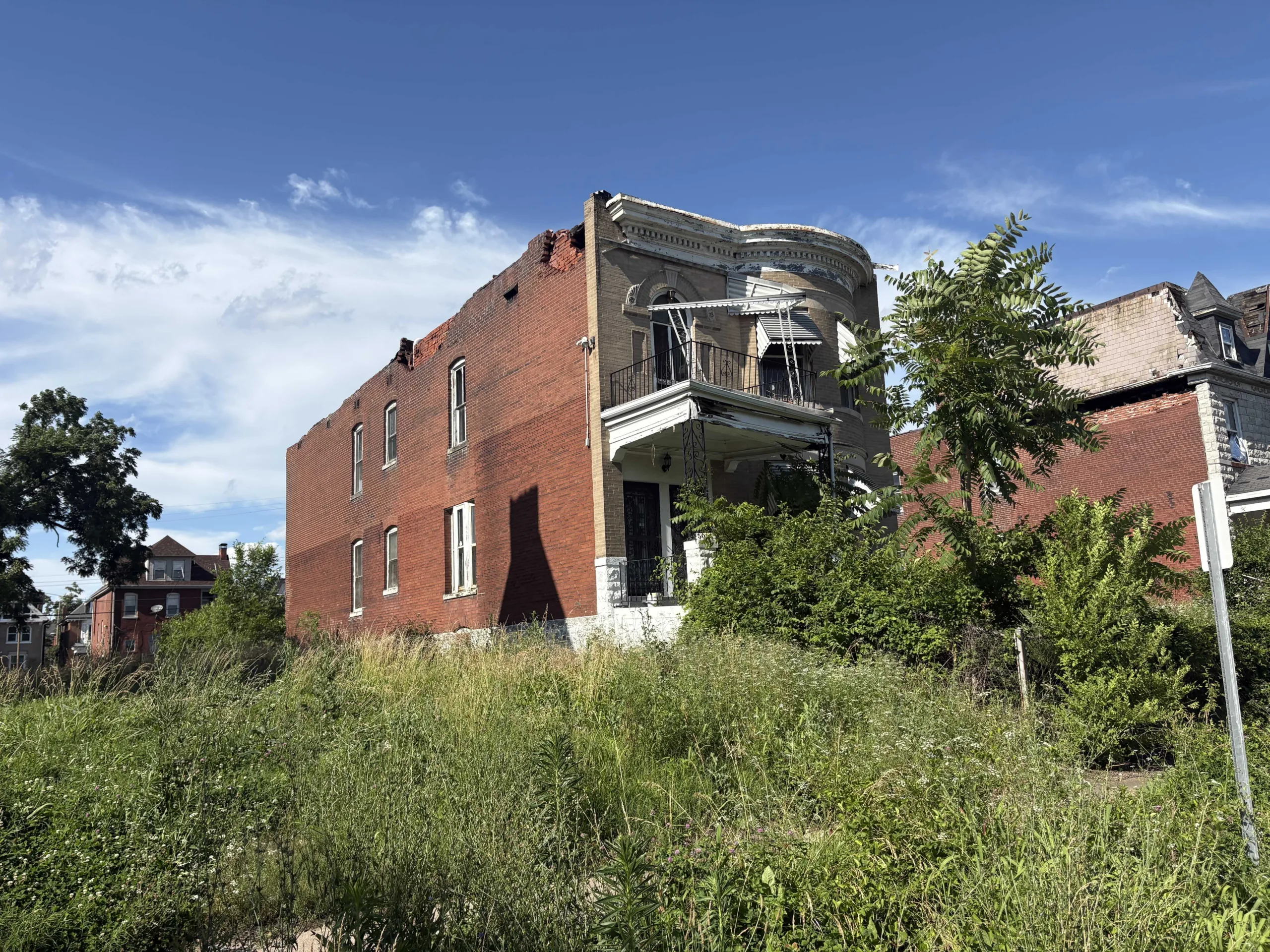
The City of St. Louis is working to get 500 vacant properties into the hands of more attentive owners, a process that involves new ordinances taking effect as well as a half-dozen city and county agencies getting over their famous fragmentation and working together.
Alderwoman Anne Schweitzer, who has long made fighting vacancy in her South City ward a top priority, says that the city moving these properties toward a special tax sale is “kind of a pilot—it’s an example of, ‘OK, this can be scaled up.’” In other words, the city has way more than 500 vacant properties with derelict owners. But it’s good to start somewhere.
Get a fresh take on the day’s top news
Subscribe to the St. Louis Daily newsletter for a smart, succinct guide to local news from award-winning journalists Sarah Fenske and Ryan Krull.
“These properties are the worst of the worst–repeat code violators, long-standing neglect,” says Peter Hoffman with Legal Services of Eastern Missouri. He stresses that none of these properties has anyone residing inside them.
The process at work here began in 2022 when the Missouri legislature passed a law allowing cities to foreclose on tax-delinquent properties. Two years later, Alderwoman Pam Boyd sponsored a bill in the city enabling fines for building code violations to become special tax bills. That matters because a special tax bill can be collected in the same manner as a property tax bill—so if it doesn’t get paid, the city can foreclose on the property.
Now, with those two (relatively) new pieces of legislation working together, the city can take the unpaid fines and fees it imposes for board-up jobs and grass cutting at vacant properties and turn those outstanding sums into tax bills. If payment is delinquent, the city can foreclose.
Previously, neglectful owners could let their properties rack up fines and fees without many real repercussions. “The consequences were just piling up bills,” says Schweitzer. “The city needs a stick.”
Hoffman has been one of the people working to get various city departments to turn the idea in Boyd’s bill into reality. “The left hand and the right hand sometimes in the city don’t communicate,” he said. Though in this case, he says, it’s a lot more than just two hands and they finally all are talking to each other.
City agencies like the Building Division and Forestry are the ones actually going out to neglected properties and assigning the fines and fees—as well as doing the work of securing the structures and cutting the lawns. The Collector of Revenue’s office files the suit against the properties over the back taxes, though its lawyers are in the City Counselor’s Office. Eventually, the Sheriff’s Office will actually conduct the sale of the properties on the steps of the courthouse downtown.
In 2024, a working group was put together to get all these entities on the same page. The tornado in May 2025 delayed things.
The city now expects to file lawsuits against around 500 properties later this month, a huge step towards moving them to the tax sale on the courthouse steps. Elected officials like Schweitzer played a big role in determining which properties are part of this initial effort. Alders helped determine properties should be the focus of this effort—both in terms of which vacant properties were most affecting the quality of life for people in their wards as well as for figuring out which properties had racked up the biggest bill to the city. Schweitzer points out that the city should be happy whether the building gets sold or the owner pays their bill. “They can get this bill and say ‘Oh, I owe $10,000. I’ll just pay it.’ The city goes, ‘OK, well thank you for paying your fines, fees and taxes,’” she says.
The sales on the courthouse steps are expected to happen early next year. Properties that don’t sell will join the roughly 11,500 parcels owned by the city’s land bank, the Land Reutilization Authority.
While Hoffman and Schweitzer say that the buildings winding up LRA-owned may not be ideal, it is far preferable to the status quo. “For the ones that have some market value, they’ll remain privately owned. For the ones that don’t, they can be brought into the public portfolio as an asset for future use,” says Hoffman. Schweitzer adds that, with an LRA-owned property, “There are people you’re able to hold accountable,” rather than dealing with the opaque network of LLCs that often own vacant buildings.
Going forward, Hoffman thinks that getting all the myriad agencies on the same page will get easier. When Mayor Cara Spencer signed the Ram settlement funding bill into law earlier this year, it included $10 million to fight vacancy—a portion which could go to bring someone in to coordinate efforts in the way the working group has for this current effort.
“First and foremost, getting it to be somebody’s job or multiple people’s job to do this, I think would help tremendously,” he says.