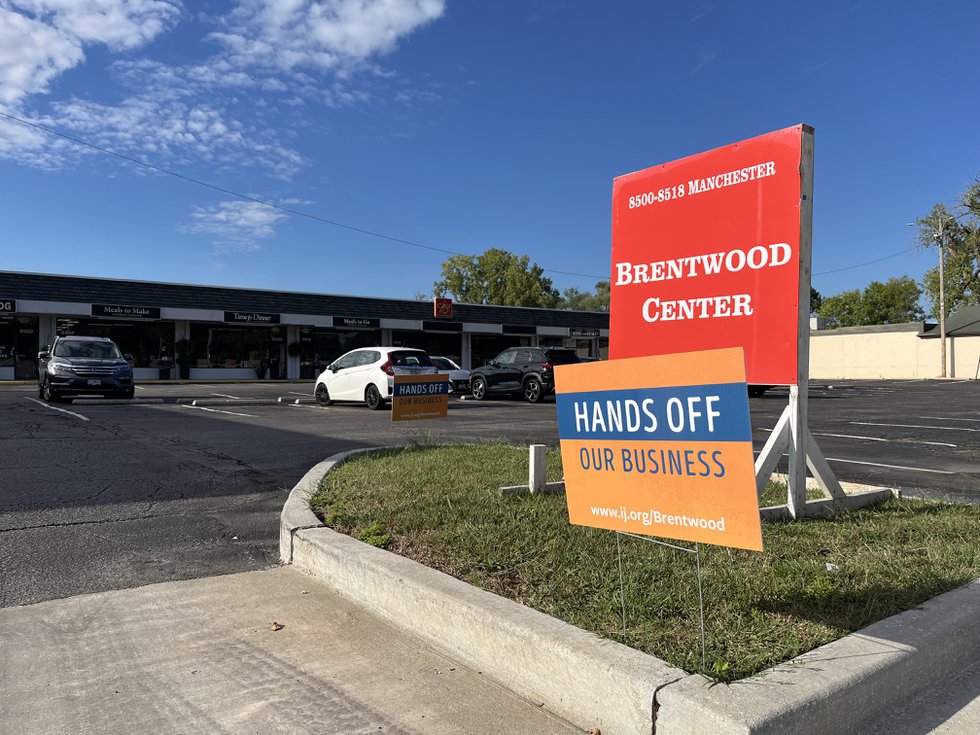
Embattled developer Green Street is off a $436 million project encompassing eight blocks of Manchester Road, but the so-called Brentwood Master Planned Redevelopment that would transform 40 acres near the municipality’s border with Maplewood is no less controversial for it.
Using eminent domain, Brentwood hopes to see the area razed and replaced with something more vibrant. But that means displacing longtime businesses.
Get a fresh take on the day’s top news
Subscribe to the St. Louis Daily newsletter for a smart, succinct guide to local news from award-winning journalists Sarah Fenske and Ryan Krull.
“It’s overwhelming,” says Amy Stanford, who for two decades has operated meal prep business Time for Dinner right in the heart of the area that would be leveled. She is one of three small business owners in the area who, along with an additional property owner, are filing suit to stop the redevelopment from happening.
If the city’s plans come to fruition, Stanford worries she could be on the hook for much higher rent if she stays in the area. If she moves, she’ll have to uproot her business, which includes about 25 employees, two walk-in freezers and a walk-in refrigerator. “Just to have to move those kinds of equipment is a huge burden. The thought of having to redo everything is scary.”
The redevelopment would start near the Brentwood-Maplewood border and stretch eight blocks west to Dorothy Avenue. The area is a mix of small businesses like Stanford’s, including a nail salon, fishing store, apothecary, and auto body shop. The district also has its fair share of empty commercial spaces, including two right across the street from Time for Dinner. There is an acre of dirt empty save for a for sale sign, as well as a boarded-up Sonic. The area also, crucially, buts up against Deer Creek and is itself low-lying and prone to floods.
The redevelopment plan calls for almost 500 apartments, a senior living facility, condos, restaurants and retail as well as a hotel.
The city has projected that even though each phase of the development will enjoy significant tax breaks for two decades, the redeveloped stretch of Manchaester would generate an additional $28 million in state and local tax revenues compared to the area being left as is. At the time the redevelopment was announced, Brentwood Mayor David Dimmitt called it a “bold decision to ensure a bright future for the Brentwood community by renewing an area of our city.”
Across the street from Time for Dinner, Peggy Barton says that she sees the wisdom in the city’s plans. The Discount Smoke Shop where she works has been flooded out four times since she started in 2017, even as Brentwood and the Missouri Department of Transportation have spent $120 million to mitigate flooding issues. The proposed development would incorporate those upgrades in its plan and adhere to higher standards for rainwater run-off.
The city announced Green Street as the project’s developer in September 2022; the Board of Aldermen unanimously approved the development the following July. Approving the plan meant declaring the entire area blighted. This allows the city to exercise eminent domain on any property that doesn’t want to sell to the developers or otherwise vacate.
Six months later, in December, Time for Dinner, Feather-Craft Fly Fishing, and Convergence Dance And Body Studio filed suit to stop the development. They are aided in the suit by the Institute for Justice, an Arlington, Virginia-based law firm that bills itself as representing “everyday people—free of charge—when the government violates their most important constitutional rights.” The firm famously fought a previous instance of eminent domain all the way to the Supreme Court. They lost, but the case sparked a major backlash against the government seizing private property.
Lately, however, as the Costco development in University City demonstrates, eminent domain is alive and well in the St. Louis area. If a developer can argue land would be worth more to a municipality with its improvements, that’s often been enough to declare it blighted.
Bobbi Taylor, the Institute for Justice attorney representing the Brentwood businesses, says that their case against the development is two-fold. She argues in legal filings that the evidence of blight that city has put forth is not sufficient.
She tells SLM that the city blighted properties based on chips in the buildings’ facades and cracks in parking lots. “Those are things they are pointing to to justify the blight designation,” she says. “But it requires more than ‘these buildings are old, these buildings have chipped paint.’”
Furthermore, says Taylor, “The city declared the entire Manchester Corridor to be a ‘blighted area.’ The city did not make a parcel-by-parcel or building-by-building determination of blight.”
Stanford calls the idea that her business is blighted “basically bogus.”
Taylor adds that the blight designation has an irony to it given that many of the properties in the development’s footprint are actually owned by the city. “They are perpetuating the very problem they claim to be combating,” she says. “Our clients’ properties specifically—they’re in business. They’re well maintained.”
Many of the parcels owned by the city are parking lots that look temporary in nature, with yellow lines spray painted atop gravel.
Reached for comment, Brentwood spokeswoman Michelle Boyer says, “Unfortunately, out of the dozens of parcels of property slated to benefit from Brentwood’s redevelopment program along Manchester Road, three tenants and one property owner filed a lawsuit challenging the City’s economic development and flood management effort. While that litigation is pending, the City simply cannot do or say anything that might give those litigants a chance to jeopardize these critical community improvements. These civic issues were fully debated and decided in public meetings spanning over two years.”
Taylor’s other argument is that Missouri law forbids eminent domain for the sole reason of economic development, which Taylor believes to be the city’s motivation here. As part of the suit’s discovery process, she is trying to get access to the communication between Green Street and the city, which she says will support her case.
And now, she is also hoping to get access to the communications between the city and Halo Real Estate Ventures, who has taken over the project from Green Street.
Green Street has faced myriad difficulties in the past year. Last month, they announced a temporary shut down of The Armory, the massive entertainment venue they opened two years ago in Midtown. They’ve been taken to court by numerous contractors who say they haven’t been paid for work on Green Street projects. An investor says in a suit filed in March that key Green Street personnel owe him almost $3 million. That same month a former employee filed suit saying that he was fired when he blew the whistle on Green Street misleading investors.
At the start of the year, Joel Oliver left Green Street with a handful of other employees to form Halo.
Oliver, perhaps taking a diplomatic tone, says that Green Street was primarily focusing their energy on managing completed projects as well as getting projects already started across the finish line. He formed Halo with other Green Street defectors because he wanted to take projects in pre-development—the 40 acres along Manchester included—and get them underway. He stresses that while Green Street is staying on in a consulting capacity for some Halo projects, his old firm is uninvolved in the project on Manchester Road.
On a brief phone call with SLM, Oliver didn’t seem worried about the lawsuit working its way through court and possibly headed to trial.
“No matter what you’re doing, where you’re trying to do it, change can be scary for folks. It’s not uncommon to have to address people’s concerns,” Oliver says. “We’re always advocates for the process being able to take its course.”